 뒤로
뒤로Dynamics of Particles: Equilibrium, Friction, and Circular Motion
스터디 가이드 - 스마트 노트
 자료에 맞춘 맞춤형 노트, 핵심 정의, 예시, 맥락을 확장해 제공합니다.
Application of Newton’s Laws
Particles in Equilibrium
When a particle is in equilibrium, the vector sum of all forces acting on it is zero. This principle is fundamental in analyzing static systems, such as objects suspended by chains or ropes.
Equilibrium Condition:
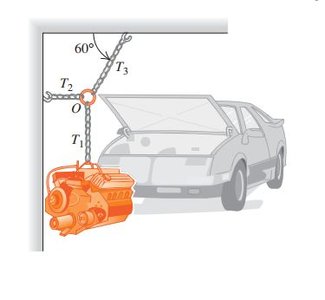
Example: A car engine of weight w hangs from a chain linked at ring O to two other chains. The tensions in the chains must balance the weight and each other.
Solving for Tensions:
Let be the tension in the vertical chain, in the horizontal chain, and in the chain at 60° to the horizontal.
Vertical equilibrium:
Horizontal equilibrium:
Dynamics of Particles
Newton’s Second Law and Applications
Newton's Second Law relates the net force acting on a particle to its acceleration: . This law is used to analyze motion in various scenarios, including frictionless surfaces, elevators, and inclined planes.
Iceboat Example: An iceboat of mass 200 kg accelerates from rest to 6.0 m/s in 4.0 s. The net force is calculated using .
Elevator Example: An elevator of mass 800 kg slows to a stop from 10.0 m/s over 25.0 m. The tension in the cable is found by considering both gravity and the required deceleration.
Inclined Plane Example: A toboggan slides down a frictionless slope. The acceleration is .
Frictional Forces
Nature of Friction
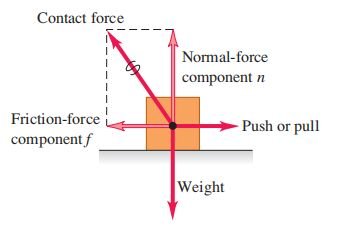
Friction is a force that opposes the relative motion of two surfaces in contact. It is divided into static friction (prevents motion) and kinetic friction (opposes ongoing motion).
Static Friction: The force that must be overcome to start moving an object.
Kinetic Friction: The force opposing motion once the object is sliding.
Normal Force: The perpendicular contact force exerted by a surface.
Frictional Force Scenarios
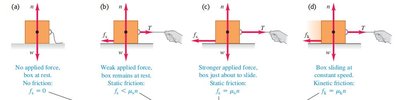
The behavior of friction changes depending on whether an object is at rest, about to move, or moving at constant speed.
No Applied Force: No friction.
Weak Applied Force: Static friction balances the applied force.
Strong Applied Force: Static friction reaches its maximum, object about to move.
Object Moving: Kinetic friction acts.
Coefficients of Friction
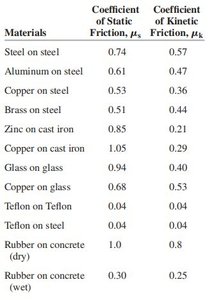
The coefficient of friction quantifies the interaction between surfaces. It varies for different material pairs and is typically higher for static friction than kinetic friction.
Static Friction Coefficient (): Maximum value before motion starts.
Kinetic Friction Coefficient (): Value during motion.
Materials | Coefficient of Static Friction, | Coefficient of Kinetic Friction, |
|---|---|---|
Steel on steel | 0.74 | 0.57 |
Aluminum on steel | 0.61 | 0.47 |
Copper on steel | 0.53 | 0.36 |
Brass on steel | 0.51 | 0.44 |
Zinc on cast iron | 0.85 | 0.21 |
Copper on cast iron | 1.05 | 0.29 |
Glass on glass | 0.94 | 0.40 |
Copper on glass | 0.68 | 0.53 |
Teflon on Teflon | 0.04 | 0.04 |
Teflon on steel | 0.04 | 0.04 |
Rubber on concrete (dry) | 1.0 | 0.8 |
Rubber on concrete (wet) | 0.30 | 0.25 |
Rolling Friction
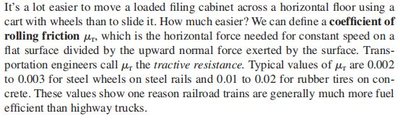
Rolling friction occurs when an object rolls over a surface, and is much less than sliding friction. The coefficient of rolling friction () is the ratio of the horizontal force needed for constant speed to the normal force.
Typical Values: for steel wheels on rails: 0.002–0.003; rubber tires on concrete: 0.01–0.02.
Application: Lower rolling friction explains why trains are more fuel efficient than trucks.
Fluid Resistance and Terminal Speed
Terminal Speed in Air
When an object falls through a fluid, it eventually reaches a constant speed called terminal speed, where the drag force equals the gravitational force.
Terminal Speed Formula: where D is the drag constant.
Example: For a 50-kg skydiver with kg/m,
Dynamics of Circular Motion
Uniform Circular Motion
Objects moving in a circle experience a centripetal force directed toward the center. This force is necessary to maintain circular motion.
Centripetal Force:
Example: A sled of mass 25.0 kg attached to a 5.00-m rope revolves in a circle. The force exerted by the rope is calculated using the formula above.
Vertical Circular Motion
When moving in a vertical circle, the forces at the top and bottom differ due to gravity.
Force at Top:
Force at Bottom:
Application: Ferris wheel passengers experience different seat forces at the top and bottom of the circle.
Fundamental Forces of Nature
Overview of Fundamental Forces
Four fundamental forces govern interactions in nature: gravitational, electromagnetic, strong, and weak interactions.
Gravitational Interaction: Attraction between masses.
Electromagnetic Interaction: Forces between charged particles.
Strong Interaction: Holds atomic nuclei together.
Weak Interaction: Responsible for radioactive decay.
