 뒤로
뒤로Electric Charge and Electric Fields: Fundamental Concepts and Applications
스터디 가이드 - 스마트 노트
 자료에 맞춘 맞춤형 노트, 핵심 정의, 예시, 맥락을 확장해 제공합니다.
Electric Charge and the Charge Model
Introduction to Charge
Electric charge is a fundamental property of matter that gives rise to electric forces and interactions. The study of charge and its behavior forms the basis of electrostatics, a core topic in physics.
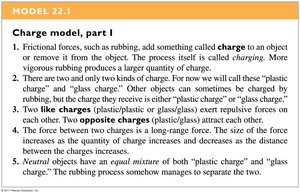
Charging refers to the process of adding or removing charge from an object, often through frictional forces such as rubbing.
There are two types of charge: positive and negative. This convention was established by Benjamin Franklin.
Objects can be charged by contact or friction, resulting in either a net positive or negative charge.
Like charges repel each other, while opposite charges attract.
The force between charges is a long-range force, increasing with the amount of charge and decreasing with distance.
Neutral objects contain equal amounts of positive and negative charge.
Conductors and Insulators
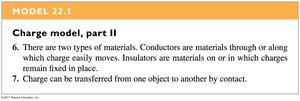
Materials are classified based on how easily charge can move through them:
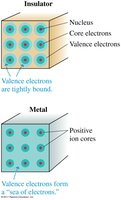
Conductors: Materials in which charge moves freely (e.g., metals).
Insulators: Materials in which charge remains fixed in place (e.g., rubber, glass).
Charge can be transferred between objects by contact, especially in conductors.
Atomic Structure and Charge Quantization
Atoms and Electricity
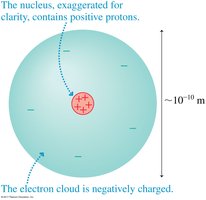
Atoms consist of a dense, positively charged nucleus surrounded by negatively charged electrons. The nucleus contains protons (positive) and neutrons (neutral).
The fundamental unit of charge is denoted by e.
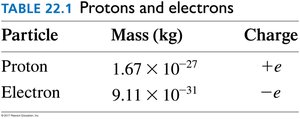
Electrons and protons have charges of equal magnitude but opposite sign.
Particle | Mass (kg) | Charge |
|---|---|---|
Proton | 1.67 \times 10^{-27} | +e |
Electron | 9.11 \times 10^{-31} | -e |
Charge Quantization and Ions
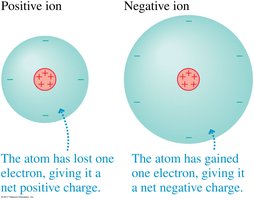
Charge is quantized, meaning any object's net charge is an integer multiple of the elementary charge e. Most objects are neutral, but ionization can create charged atoms or molecules (ions).
Ionization: Removing or adding electrons to an atom creates positive or negative ions, respectively.
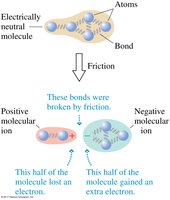
Molecular ions can be formed by breaking chemical bonds, often through friction.
Polarization and Electric Dipoles
Polarization of Atoms and Insulators
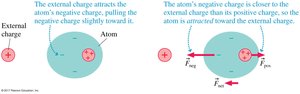
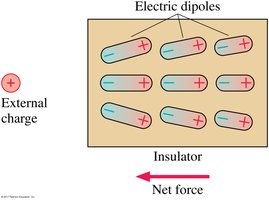
When an external charge is brought near a neutral atom or insulator, the atom's electron cloud shifts slightly, creating an electric dipole. This process is called polarization.
Polarization results in a net force that attracts the atom or insulator toward the external charge.
All atoms in an insulator can become polarized, producing a net polarization force.
Coulomb's Law
Electrostatic Force Between Charges
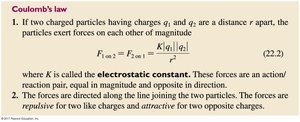
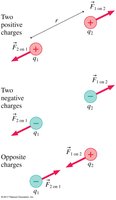
Coulomb's law quantifies the force between two point charges. The force is proportional to the product of the charges and inversely proportional to the square of the distance between them.
The force is repulsive for like charges and attractive for opposite charges.
The electrostatic constant is $K = 8.99 \times 10^9 \ \mathrm{N \ m^2 / C^2}$.
The mathematical form of Coulomb's law is:
$F_{on\ 2} = F_{on\ 1} = K \frac{|q_1||q_2|}{r^2}$
Permittivity Constant
Coulomb's law can also be expressed using the permittivity of free space, $\epsilon_0$:
$\epsilon_0 = \frac{1}{4\pi K} = 8.85 \times 10^{-12} \ \mathrm{C^2 / N \ m^2}$
$F = \frac{1}{4\pi \epsilon_0} \frac{|q_1||q_2|}{r^2}$


Example Application: Lifting a Glass Bead
Worked Example
Consider a small plastic sphere charged to $-10$ nC held 1.0 cm above a small glass bead with a charge of $+10$ nC. The bead has a mass of $2.0 \times 10^{-6}$ kg. Will the glass bead "leap up" to the plastic sphere?
Model both objects as point charges.
Calculate the electrostatic force and compare it to the gravitational force.

Solution:
Calculate the electrostatic force:
$F = K \frac{|q_1||q_2|}{r^2}$
Compare with gravitational force $F_G = mg$.
If $F > F_G$, the bead will leap upward.
The Field Model and Electric Fields
Concept of a Field
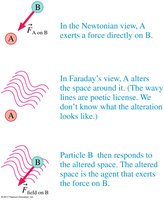
Charges interact via the electric field, which is a vector field assigning a force per unit charge at every point in space. The field is created by source charges and exerts forces on other charges.
The electric field at a point is defined as the force per unit charge: $\vec{E} = \frac{\vec{F}}{q}$
The field exists at all points in space and is independent of the presence of a test charge.

Electric Field of a Point Charge
The electric field due to a point charge $q$ at a distance $r$ is given by:
$\vec{E} = \frac{1}{4\pi \epsilon_0} \frac{q}{r^2} \hat{r}$
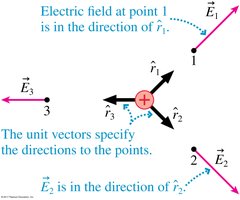
The direction of $\vec{E}$ is away from positive charges and toward negative charges.
The field strength decreases with the square of the distance from the charge.

Unit Vector Notation
Unit vectors are used to specify the direction of the electric field at various points in space. The electric field at a point is always in the direction of the unit vector pointing from the source charge to the location of interest.

Summary Table: Key Equations and Constants
Concept | Equation | Description |
|---|---|---|
Coulomb's Law | $F = K \frac{|q_1||q_2|}{r^2}$ | Force between two point charges |
Permittivity of Free Space | $\epsilon_0 = 8.85 \times 10^{-12} \ \mathrm{C^2 / N \ m^2}$ | Constant in electrostatics |
Electric Field (point charge) | $\vec{E} = \frac{1}{4\pi \epsilon_0} \frac{q}{r^2} \hat{r}$ | Field due to a point charge |
Example Application: Electric Field of a Proton
Worked Example
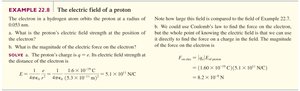
Calculate the electric field strength at the position of an electron in a hydrogen atom, given the proton's charge and the electron's orbital radius.
Use the electric field equation for a point charge.
Apply the result to find the force on the electron.
Additional info: These notes cover the foundational concepts of electric charge, Coulomb's law, and the electric field, which are essential for understanding electrostatics in college-level physics.
