 뒤로
뒤로Electric Charges and Forces – Study Notes
스터디 가이드 - 스마트 노트
 자료에 맞춘 맞춤형 노트, 핵심 정의, 예시, 맥락을 확장해 제공합니다.
Electric Charges and Forces
Introduction to Electric Phenomena
Electric phenomena arise from the presence and interactions of electric charges. These interactions are governed by fundamental principles involving charges, forces, and fields. Understanding these concepts is essential for exploring the behavior of matter at both macroscopic and microscopic levels.
Discovering Electricity: Experimental Foundations
Neutral Objects and Charging by Friction
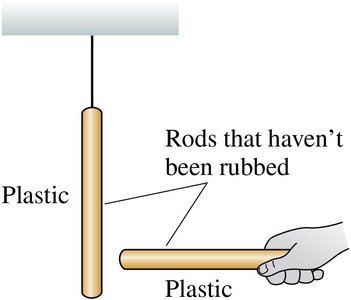
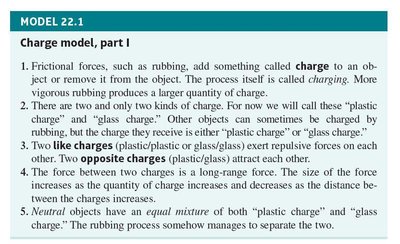
Neutral Objects: Objects that have not been disturbed or rubbed typically exhibit no observable electric forces when brought near each other. They are said to be electrically neutral.
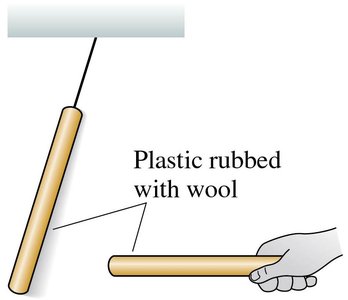
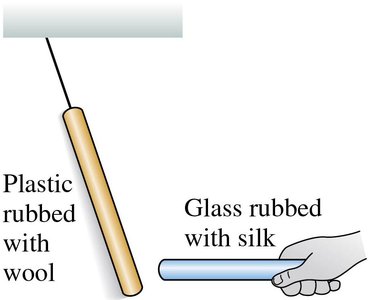
Charging by Friction: Rubbing certain materials (e.g., plastic rods with wool, glass rods with silk) can transfer charge, causing the objects to become electrically charged and capable of exerting forces at a distance.
Like Charges Repel: Two objects charged in the same way (e.g., both plastic rods rubbed with wool) repel each other without contact.
Unlike Charges Attract: Objects charged differently (e.g., plastic rubbed with wool and glass rubbed with silk) attract each other.
Distance and Strength of Electric Forces
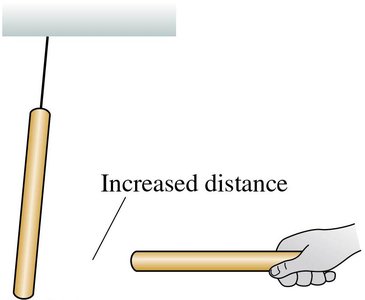
The strength of the force between two charged objects increases with the amount of charge and decreases as the distance between them increases.
Attraction Between Charged and Neutral Objects
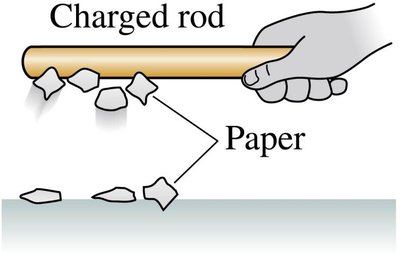
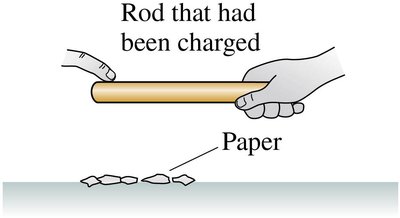
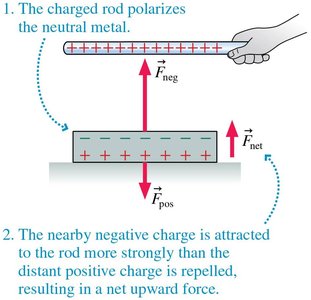
Charged objects can attract neutral objects, such as small pieces of paper, due to the phenomenon of charge polarization.

Charge Transfer and Discharging
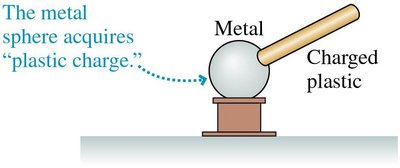
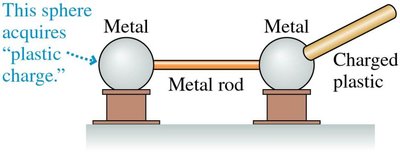
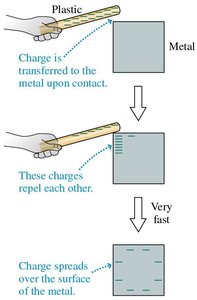
Charge Transfer: Charge can be transferred from one object to another by direct contact, as seen when a charged rod touches a neutral metal sphere.
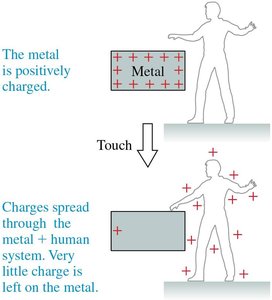
Discharging: Touching a charged object with a finger or another conductor can remove excess charge, neutralizing the object.
Conductors and Insulators
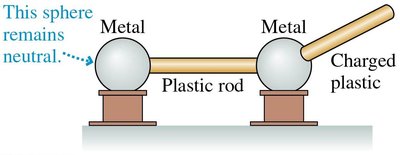
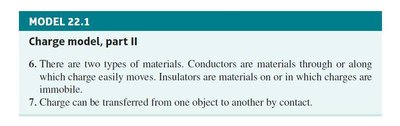
Conductors: Materials (like metals) in which charges move freely. When connected by a metal rod, charge can distribute between objects.
Insulators: Materials (like glass and plastic) in which charges are immobile and remain localized.
Summary of the Charge Model
Key Point | Explanation |
|---|---|
Two Types of Charge | Plastic (negative) and glass (positive); like charges repel, opposite charges attract. |
Charge Transfer | Occurs by contact; more vigorous rubbing produces more charge. |
Conductors vs. Insulators | Conductors allow charge movement; insulators do not. |
Neutral Objects | Contain equal amounts of both types of charge. |
Atomic Structure and Charge Quantization
Structure of the Atom
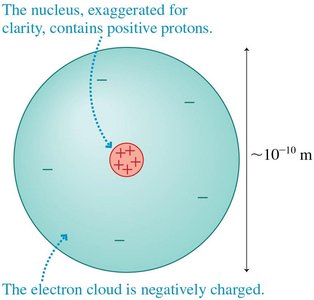
An atom consists of a dense nucleus (containing protons and neutrons) surrounded by electrons.
Protons are positively charged, electrons are negatively charged, and neutrons are neutral.
Charge Quantization
The fundamental unit of charge is C.
The net charge of an object is , where and are the numbers of protons and electrons, respectively.
Charge is always an integer multiple of (quantization of charge).
Ionization and Molecular Ions
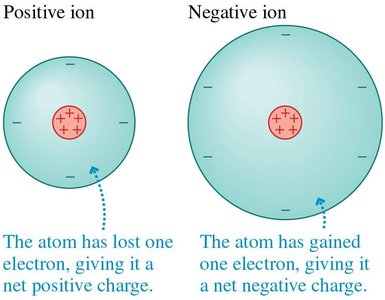
Ionization: Removing or adding electrons to an atom creates ions (positive if electrons are lost, negative if gained).
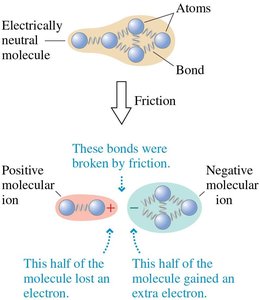
Molecular Ions: Friction can break molecular bonds, creating positive and negative molecular ions, as in charging by rubbing.
Conductors, Insulators, and Charge Movement
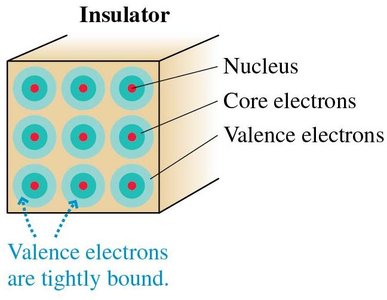
Insulators
Electrons are tightly bound to nuclei and cannot move freely. Charging by friction leaves immobile patches of charge on the surface.
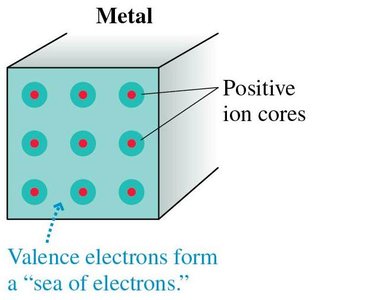
Conductors
Outer electrons are weakly bound and can move freely throughout the material, forming a 'sea of electrons.'
Charging and Discharging Conductors
When a conductor is charged by contact, electrons spread out due to repulsive forces.
Touching a charged conductor to a larger conductor (like a human body) allows excess charge to spread and neutralize.
Charge Polarization and Induction
Charge Polarization
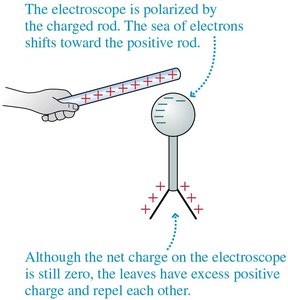
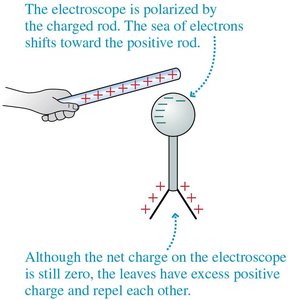
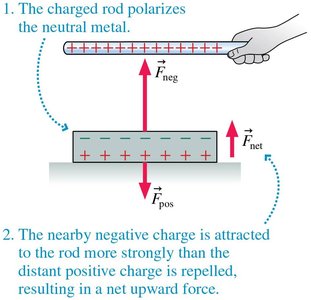
When a charged object is brought near a neutral conductor, it causes a slight separation of charges within the conductor (polarization), resulting in an attractive force.
The Electric Dipole
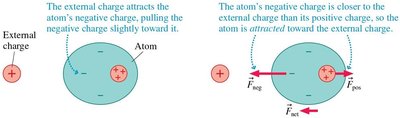
A neutral atom or molecule can be polarized by an external charge, forming an electric dipole with separated positive and negative charges.
Coulomb’s Law
Force Between Point Charges
The magnitude of the force between two point charges is given by Coulomb’s law:
where N·m2/C2, and are the charges, and is the distance between them.
The force is repulsive for like charges and attractive for opposite charges.
The forces are equal in magnitude and opposite in direction (Newton’s third law).
Permittivity Constant
Coulomb’s law can also be written using the permittivity of free space ():
C2/(N·m2)F = \frac{1}{4\pi \epsilon_0} \frac{|q_1||q_2|}{r^2}$
The Electric Field
Definition and Properties
The electric field at a point in space is defined as the force per unit charge experienced by a small positive test charge placed at that point:
The units of electric field are newtons per coulomb (N/C).
Electric Field of a Point Charge
The electric field produced by a point charge at a distance is:
The direction of is radially outward from a positive charge and inward toward a negative charge.
Example: Electric Field in a Cell Membrane
Given a field strength N/C and a singly charged ion (), the force is:
Example: Electric Field of a Proton
At a distance nm from a proton ():
The force on an electron at this distance is:
Summary Table: Properties of Protons and Electrons
Particle | Mass (kg) | Charge |
|---|---|---|
Proton | 1.67 × 10⁻²⁷ | +e |
Electron | 9.11 × 10⁻³¹ | −e |
Key Equations
Coulomb’s Law:
Electric Field (point charge):
Force on a charge in an electric field:
Charge quantization:
Additional info: These notes are based on the introductory chapter for electric charges and forces, suitable for a first-year college physics course. They include experimental foundations, atomic structure, conductors and insulators, charge polarization, Coulomb’s law, and the electric field concept, with relevant examples and tables for clarity.
