 뒤로
뒤로Electric Fields and Continuous Charge Distributions
스터디 가이드 - 스마트 노트
 자료에 맞춘 맞춤형 노트, 핵심 정의, 예시, 맥락을 확장해 제공합니다.
Electric Fields: Concepts and Principles
Introduction to Electric Fields
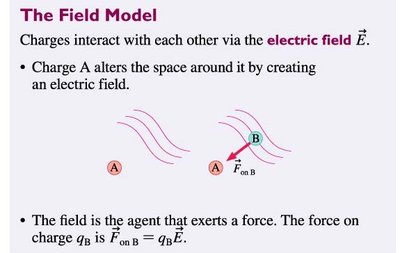
The electric field is a fundamental concept in physics, describing the influence that electric charges exert on each other at a distance. The field model allows us to understand how charges interact by altering the space around them, creating a region where other charges experience a force.
Electric Field (\(\vec{E}\)): A vector field representing the force per unit charge at each point in space.
Field Model: Charges interact via the electric field, not by direct contact.
Force on a Charge: \(\vec{F} = q\vec{E}\), where \(q\) is the charge and \(\vec{E}\) is the electric field at its location.
Electric Field of a Point Charge
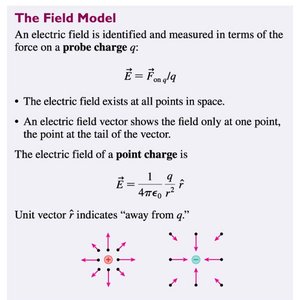
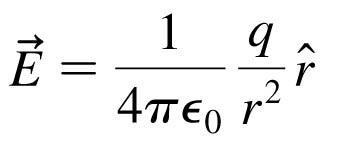
The electric field created by a point charge is radial and its magnitude decreases with the square of the distance from the charge.
Formula:
\(\epsilon_0\): Permittivity of free space.
\(\hat{r}\): Unit vector pointing away from the charge.
Superposition Principle
The net electric field at any point due to multiple charges is the vector sum of the fields produced by each charge individually.
Superposition:
Each field is calculated as if the other charges were absent.
Electric Dipoles
Definition and Types of Dipoles
An electric dipole consists of two equal and opposite charges separated by a small distance. Dipoles can be permanent (as in water molecules) or induced by external electric fields.
Permanently Polar Molecules: Molecules like water have a permanent dipole moment due to uneven electron distribution.
Induced Dipoles: External electric fields can stretch or separate charges within a neutral molecule, creating a temporary dipole.

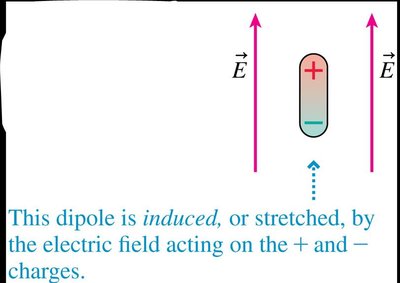
Dipole Moment
The dipole moment is a vector quantity that characterizes the separation of positive and negative charges in a system.
Definition: , where \(q\) is the magnitude of each charge and \(\vec{s}\) is the displacement vector from negative to positive charge.
Direction: From negative to positive charge.
Units: Coulomb-meter (C·m).
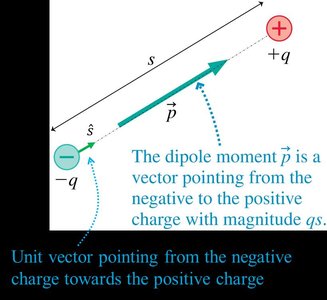
Electric Field of a Dipole
The electric field produced by a dipole depends on the position relative to the dipole axis. The field is stronger along the axis and weaker in the plane bisecting the dipole.
On the axis:
On the bisecting plane:
The field direction and magnitude depend on the observation point.
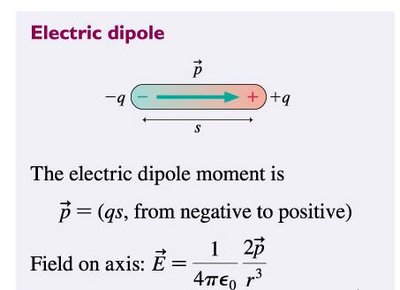


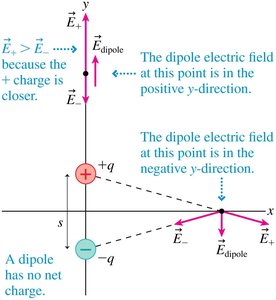
Field Lines of a Dipole
Electric field lines for a dipole start on the positive charge and end on the negative charge, illustrating the direction and relative strength of the field.
Field lines are tangent to the electric field vectors at every point.
The density of lines indicates field strength.


Continuous Charge Distributions
Linear and Surface Charge Densities
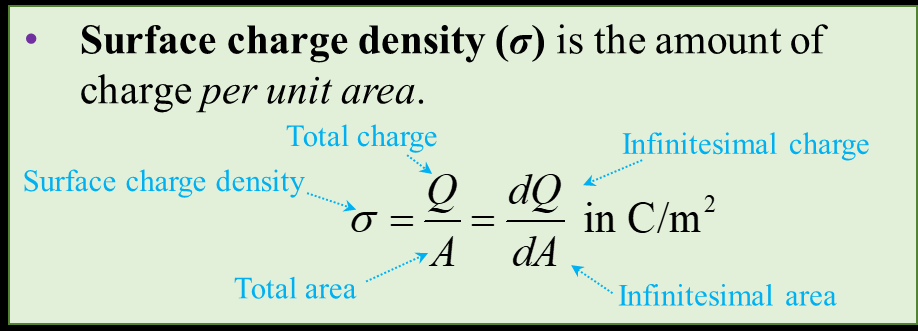
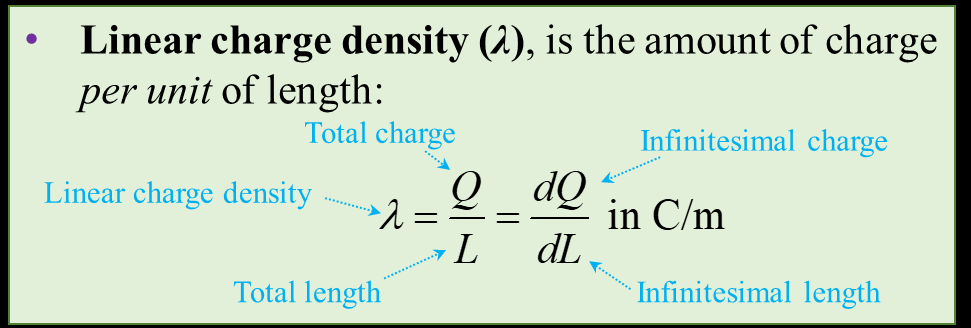
When charge is distributed over a line, surface, or volume, we use charge densities to describe the distribution.
Linear Charge Density (\(\lambda\)): in C/m
Surface Charge Density (\(\sigma\)): in C/m2
Electric Field of a Line of Charge
The electric field due to a uniformly charged rod can be calculated by integrating the contributions from each infinitesimal segment.
For an infinitely long line of charge, the field at a distance \(r\) is:
The field points radially outward from the line (if positively charged).
Electric Field of a Ring of Charge
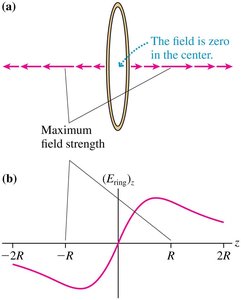
A ring of charge produces an electric field along its axis, which can be found by integrating the contributions from each infinitesimal segment of the ring.
The field is zero at the center and reaches a maximum at a certain distance from the center.
Electric Field of a Disk or Plane of Charge
A uniformly charged disk or plane creates an electric field perpendicular to its surface. For an infinite plane, the field is constant and independent of distance from the plane.
For an infinite plane:
The field is uniform and points away from the plane if the charge is positive.
Summary Table: Electric Field Expressions
Configuration | Electric Field Expression | Direction |
|---|---|---|
Point Charge | Radial | |
Dipole (axis) | Along dipole axis | |
Dipole (bisecting plane) | Perpendicular to dipole axis | |
Infinite Line of Charge | Radial | |
Infinite Plane of Charge | Perpendicular to plane |
Visualizing Electric Fields
Field Patterns for Various Electrode Configurations
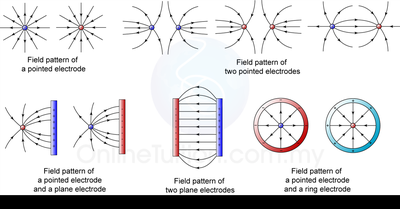
Electric field patterns depend on the geometry and arrangement of electrodes or charged objects. These patterns help visualize how the field behaves in different setups.
Field lines start on positive charges and end on negative charges.
Field lines never cross and are denser where the field is stronger.
Key Takeaways
Electric fields describe the influence of charges in space and are fundamental to understanding electromagnetic interactions.
The superposition principle allows calculation of the net field from multiple sources.
Continuous charge distributions require integration to find the total field.
Field lines and vectors provide a visual and quantitative understanding of electric fields.
