 뒤로
뒤로Electric Forces and Electric Fields: Structured Study Notes
스터디 가이드 - 스마트 노트
 자료에 맞춘 맞춤형 노트, 핵심 정의, 예시, 맥락을 확장해 제공합니다.
Electric Forces and Electric Fields
Electric Charge
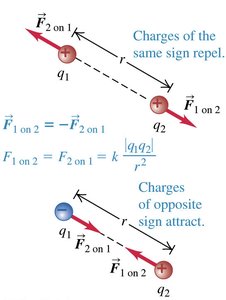
Electric charge is a fundamental property of matter that gives rise to electric forces and fields. There are only two types of electric charges in nature: positive and negative. Like charges repel each other, while opposite charges attract. The unit of charge in the metric system is the Coulomb (C). Electric charge is quantized in units of the elementary charge, e, where e = 1.60 \times 10^{-19}~C. Charge is conserved: it can be transferred but not created nor destroyed.
Quantization: , where is an integer.
Conservation: Total charge in a closed system remains constant.
Conductors and Insulators
Materials are classified based on how freely their electrons can move:
Conductors: Electrons are free to move throughout the material (e.g., metals).
Insulators (Dielectrics): Electrons are bound to atoms and cannot move freely (e.g., glass, rubber).
Coulomb’s Law
Coulomb’s Law describes the force between two point charges. The magnitude of the electric force exerted by charge on a distance away is:
Formula:
Coulomb’s constant:
Permittivity of free space: ,
Direction: Repulsive for like charges, attractive for opposite charges.
Vector nature: Forces act along the line joining the charges.
Superposition Principle
The electric force is a vector quantity. The resultant force acting on a charge is the vector sum of the forces exerted by all other charges:
Formula:
Electric Fields
An electric field is a region of space where an electric charge experiences a force. Electric fields can be generated by electric charges (at rest or moving) and by time-varying magnetic fields.
Electric Field Generated by Point Charges
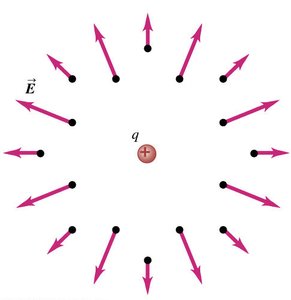
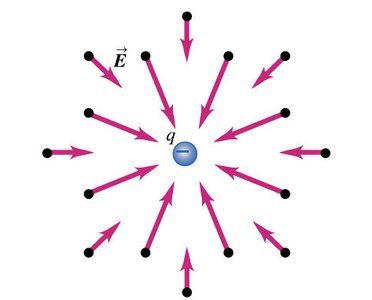
A point charge generates an electric field in the surrounding space. The magnitude of the electric field at a distance from a point charge is:
Formula:
Direction: Away from the charge if positive, toward the charge if negative.
Unit: Newton per Coulomb (N/C).
Electric Field Lines
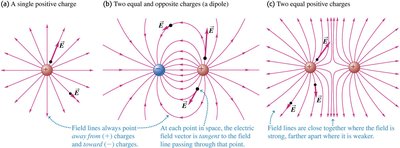
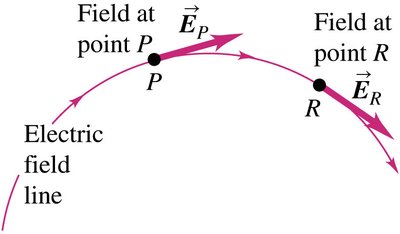
Electric field lines visually represent the direction and strength of the electric field. They start at positive charges and end at negative charges or extend to infinity. The field vector is tangent to the electric field line at any point.
Field lines: Closer together where the field is stronger.
Direction: Away from positive, toward negative.
Electric Field of Multiple Charges
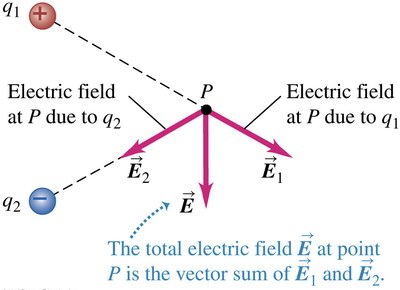
The total electric field at any point due to multiple point charges is the vector sum of the fields from each charge (superposition principle):
Formula:
Electric Fields from Continuous Charge Distributions
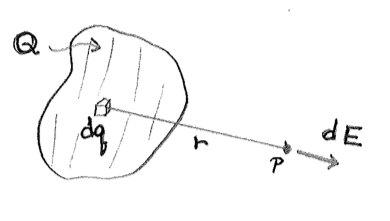
For continuous charge distributions, the electric field is calculated by integrating the contributions from each infinitesimal charge element:
Charge per unit length:
Charge per unit area:
Charge per unit volume:
Field from element:
Total field:
Electric Dipole
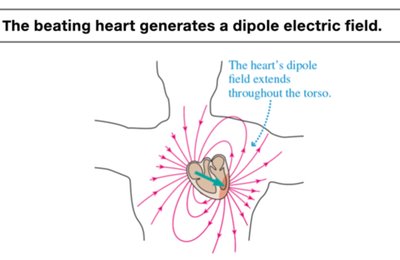
An electric dipole consists of two equal and opposite charges separated by a small distance. The dipole moment has magnitude and points from negative to positive charge. The net charge is zero, but the field arises from charge separation (polarization).
Dipole moment:
Applications: Polar molecules, biological systems.
Electric Field Outside a Uniformly Charged Sphere
A uniformly charged sphere produces an electric field outside the sphere identical to that of a point charge at its center:
Formula: for
Electric Field of a Large Sheet of Charge
A very large sheet with total charge uniformly distributed on its surface generates an electric field:
Formula:
Direction: Away from positive, toward negative.
Parallel Plate Capacitor
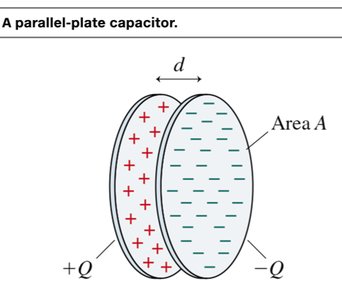
A parallel plate capacitor consists of two conducting plates separated by an insulator. The electric field between the plates is:
Formula:
Direction: From positive plate to negative plate.
Electric Fields Around and Within Conductors in Electrostatic Equilibrium
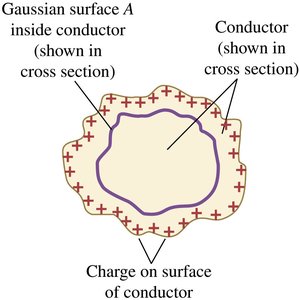
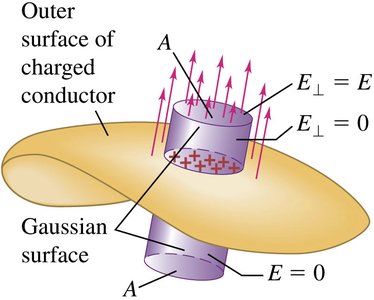
In electrostatic equilibrium:
Inside conductor: everywhere.
Net charge: Resides on the surface.
Just outside: Field is perpendicular to surface, .
Motion of Charged Particles in an External Electric Field
The force exerted by an external electric field on a point charge is:
Formula:
Newton’s Second Law:
Constant acceleration: If is uniform and constant.
Example: Charged particle motion in a uniform electric field follows kinematic equations for constant acceleration.
