 뒤로
뒤로Electric Potential and Potential Energy
스터디 가이드 - 스마트 노트
 자료에 맞춘 맞춤형 노트, 핵심 정의, 예시, 맥락을 확장해 제공합니다.
Electric Potential
Definition and Properties
Electric potential (V) is a scalar quantity that represents the electric potential energy per unit charge at a point in space due to electric charges. It is sometimes referred to as the scalar potential because, unlike the electric field, it does not have a direction.
Unit: The SI unit of electric potential is the volt (V), where 1 V = 1 Joule/Coulomb (J/C).
Superposition Principle: The total electric potential at a point due to multiple charges is the algebraic sum of the potentials due to each charge individually.
Electric Potential Due to a Point Charge
The electric potential V at a distance r from a point charge q is given by:
where is Coulomb's constant ( N·m2/C2).
Electric Potential Due to Multiple Point Charges
For a collection of point charges, the total electric potential at point P is:
where is the distance from the -th charge to point P.
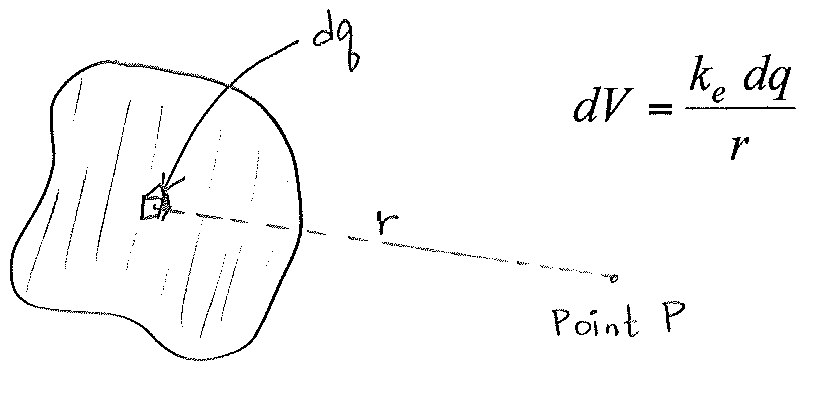
Electric Potential Due to a Continuous Charge Distribution
For a continuous distribution of charge, the electric potential at point P is found by integrating the contributions from each infinitesimal charge element :
Electric Potential Energy
Potential Energy of a Point Charge in an External Potential
The electric potential energy (U) of a point charge q in an external electric potential V_{ext} is:
where can be generated by a collection of point charges or a continuous charge distribution.
Energy Conversion:
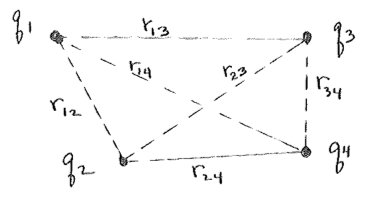
Potential Energy of an Assembly of Point Charges
The total electric potential energy of a system of point charges is the sum of the potential energies for each unique pair:
Electric Potential Difference and the Electric Field
Potential Difference (Voltage)
The electric potential difference () between two points is related to the electric field by:
The negative sign indicates that the electric field points in the direction of decreasing potential.
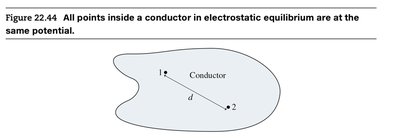
Potential of a Charged Conductor in Electrostatic Equilibrium
When a conductor is in electrostatic equilibrium, the electric field inside the conductor is zero (), and the electric potential is constant throughout the conductor and equal to its value at the surface.
Work-Energy Theorem and Potential Energy
Work-Energy Theorem (General Form)
The work done by all forces on a particle equals the change in its kinetic energy:
For conservative and non-conservative forces:
Potential Energy Forms
Gravitational Potential Energy (near Earth's surface):
Gravitational Potential Energy (general):
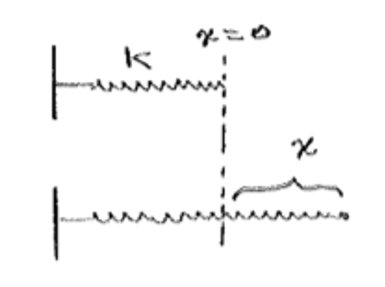
Elastic (Spring) Potential Energy:
Electric Potential Energy:
Conservation of Energy for Charged Particles
When only conservative forces act, the sum of kinetic and potential energies is constant:
For a charged particle moving in an electric potential (ignoring gravity and springs):
If the initial speed is zero:
Additional Concepts
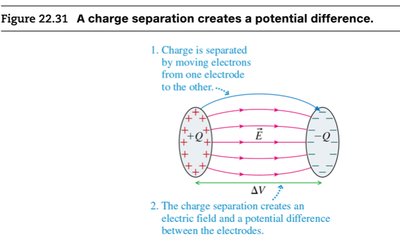
Charge Separation and Potential Difference
When charge is separated (e.g., by moving electrons from one electrode to another), an electric field and a potential difference are created between the electrodes.
Summary Table: Forms of Potential Energy
Type | Expression | Physical Context |
|---|---|---|
Gravitational (near Earth) | Object near Earth's surface | |
Gravitational (general) | Two masses separated by distance r | |
Elastic (Spring) | Mass attached to a spring | |
Electric | Charge in an electric potential |
Additional info: The images included are directly relevant to the explanation of electric potential, charge distributions, and energy concepts as described in the notes. The summary table provides a concise comparison of different forms of potential energy encountered in physics.
