 뒤로
뒤로Electric Potential and Potential Energy
스터디 가이드 - 스마트 노트
 자료에 맞춘 맞춤형 노트, 핵심 정의, 예시, 맥락을 확장해 제공합니다.
Electric Potential and Potential Energy
Introduction to Electric Potential
The concept of electric potential is fundamental in understanding how charges interact in an electric field. Electric potential energy is the energy a charge possesses due to its position in an electric field, analogous to gravitational potential energy in a gravitational field.
Electric Potential Energy (U): The work required to move a charge from one point to another in an electric field.
Electric Potential (V): Defined as the electric potential energy per unit charge:
Unit: The SI unit of electric potential is the volt (V), where .
Work and Potential Difference
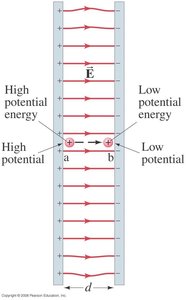
When a charge moves in an electric field, the work done by the field changes the potential energy of the charge. For a conservative electric field, the work done is path-independent.
Potential Difference (Vba): The difference in electric potential between two points a and b is .
Conservative Force: The electric force is conservative, so the potential energy change depends only on the initial and final positions, not the path taken.
Direction of Motion: A positive charge moves from high to low potential, while a negative charge moves from low to high potential.
Comparison with Gravitational Potential Energy
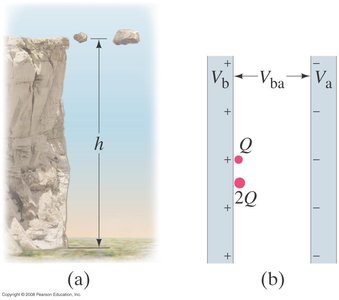
Electric potential energy is analogous to gravitational potential energy. Both depend on the magnitude of the charge or mass and the potential difference or height.
Gravitational:
Electric: (for a uniform field)
Potential energy increases with increasing mass or charge.
Reference Level for Potential
Electric potential is always measured as a difference between two points. The Earth is often chosen as the zero reference point for potential.
Potential Difference: Only differences in potential are physically meaningful.
Earth as Reference: The potential of the Earth is usually set to zero for convenience.
Mathematical Formulation of Potential Difference
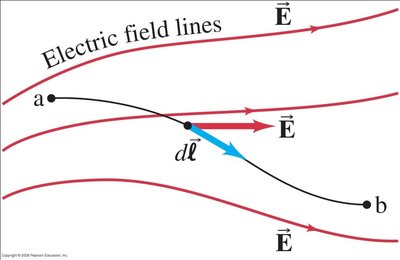
The potential difference between two points a and b in an electric field is given by the negative line integral of the electric field along the path from a to b:
For a uniform electric field and a straight path parallel to the field:
Potential Due to a Point Charge
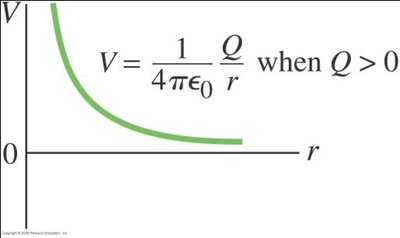
The electric potential at a distance r from a point charge Q is given by:
The potential is zero at infinity ().
For multiple point charges, the total potential is the algebraic sum of the potentials due to each charge.
Potential of a Charge Distribution
For a system of discrete charges, the potential at a point is the sum of the potentials due to each charge. For a continuous charge distribution, the potential is found by integrating over the distribution:
Discrete:
Continuous:
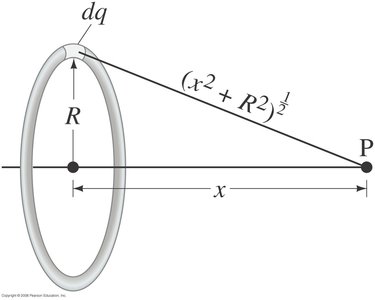
Potential of a Ring and Disk of Charge
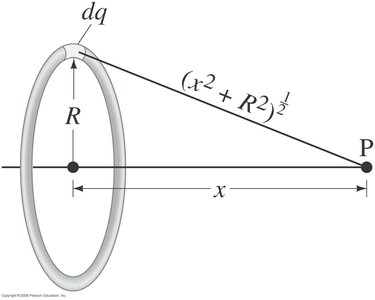
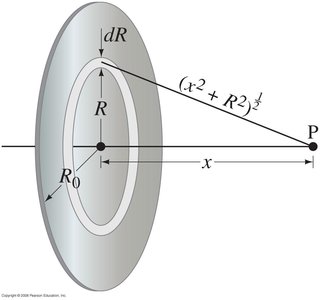
The potential at a point on the axis of a ring or disk of charge can be calculated by integrating over the charge distribution:
Ring:
Disk: (integrated over the disk's area)
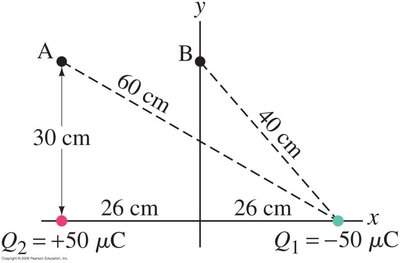
Potential of an Electric Dipole
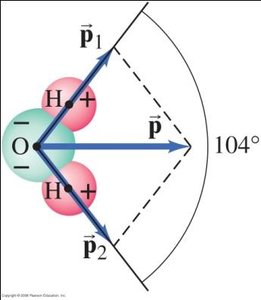
An electric dipole consists of two equal and opposite charges separated by a distance. The potential at a point far from the dipole is approximately:
, where is the dipole moment.
This approximation holds for .
Equipotential Surfaces
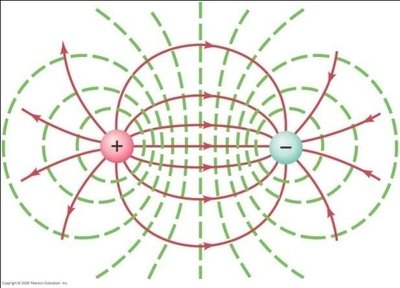
Equipotential surfaces are surfaces on which the electric potential is constant. The electric field is always perpendicular to equipotential surfaces.
Property: No work is required to move a charge along an equipotential surface.
Relation to Field: ; if , then is perpendicular to the path.
Relationship Between Electric Field and Potential
The electric field is related to the spatial rate of change of the electric potential:
In one dimension:
In three dimensions:
The gradient operator is
Charge Distribution on Conductors
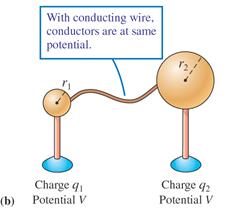
When two conducting spheres are connected by a wire, they reach the same potential. The surface charge density is higher on the sphere with the smaller radius, leading to a concentration of charge (and electric field) at sharp points.
For spheres:
Surface charge density:
Thus,
Sharp points on conductors accumulate more charge, which is the principle behind lightning rods.
Applications: Lightning Rods
Lightning rods are used to protect buildings by providing a path of least resistance for lightning to reach the ground, utilizing the concentration of charge at sharp points to initiate discharge safely.
Lightning rods are connected to the ground, ensuring that any excess charge is safely conducted away from the structure.
Typical Potential Differences
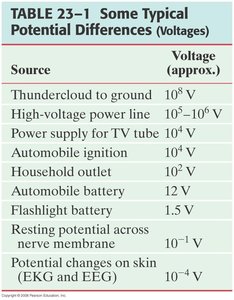
Various sources produce different potential differences (voltages). The table below summarizes some typical values:
Source | Voltage (approx.) |
|---|---|
Thundercloud to ground | V |
High-voltage power line | – V |
Power supply for TV tube | V |
Automobile ignition | V |
Household outlet | V |
Automobile battery | 12 V |
Flashlight battery | 1.5 V |
Resting potential across nerve membrane | V |
Potential changes on skin (EKG and EEG) | V |
Summary
Electric potential and potential energy are central to understanding electric fields and forces.
Potential is a scalar quantity, making it easier to work with than the vector electric field in many cases.
Equipotential surfaces and the relationship between electric field and potential are key concepts for analyzing electric phenomena.
Applications such as lightning rods utilize the principles of electric potential and charge distribution.
