 뒤로
뒤로Electromagnetic Induction and Faraday’s Law: Study Notes
스터디 가이드 - 스마트 노트
 자료에 맞춘 맞춤형 노트, 핵심 정의, 예시, 맥락을 확장해 제공합니다.
Electromagnetic Induction
Introduction to Electromagnetic Induction
Electromagnetic induction is the process by which a changing magnetic field induces an electromotive force (emf) in a conductor. This phenomenon is fundamental to the operation of many electrical devices, including generators and transformers. The discovery of electromagnetic induction provided a crucial link between electricity and magnetism, leading to the development of modern electromagnetic theory.
Experimental Evidence of Induction
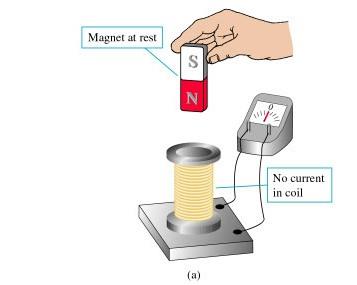
Stationary Magnet and Coil: When both a magnet and a coil are stationary, no current is observed in the coil, indicating no induced emf.
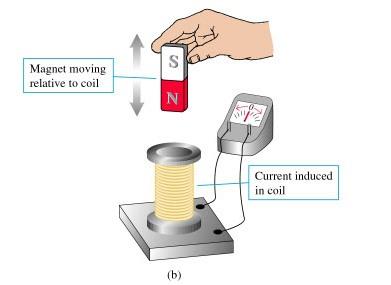
Relative Motion: When the magnet moves relative to the coil (or vice versa), a current is induced in the coil. The direction of the current depends on the direction of motion.
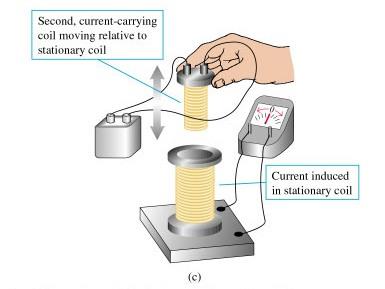
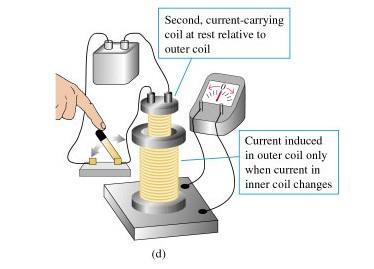
Current-Carrying Coil: Replacing the magnet with a current-carrying coil, a current is induced in a nearby coil only if there is relative motion or a change in current in the primary coil.
Faraday’s Law of Induction
Faraday’s law quantitatively describes how a changing magnetic flux induces an emf in a circuit. The induced emf is proportional to the rate of change of magnetic flux through the circuit.
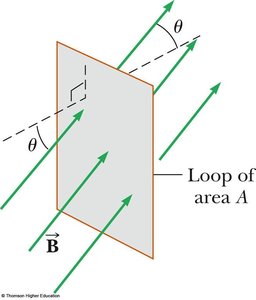
Magnetic Flux (\(\Phi_B\)): The magnetic flux through a loop of area \(A\) in a magnetic field \(\vec{B}\) is given by:
Faraday’s Law (General Form):
For N Loops:
Ways to Change Magnetic Flux:
Change the magnitude of \(B\)
Change the area \(A\) of the loop
Change the angle \(\theta\) between \(\vec{B}\) and the normal to the loop
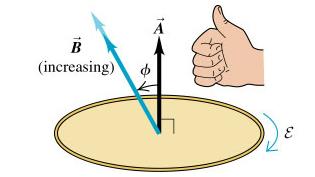
Lenz’s Law: Direction of Induced EMF
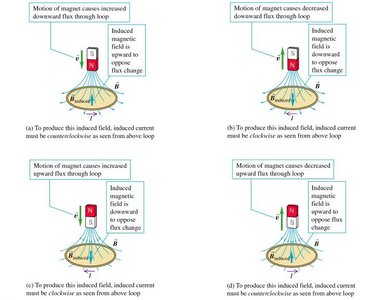
Lenz’s law provides the direction of the induced emf and current. It states that the induced current will flow in a direction such that the magnetic field it creates opposes the change in the original magnetic flux.
Physical Interpretation: The induced emf always acts to oppose the change in flux, consistent with the conservation of energy.
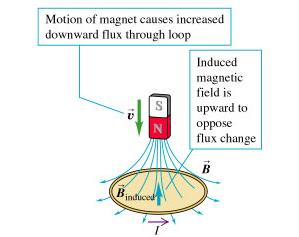
Example: If a magnet is moved toward a loop, the induced current creates a magnetic field opposing the increase in flux.
Motional EMF
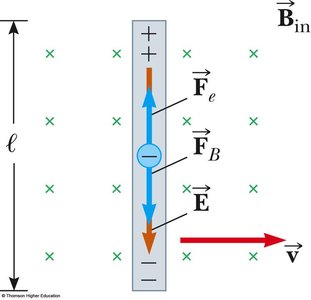
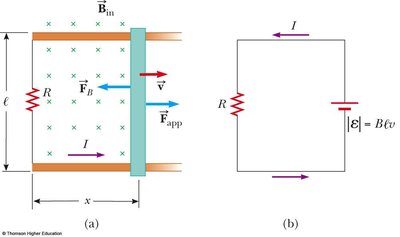
A motional emf is generated when a conductor moves through a magnetic field. The emf is given by the product of the magnetic field, the length of the conductor, and the velocity perpendicular to the field.
Formula:
Direction: The polarity of the emf depends on the direction of motion and the orientation of the magnetic field.
Energy Considerations: The work done to move the conductor is converted into electrical energy, which can be dissipated as heat in a resistor.
Induced Electric Fields
A changing magnetic field induces an electric field, even in the absence of a conductor. This induced electric field is nonconservative, meaning the line integral around a closed path is not zero.
General Form of Faraday’s Law:
Applications of Faraday’s Law
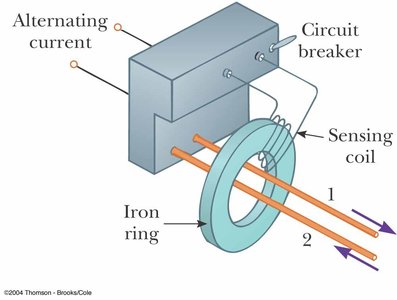
Ground Fault Indicator (GFI): Detects differences in current between two wires, triggering a circuit breaker if a fault is detected.
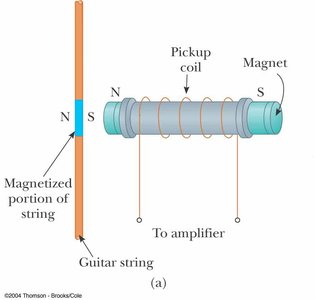
Electric Guitar Pickup: Uses a coil and a vibrating magnetized string to induce an emf, which is then amplified.
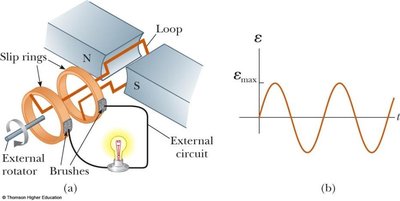
Generators: Convert mechanical energy into electrical energy by rotating a coil in a magnetic field, producing a sinusoidal emf.
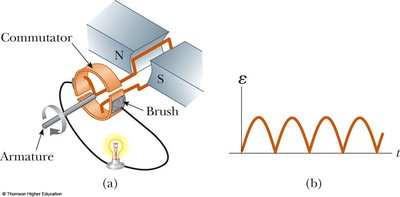
DC Generators: Use a commutator to produce a unidirectional (pulsating) emf.
Eddy Currents
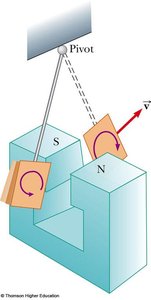
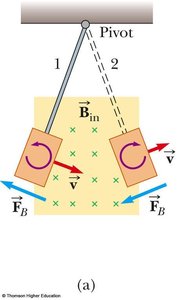
Eddy currents are circulating currents induced in bulk conductors moving through a magnetic field. These currents can cause energy losses due to heating and are often minimized by laminating the conductor or introducing slots.
Maxwell’s Equations and Electromagnetic Waves
Maxwell’s Equations
Maxwell’s equations summarize the fundamental laws of electricity and magnetism, unifying them into a single theoretical framework. They predict the existence of electromagnetic waves, which travel at the speed of light.
Gauss’s Law for Electricity: The electric flux through a closed surface is proportional to the enclosed charge.
Gauss’s Law for Magnetism: The net magnetic flux through a closed surface is zero (no magnetic monopoles).
Faraday’s Law: A changing magnetic field induces an electric field.
Ampère-Maxwell Law: A changing electric field or current induces a magnetic field.
Key Equations:
Electromagnetic Waves: Maxwell’s equations predict that electric and magnetic fields can propagate as waves at the speed of light, \(c = 3 \times 10^8\) m/s.
Additional info: Maxwell’s unification of electricity and magnetism led to the prediction and later experimental confirmation of electromagnetic waves, forming the basis for much of modern physics and technology.
