 뒤로
뒤로Fluid Pressure and Buoyancy: Study Notes
스터디 가이드 - 스마트 노트
 자료에 맞춘 맞춤형 노트, 핵심 정의, 예시, 맥락을 확장해 제공합니다.
Fluid Pressure and Buoyancy
Pressure in Liquids
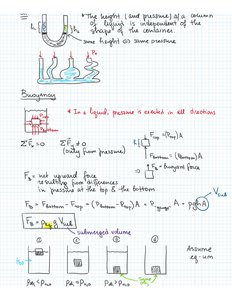
Pressure in a liquid is determined by the height of the liquid column and is independent of the shape of the container. This principle is fundamental in understanding how fluids behave under gravity.
Key Point 1: The height (and pressure) of a column of liquid is independent of the shape of the container.
Key Point 2: At the same height, the pressure is the same regardless of the container's shape.
Formula: The pressure at a depth h in a liquid is given by: where P is the pressure at depth, P_0 is atmospheric pressure, \rho is the density of the liquid, g is acceleration due to gravity, and h is the height of the liquid column.
Example: Water in containers of different shapes but with the same height will exert the same pressure at the bottom.
Buoyancy
Buoyancy is the upward force exerted by a fluid on a submerged or partially submerged object. This force arises because pressure increases with depth in a fluid, resulting in a net upward force.
Key Point 1: In a liquid, pressure is exerted in all directions.
Key Point 2: The net upward force (buoyant force) is equal to the weight of the fluid displaced by the object.
Formula: The buoyant force F_b is: where \rho_{fluid} is the density of the fluid, g is acceleration due to gravity, and V_{sub} is the submerged volume of the object.
Example: An object submerged in water experiences an upward force equal to the weight of the water displaced.
Pressure Differences and Submerged Volume
The pressure at the bottom of a submerged object is greater than at the top, resulting in a net upward force. The difference in pressure is proportional to the height of the submerged object and the density of the fluid.
Key Point 1: Pressure at the bottom:
Key Point 2: Pressure at the top:
Net Upward Force:
Submerged Volume: The net force is related to the volume of the object submerged in the fluid.
Summary Table: Pressure and Buoyancy
Concept | Formula | Explanation |
|---|---|---|
Pressure at Depth | Pressure increases with depth in a fluid. | |
Buoyant Force | Upward force equal to weight of displaced fluid. | |
Net Upward Force | Difference in pressure times area gives net force. |
Additional info: The notes illustrate the principle of fluid statics, specifically the concepts of pressure in liquids and buoyancy, which are central to Chapter 13: Fluids in college physics.
