 뒤로
뒤로Gauss's Law and Electric Flux: Concepts, Applications, and Mathematical Formulation
스터디 가이드 - 스마트 노트
 자료에 맞춘 맞춤형 노트, 핵심 정의, 예시, 맥락을 확장해 제공합니다.
Wet van Gauss (Gauss's Law)
Elektrische Flux (Electric Flux)
The concept of electric flux quantifies the number of electric field lines passing through a given surface. It is a foundational idea for understanding Gauss's Law in electrostatics.
Definition: For a uniform electric field \( \vec{E} \) passing through a flat surface of area A, the electric flux \( \Phi_E \) is given by:
Where \( \theta \) is the angle between the electric field and the normal (perpendicular) to the surface.
\( \vec{A} \) is a vector whose magnitude is the area and whose direction is perpendicular to the surface.
The flux is maximized when the field is perpendicular to the surface (\( \theta = 0 \)).
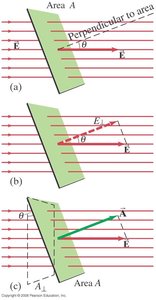
Elektrische Flux door Niet-Homogene Velden (Electric Flux through Non-Uniform Fields)
For non-uniform electric fields or curved surfaces, the surface is divided into infinitesimal elements \( \Delta A_i \), and the total flux is the sum (or integral) over all elements:
In the limit as \( \Delta A_i \to 0 \):
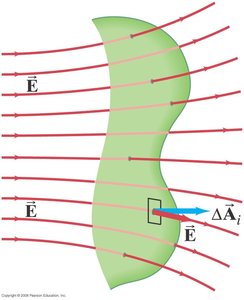
Richting van dA en Gesloten Oppervlakken (Direction of dA and Closed Surfaces)
The direction of the infinitesimal area vector \( d\vec{A} \) is defined as outward from the enclosed volume for closed surfaces. The net electric flux through a closed surface is:
\( \Phi_E > 0 \): Net flux leaves the volume (more field lines exit than enter).
\( \Phi_E < 0 \): Net flux enters the volume (more field lines enter than exit).
\( \Phi_E \neq 0 \) only if the surface encloses a net charge.
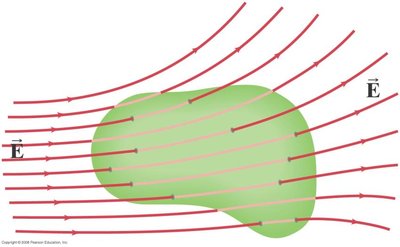
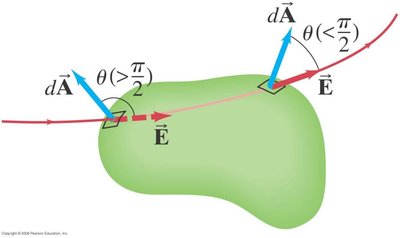
Gauss's Law: Statement and Mathematical Formulation
Formule van de Wet van Gauss (Gauss's Law Formula)
Gauss's Law relates the net electric flux through a closed surface to the net charge enclosed by that surface:
\( Q_{\text{encl}} \): Net charge enclosed by the surface
\( \varepsilon_0 \): Permittivity of free space (\( 8.85 \times 10^{-12} \; \text{C}^2/\text{N} \cdot \text{m}^2 \))
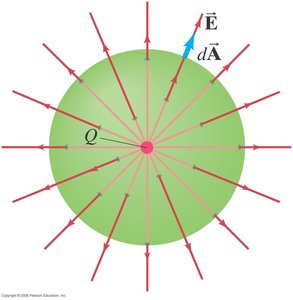
Vergelijking met de Wet van Coulomb (Comparison with Coulomb's Law)
For a point charge \( Q \) at the center of a sphere of radius \( r \):
The total flux through the sphere is:
This demonstrates that Gauss's Law is consistent with Coulomb's Law for point charges.
Algemene Geldigheid (General Validity)
Gauss's Law is valid for any electric field, including those produced by changing magnetic fields, making it more general than Coulomb's Law.
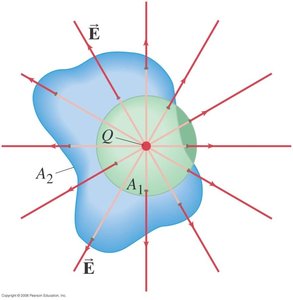
Toepassingen van de Wet van Gauss (Applications of Gauss's Law)
Metalen Bol (Conducting Sphere)
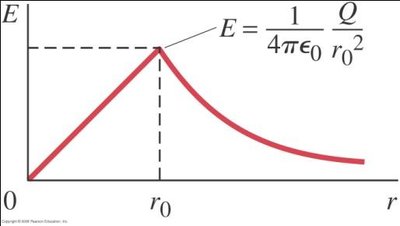
For a conducting sphere of radius \( r_0 \) carrying charge \( Q \):
Outside the sphere (\( r > r_0 \)):
Inside the sphere (\( r < r_0 \)):
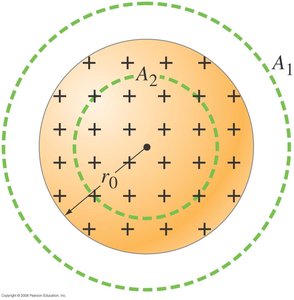
Volle Isolerende Bol (Solid Insulating Sphere)
For a solid insulating sphere of radius \( r_0 \) with total charge \( Q \) uniformly distributed:
Outside the sphere (\( r > r_0 \)):
Inside the sphere (\( r < r_0 \)):
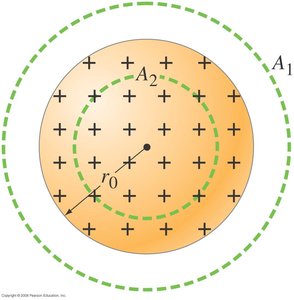
Toepassing: Lijnlading (Line Charge)
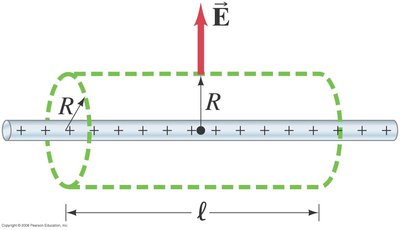
For an infinite line of charge with linear charge density \( \lambda \):
Where \( R \) is the radial distance from the line.
Toepassing: Oneindig Vlak (Infinite Plane)
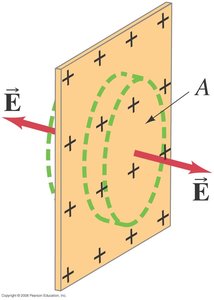
For an infinite plane with surface charge density \( \sigma \):
Wet van Gauss in Differentiaalvorm (Gauss's Law in Differential Form)
Stelling van Gauss (Gauss's Theorem / Divergence Theorem)
The divergence theorem relates the flux of a vector field through a closed surface to the divergence of the field inside the volume:
\( \nabla \cdot \vec{a} = \frac{\partial a_x}{\partial x} + \frac{\partial a_y}{\partial y} + \frac{\partial a_z}{\partial z} \)
Differentiaalvorm van de Wet van Gauss (Differential Form of Gauss's Law)
Applying the divergence theorem to Gauss's Law gives:
\( \rho \): Charge density (C/m3)
This is the local (pointwise) form of Gauss's Law, stating that the divergence of the electric field at a point is proportional to the charge density at that point.
