 뒤로
뒤로Optics - Geometric Optics: Reflection from Plane and Curved Mirrors
스터디 가이드 - 스마트 노트
 자료에 맞춘 맞춤형 노트, 핵심 정의, 예시, 맥락을 확장해 제공합니다.
Geometric Optics
Introduction to Mirrors and Reflection
Geometric optics is the study of light propagation in terms of rays, especially as it interacts with mirrors and lenses. This section focuses on the behavior of light when it encounters plane (flat) and curved mirrors, including the rules of reflection and the formation of images.
Plane Mirrors: Produce images that are actual size and erect.
Curved Mirrors: Can produce images that are larger, smaller, or inverted.
Reflection Rules: The angle of incidence () equals the angle of reflection ().
Geometry and Trigonometry: Used to analyze image formation.
Curved Mirrors: Concave and Convex
Curved mirrors are classified as concave (inwardly curved) or convex (outwardly curved). Their image formation properties differ significantly from plane mirrors.
Concave Mirrors: Can form real, inverted images or magnified images depending on object position.
Convex Mirrors: Always form virtual, diminished, and erect images.
Light Rays: Concave mirrors converge rays to a focal point; convex mirrors diverge rays from a focal point.
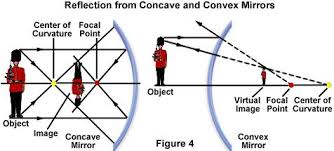
Example: The image above shows how concave mirrors can produce real, inverted images, while convex mirrors produce virtual, upright images.
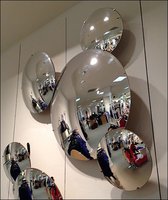
Example: Convex mirrors in real-world settings demonstrate the formation of virtual images that appear smaller and upright.
Reflection at a Plane Surface
Plane mirrors reflect light according to the law of reflection, creating images that are the same size as the object and located behind the mirror.
Object Point (P): The actual location of the object.
Image Point (P’): The location of the image formed by the mirror.
Perpendicular Line: The line joining P and P’ is perpendicular to the mirror.
Equal Triangles: The geometry forms two triangles with equal angles.
Object Distance ( or ): The distance from the object to the mirror.
Image Distance ( or ): The distance from the image to the mirror.
Law of Reflection:
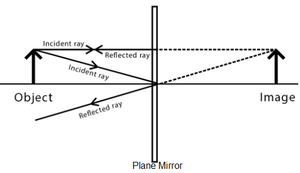
Example: The diagram above illustrates the formation of an image in a plane mirror, showing incident and reflected rays.
Sign Rules for Reflection and Refraction
Sign conventions are important for analyzing image formation in both plane and spherical mirrors.
Object Distance ( or ): Positive if on the same side as the incident ray; negative otherwise.
Image Distance ( or ): Positive if on the same side as the reflected ray; negative otherwise.
Image Reversal: The image is reversed relative to the object.
Relationship:
Lateral Magnification: , where is image height and is object height.
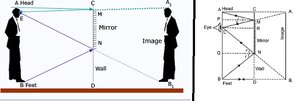
Example: The image above shows the geometric relationship between object and image in a plane mirror, including equal triangles and perpendicular lines.
Curved Mirror Ray Diagrams
Ray diagrams are used to analyze image formation in concave and convex mirrors. Rays from a point source (object) are traced to determine the location and nature of the image.
Object Distance ( or ): Solid lines represent real rays.
Image Distance ( or ): Dashed lines represent virtual rays.
Normal: The perpendicular to the mirror surface at the point of incidence.
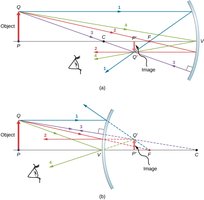
Example: The ray diagrams above show how rays from an object interact with concave and convex mirrors to form images.
Ray Model of Reflection
The ray model of reflection describes how incident rays interact with a reflecting surface, obeying the law of reflection.
Incident Rays: Rays approaching the reflecting surface.
Reflected Rays: Rays leaving the surface after reflection.
Wavefronts: The orientation of wavefronts before and after reflection.
Law of Reflection:
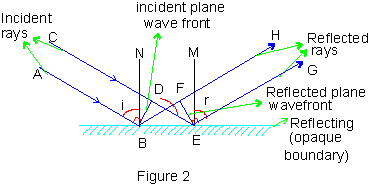
Example: The diagram above illustrates the law of reflection for plane wavefronts.
Summary Table: Mirror Types and Image Properties
The following table summarizes the properties of images formed by different types of mirrors:
Mirror Type | Image Type | Image Orientation | Image Size |
|---|---|---|---|
Plane | Virtual | Erect | Same as object |
Concave | Real or Virtual | Inverted or Erect | Varies (larger/smaller) |
Convex | Virtual | Erect | Smaller than object |
Additional info: Academic context was added to clarify sign conventions, ray diagrams, and magnification formulas.
