 뒤로
뒤로Magnetic Fields and Forces: Step-by-Step Physics Guidance
스터디 가이드 - 스마트 노트
 자료에 맞춘 맞춤형 노트, 핵심 정의, 예시, 맥락을 확장해 제공합니다.
Q1. A particle with a charge of 14 μC experiences a force of 2.2 × 10⁻⁴ N when it moves at right angles to a magnetic field with a speed of 27 m/s. What force does this particle experience when it moves with a speed of 6.3 m/s at an angle of 25° relative to the magnetic field?
Background
Topic: Magnetic Force on a Moving Charge
This question tests your understanding of the magnetic force exerted on a charged particle moving in a magnetic field, including the effect of the angle between velocity and the field.
Key Terms and Formulas
Magnetic force on a charge:
= charge (in coulombs)
= speed of the particle (in m/s)
= magnetic field strength (in tesla)
= angle between velocity and magnetic field
Step-by-Step Guidance
First, use the initial scenario (right angles, ) to solve for the magnetic field .
Recall that , so the formula simplifies to for the first case.
Rearrange to solve for : using the given values.
Now, for the second scenario, use the new speed and angle in the general formula .
Plug in the values for , , (from previous calculation), and to set up the final calculation for the new force.
Try solving on your own before revealing the answer!
Final Answer: 3.1 × 10⁻⁵ N
Using the steps above, first solve for using the initial force, then substitute all values into to find the new force. The answer is approximately N.
Q2. An electron accelerated from rest through a voltage of 550 V enters a region of constant magnetic field. If the electron follows a circular path with a radius of 17 cm, what is the magnitude of the magnetic field?
Background
Topic: Motion of a Charged Particle in a Magnetic Field
This question tests your ability to relate the energy gained by an electron in an electric field to its motion in a magnetic field, specifically circular motion.
Key Terms and Formulas
Kinetic energy from voltage:
Relationship to speed:
Magnetic force provides centripetal force:
= elementary charge, = mass of electron, = voltage, = radius
Step-by-Step Guidance
Calculate the kinetic energy gained by the electron: .
Set and solve for (the speed of the electron).
Use the formula for circular motion in a magnetic field: .
Rearrange to solve for : .
Substitute the values for , (from previous step), , and to set up the calculation for .
Try solving on your own before revealing the answer!
Final Answer: 0.22 T
After calculating the speed from the kinetic energy and substituting all values, the magnitude of the magnetic field is approximately T.
Q3. A wire with a length of 3.6 m and a mass of 0.75 kg is in a region of space with a magnetic field of 0.84 T. What is the minimum current needed to levitate the wire?
Background
Topic: Magnetic Force on a Current-Carrying Wire
This question tests your understanding of the force exerted by a magnetic field on a current-carrying wire and the conditions for equilibrium (levitation).
Key Terms and Formulas
Magnetic force:
For levitation,
Gravitational force:
= current, = length, = magnetic field, = mass, = acceleration due to gravity
Step-by-Step Guidance
Set the magnetic force equal to the gravitational force: (assuming for maximum force).
Rearrange to solve for the current: .
Plug in the values for , , , and to set up the calculation for .
Try solving on your own before revealing the answer!
Final Answer: 2.4 A
Substituting the given values into yields a minimum current of approximately A needed to levitate the wire.
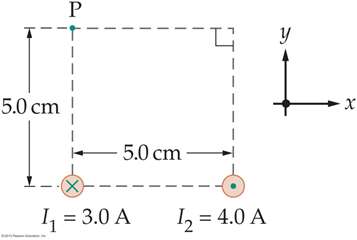
Q4. Two long, straight wires are oriented perpendicular to the page. The current in one wire is I1 = 3.0 A, pointing into the page, and the current in the other wire is I2 = 4.0 A, pointing out of the page. Find the magnitude and direction of the net magnetic field at point P.
Background
Topic: Magnetic Field Due to Long Straight Currents (Biot-Savart Law / Ampère's Law)
This question tests your ability to calculate the magnetic field at a point due to multiple current-carrying wires using the right-hand rule and superposition.
Key Terms and Formulas
Magnetic field from a long straight wire:
= permeability of free space ( T·m/A)
Superposition principle: vector sum of fields from each wire
Step-by-Step Guidance
Calculate the distance from each wire to point P (both are 5.0 cm).
Use to find the magnetic field at P due to each wire separately.
Determine the direction of each field at P using the right-hand rule.
Express each field as a vector (e.g., along , along or as appropriate).
Set up the vector addition to find the magnitude and direction of the net field at P.
Try solving on your own before revealing the answer!
Final Answer: 1.7 × 10⁻⁵ T at 53° above the x-axis
The net magnetic field at P is approximately T, directed at an angle of above the x-axis (toward the upper right), found by vector addition of the individual fields.
