 뒤로
뒤로Magnetic Fields and Magnetic Forces: Study Notes
스터디 가이드 - 스마트 노트
 자료에 맞춘 맞춤형 노트, 핵심 정의, 예시, 맥락을 확장해 제공합니다.
Magnetic Field and Magnetic Forces
Introduction to Magnetism
Magnetism is a fundamental force of nature associated with moving electric charges. It manifests in materials such as iron and is responsible for the forces between magnets and the behavior of compasses in Earth's magnetic field.
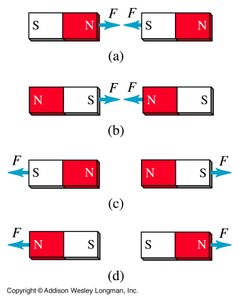
Magnets have two poles: north (N) and south (S).
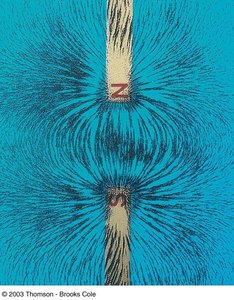
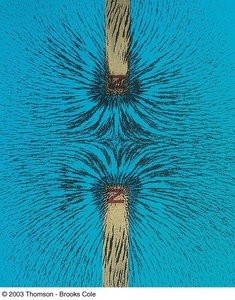
Like poles repel; unlike poles attract.
Magnetic monopoles (isolated N or S) have never been observed; cutting a magnet always yields two poles.
Magnetism is closely related to electricity, as discovered by Oersted and further developed by Faraday and Maxwell.
Magnetic Forces and Materials
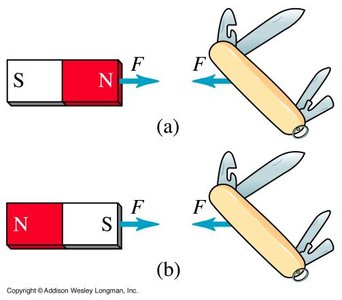
Magnets exert forces on each other and on materials containing iron. Unmagnetized iron objects can be attracted to magnets due to induced magnetism.
Historical Development of Magnetism
Ancient Chinese and Greeks used natural magnets (magnetite) and compasses.
Pierre de Maricourt (1269): Identified poles and field lines.
William Gilbert (1600): Proposed Earth as a giant magnet.
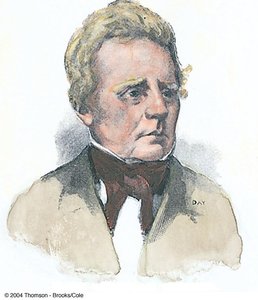
Hans Christian Oersted (1819): Discovered that electric currents produce magnetic fields.
Faraday, Henry, and Maxwell: Unified electricity and magnetism into electromagnetism.
Magnetic Field Lines
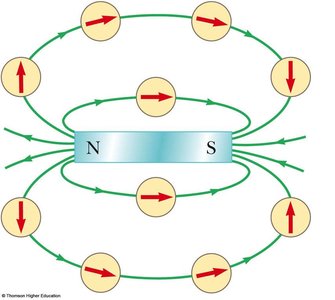
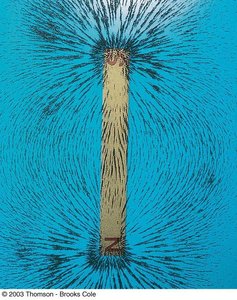
The magnetic field (B) is a vector field surrounding magnets and moving charges. Field lines indicate the direction and strength of the field.
Field lines emerge from the north pole and enter the south pole outside the magnet.
Inside the magnet, lines run from south to north, forming closed loops.
The density of lines indicates field strength.
Earth's Magnetic Field
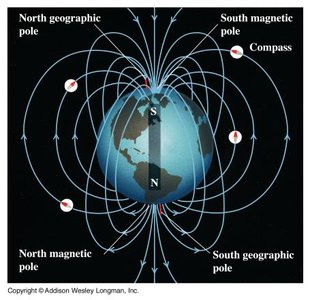
Earth acts as a giant magnet, with its geographic north pole being a magnetic south pole and vice versa. Compasses align with Earth's field lines.
Definition and Units of Magnetic Field
The magnetic field at a point is defined by the force it exerts on a moving charge:
SI unit: Tesla (T)
1 T = 104 Gauss (G)
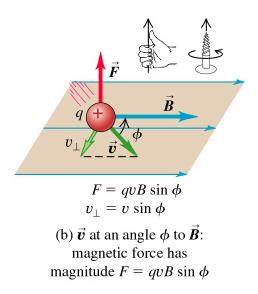
Mathematically, the force on a charge q moving with velocity v in a magnetic field B is:
where is the angle between v and B.
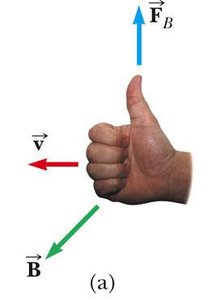
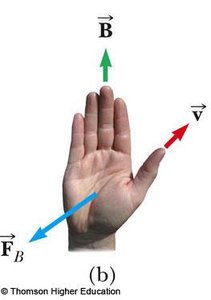
Direction of Magnetic Force: Right-Hand Rule
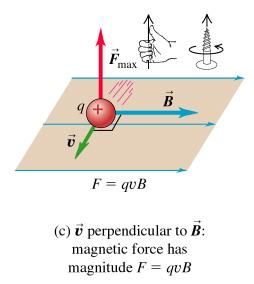
The direction of the magnetic force is perpendicular to both the velocity of the charge and the magnetic field. The right-hand rule is used to determine this direction:
Point fingers in the direction of v, curl toward B, thumb points in the direction of force (F) for a positive charge.
Magnitude of Magnetic Force
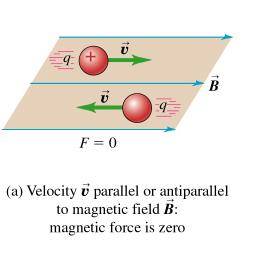
If v is parallel or antiparallel to B, or , so .
If v is perpendicular to B, , so (maximum force).
Comparison: Electric vs. Magnetic Fields
Electric force acts along the field direction and can do work, changing the speed of a particle.
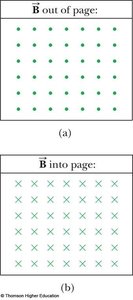
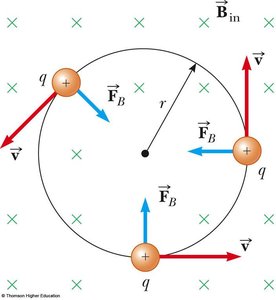
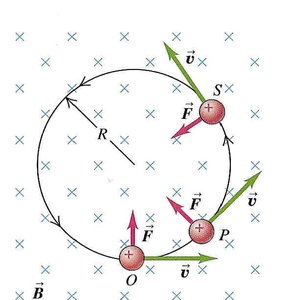
Magnetic force acts perpendicular to both velocity and field, does no work, and only changes the direction of motion.
Motion of Charged Particles in Magnetic Fields
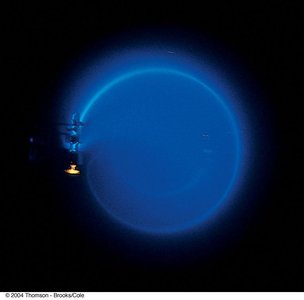
A charged particle moving perpendicular to a uniform magnetic field follows a circular path due to the magnetic force acting as a centripetal force:
Solving for the radius:
The angular frequency (cyclotron frequency):
The period of revolution:
Helical and Complex Motion
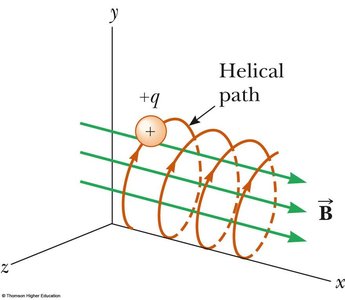
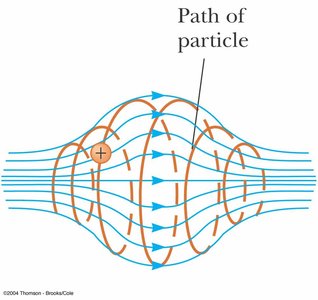
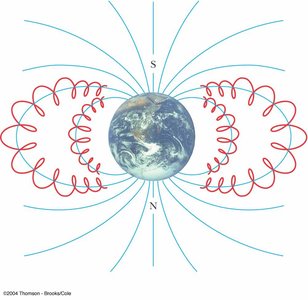
If the velocity is at an angle to the field, the particle moves in a helical path. In non-uniform fields, particles can be trapped in regions called magnetic bottles, as seen in Earth's Van Allen belts.
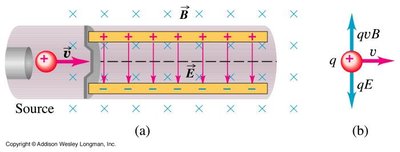
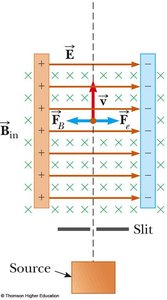
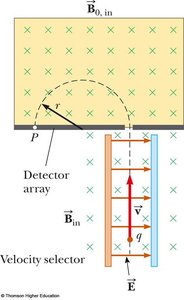
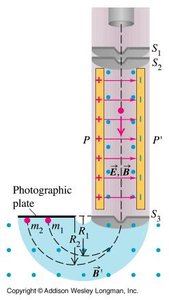
Charged Particles in Electric and Magnetic Fields (Lorentz Force)
When both electric and magnetic fields are present, the total force is:
This principle is used in velocity selectors and mass spectrometers.
Applications: Cathode Ray Tube and Cyclotron
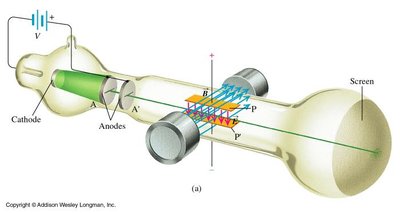
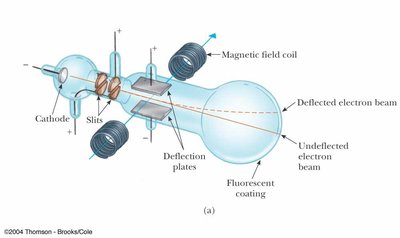
Cathode ray tubes use electric and magnetic fields to deflect electron beams, allowing measurement of charge-to-mass ratio.
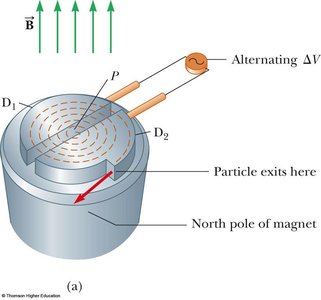
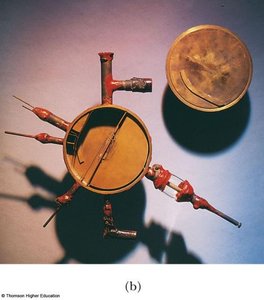
Cyclotrons accelerate charged particles using a combination of electric fields (for acceleration) and magnetic fields (for circular motion).
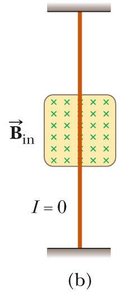
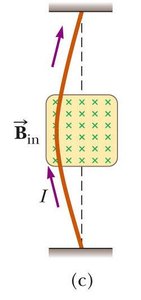
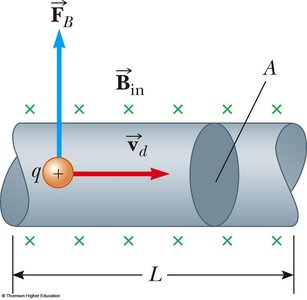
Magnetic Force on a Current-Carrying Conductor
A current-carrying wire in a magnetic field experiences a force:
I is the current, L is the length vector in the direction of current, B is the magnetic field.
The direction is given by the right-hand rule.
Torque on a Current Loop and Magnetic Dipole Moment
A current loop in a magnetic field experiences a torque:
A is the area of the loop, θ is the angle between the normal to the loop and the field.
The magnetic dipole moment is .
The torque can be written as .
Hall Effect
The Hall effect occurs when a current-carrying conductor is placed in a magnetic field, generating a transverse voltage (Hall voltage) due to the deflection of charge carriers.
Hall voltage:
Hall coefficient:
Used to determine the sign and density of charge carriers and to measure magnetic fields.
Magnetic Flux and Gauss' Law for Magnetism
Magnetic flux through a surface is defined as:
For a flat surface at angle θ to the field:
Unit: Weber (Wb), where 1 Wb = 1 T·m2
Gauss' law for magnetism: The net magnetic flux through any closed surface is zero, reflecting the absence of magnetic monopoles.
Quantity | Symbol | SI Unit |
|---|---|---|
Magnetic Field | B | Tesla (T) |
Magnetic Flux | ΦB | Weber (Wb) |
Magnetic Dipole Moment | μ | A·m2 |
Additional info: This guide covers the core concepts of Chapter 27: Magnetic Field and Magnetic Forces, including historical context, field definitions, force laws, particle motion, applications, and the Hall effect. All equations are provided in LaTeX format for clarity.
