 뒤로
뒤로Magnetism: Magnetic Forces, Fields, and Applications
스터디 가이드 - 스마트 노트
 자료에 맞춘 맞춤형 노트, 핵심 정의, 예시, 맥락을 확장해 제공합니다.
Magnetism
Magnetic Force and Magnetic Materials
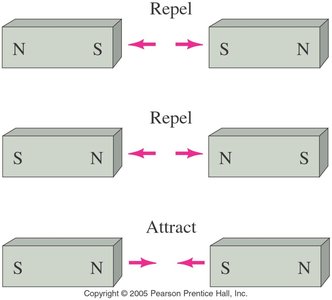
Magnetism is a fundamental force of nature, closely related to electricity. Magnets exert forces on certain materials, such as iron (Fe), cobalt (Co), and nickel (Ni). Every magnet has two poles: a north pole and a south pole. Like poles repel each other, while opposite poles attract.
Magnetic Poles: North and south poles always appear in pairs; isolated magnetic monopoles have never been observed.
Force Interactions: North repels north, south repels south, and north attracts south.
Key Difference from Electric Charges: Electric charges can exist independently (positive or negative), but magnetic poles always come in pairs.
Magnetic Fields
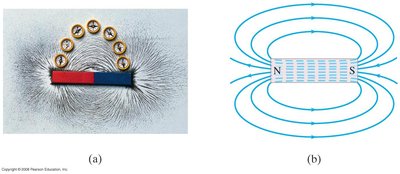
The concept of a magnetic field (B) is used to describe the region around a magnet where magnetic forces are exerted. The direction of the magnetic field at any point is the direction a compass needle's north pole would point.
Field Lines: Magnetic field lines emerge from the north pole and enter the south pole outside the magnet, forming closed loops.
Homogeneous Field: Between two wide, parallel magnet poles, the field is nearly uniform, similar to the electric field between parallel plates.
Magnetic Fields and Electric Currents
Production of Magnetic Fields by Currents
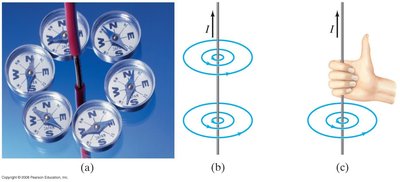
An electric current in a wire produces a magnetic field. This experimental fact demonstrates the deep connection between electricity and magnetism.
Right-Hand Rule: If you point your right thumb in the direction of the current, your fingers curl in the direction of the magnetic field lines around the wire.
Force on a Current-Carrying Wire
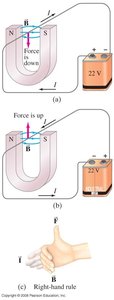
A wire carrying an electric current in an external magnetic field experiences a force. The force is perpendicular to both the current and the magnetic field.
Direction: Determined by the right-hand rule.
Magnitude (for straight wire in uniform field):
General Case (curved wire or non-uniform field):
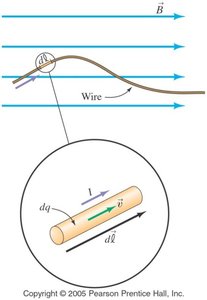
Units of Magnetic Field
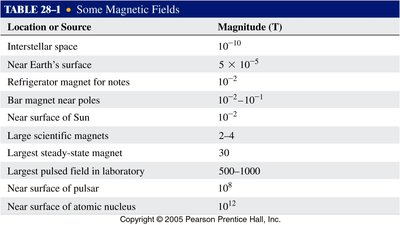
The SI unit of magnetic field is the tesla (T), where .
Location or Source | Magnitude (T) |
|---|---|
Interstellar space | |
Near Earth's surface | |
Refrigerator magnet | |
Bar magnet near poles | |
Near surface of Sun | |
Large scientific magnets | |
Largest steady-state magnet | $30$ |
Largest pulsed field in laboratory | |
Near surface of pulsar | |
Near surface of atomic nucleus |
Lorentz Force: Force on a Moving Charge
Lorentz Force Law
A charged particle moving in a magnetic field experiences a force called the Lorentz force. The force is always perpendicular to both the velocity of the particle and the magnetic field.
Formula:
Direction: Right-hand rule for positive charges; opposite for negative charges.
Work: The Lorentz force does no work, as it is always perpendicular to the velocity; kinetic energy remains constant.
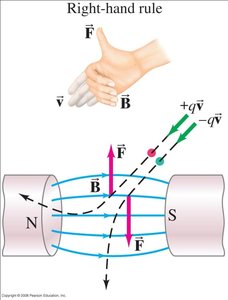
Motion of a Charged Particle in a Magnetic Field
If the velocity is perpendicular to the magnetic field, the particle moves in a circle due to the constant perpendicular force (centripetal force).
Radius of Path:
Period of Revolution:
Cyclotron Frequency:
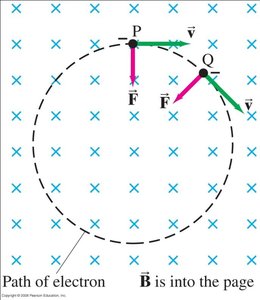
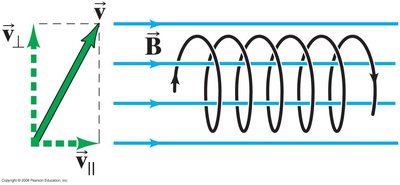
If the velocity is not perpendicular, the particle follows a helical (spiral) path, with the parallel component of velocity remaining unchanged.
Applications of Magnetic Forces
Velocity Selector
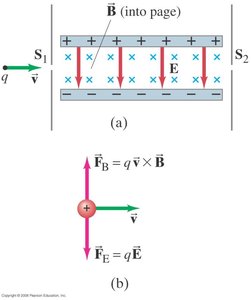
A velocity selector uses perpendicular electric and magnetic fields to select particles of a specific velocity. Only particles with pass through undeflected.
Force Balance:
Mass Spectrometer
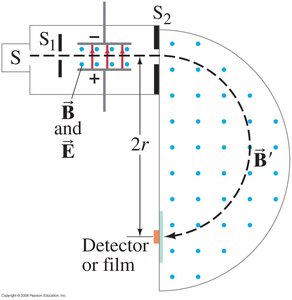
A mass spectrometer uses a velocity selector followed by a region with only a magnetic field to separate ions by mass. The radius of curvature in the magnetic field depends on the mass-to-charge ratio.
Radius:
Magnetic Dipole Moment and Torque
Current Loop in a Magnetic Field
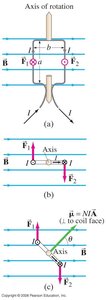
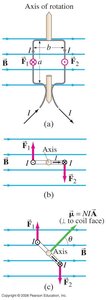
A current-carrying loop in a magnetic field experiences a torque that tends to align the loop's magnetic dipole moment with the field.
Torque:
Magnetic Dipole Moment: , where is current and is the area vector perpendicular to the loop.
Potential Energy:
Applications: Electric Motors and Loudspeakers
Electric Motors
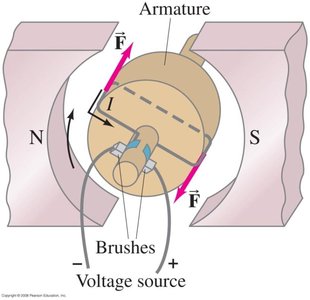
Electric motors convert electrical energy into mechanical energy using the torque on a current-carrying coil in a magnetic field. To maintain continuous rotation, the current direction in the coil is reversed using a commutator and brushes.
DC Motor: Uses a commutator to reverse current direction every half turn.
AC Motor: Uses alternating current; brushes remain stationary while the commutator rotates.
Loudspeakers
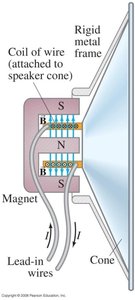
Loudspeakers convert electrical signals into sound. An alternating current passes through a coil in a magnetic field, causing the coil (and attached cone) to move back and forth, producing sound waves.
Summary Table: Key Equations
Concept | Equation |
|---|---|
Force on wire | |
Lorentz force | |
Radius of circular motion | |
Period of revolution | |
Torque on loop | |
Magnetic dipole moment | |
Potential energy |
