 뒤로
뒤로Mechanics: 1D Kinematics, Forces, and Vectors – Study Notes
스터디 가이드 - 스마트 노트
 자료에 맞춘 맞춤형 노트, 핵심 정의, 예시, 맥락을 확장해 제공합니다.
1D Kinematics
Introduction to Motion in One Dimension
Motion in one dimension (1D) involves the movement of objects along a straight line, described by position, velocity, and acceleration as functions of time. Understanding these concepts is foundational for analyzing more complex motions in physics.
Position (x): The location of an object along a straight line, typically measured from a reference point.
Displacement (Δx): The change in position, Δx = xf - xi.
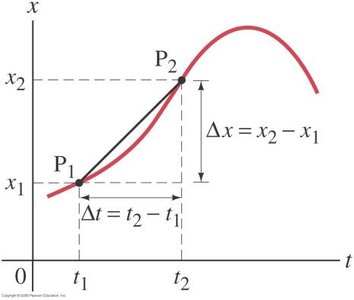
Velocity (v): The rate of change of position with respect to time. Average velocity is given by .
Speed: The magnitude of velocity, always positive.
Acceleration (a): The rate of change of velocity with respect to time. Average acceleration is .
Graphical Analysis of Motion
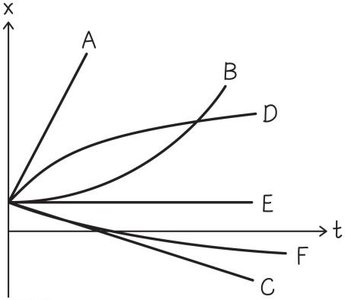
Position-time and velocity-time graphs provide visual representations of motion. The slope of a position-time graph gives velocity, while the slope of a velocity-time graph gives acceleration.
Constant velocity: Straight line on x-t graph.
Changing velocity (acceleration): Curved line on x-t graph.
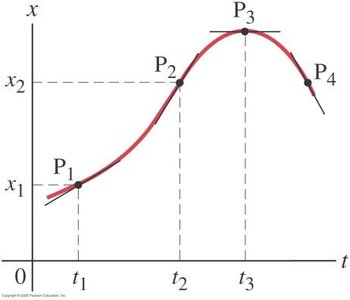
Instantaneous velocity: Slope of the tangent to the x-t curve at a point.
Kinematic Equations for Constant Acceleration
When acceleration is constant, the following equations describe the motion:
These equations allow calculation of unknown quantities when three of the five variables (x, vi, vf, a, t) are known.
Examples and Applications
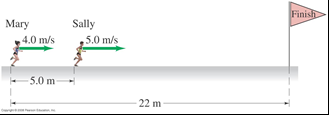
Traffic Light Problem: Calculating total travel time, average velocity, and average speed when stops are involved.
Helicopter Rescue: Determining total time and average velocity for a two-part journey with different speeds.
Sports Car Acceleration: Finding average acceleration from rest to a given speed over a time interval.
Graphical Representation of Acceleration
Velocity-time graphs for constant acceleration are straight lines. The area under the curve represents displacement.
Instantaneous and Average Quantities
Instantaneous velocity:
Instantaneous acceleration:
Calculus in Kinematics
Differentiation and Integration
Calculus provides a powerful tool for analyzing motion, especially when acceleration is not constant.
Differentiation: Used to find velocity from position and acceleration from velocity.
Integration: Used to find position from velocity and velocity from acceleration.
For ,
These principles extend to more complex functions, including trigonometric and exponential forms.
Free Fall
Motion Under Gravity
Objects in free fall experience constant acceleration due to gravity (g ≈ 9.8 m/s2, often approximated as 10 m/s2 for calculations). In the absence of air resistance, all objects fall at the same rate regardless of mass.
Key equations:
Scenarios include objects dropped from rest, thrown downward, or thrown upward.
Forces and Newton's Laws
Introduction to Forces
A force is a push or pull acting on an object, described as a vector quantity with both magnitude and direction. Forces can be classified as contact forces (requiring physical contact) or long-range forces (acting at a distance, such as gravity).
Contact forces: Normal force, friction, tension, spring force.
Long-range forces: Gravitational force, electromagnetic force.



Types of Forces
Weight: The gravitational force exerted by the Earth on an object, always directed downward.
Normal Force: The perpendicular contact force exerted by a surface on an object.
Friction: The force parallel to the surface that opposes motion. Kinetic friction acts during motion, static friction prevents motion.
Tension: The pulling force transmitted by a string, rope, or cable.
Spring Force: Follows Hooke's Law:
Buoyant Force: Upthrust on objects in fluids, given by


Newton's Laws of Motion
First Law (Inertia): An object remains at rest or in uniform motion unless acted upon by a net external force.
Second Law: The net force on an object is equal to the mass times its acceleration:
Third Law: For every action, there is an equal and opposite reaction.
Momentum
Definition and Application
Momentum is the product of an object's mass and velocity: . It is a vector quantity and is conserved in isolated systems.
Units: kg·m/s
Newton's Second Law (in terms of momentum):
Vectors and Two-Dimensional Motion
Introduction to Vectors
Vectors are quantities with both magnitude and direction. They are essential for describing displacement, velocity, acceleration, and force in two or three dimensions.
Vector addition: Can be performed graphically (tip-to-tail method) or analytically (component-wise).
Components: Any vector can be resolved into perpendicular components, typically along x, y, and z axes.
Unit vectors: , , represent the x, y, and z directions, respectively.
Projectile Motion
Projectile motion is a classic example of two-dimensional kinematics, where the horizontal and vertical motions are analyzed independently.
Horizontal motion: Constant velocity (no acceleration if air resistance is neglected).
Vertical motion: Constant acceleration due to gravity.
Key equations:
Applications of Vectors in Forces
Forces acting at angles can be resolved into components parallel and perpendicular to surfaces, which is essential for analyzing inclined planes and systems with multiple forces.
Summary Table: Types of Forces
Force Type | Symbol | Direction | Formula |
|---|---|---|---|
Weight | W | Downward | |
Normal | N | Perpendicular to surface | Varies |
Friction (kinetic) | fk | Opposes motion | |
Friction (static) | fs | Opposes impending motion | |
Tension | T | Along string/rope | Varies |
Spring | Fsp | Opposes displacement | |
Buoyant | Fbuoyant | Upward |
Key Skills for Mastery
Analyze 1D and 2D motion using kinematic equations and calculus.
Draw and interpret motion graphs (x-t, v-t, a-t).
Identify and resolve forces in various contexts, including inclined planes and pulleys.
Apply Newton’s laws to predict and analyze motion.
Use vector notation and operations to solve physics problems.
