 뒤로
뒤로Momentum & Impulse: Structured Study Notes for College Physics
스터디 가이드 - 스마트 노트
 자료에 맞춘 맞춤형 노트, 핵심 정의, 예시, 맥락을 확장해 제공합니다.
Momentum & Impulse
Introduction to Momentum
Momentum is a fundamental concept in physics that quantifies the motion of objects with mass. It is a vector quantity, meaning it has both magnitude and direction, and is directly proportional to an object's mass and velocity.
Definition: Momentum (p) is defined as the product of mass (m) and velocity (v).
Formula:
Units: kg·m/s
Direction: Momentum always points in the same direction as the velocity of the object.
Sign: If the object moves in the negative direction, both velocity and momentum are negative.
Conceptual Meaning: Momentum measures how difficult it is to stop a moving object.
Example: A 4,000 kg truck moves to the right with 10 m/s. An 800 kg racecar moves to the left with 50 m/s. Their momenta are:
Truck: kg·m/s (right)
Racecar: kg·m/s (left)
Impulse
Impulse is the change in momentum of an object when a force is applied over a period of time. It is closely related to Newton's Second Law and is used to analyze collisions and force interactions.
Definition: Impulse (J) is the product of force (F) and the time interval (Δt) during which the force acts.
Formula:
Units: N·s or kg·m/s
Relation to Work: Both impulse and work involve force, but work is force times displacement, while impulse is force times time.
Example: You push a 50 kg crate with a constant 100 N force for 8 seconds. The impulse delivered is N·s.
Impulse from Force vs. Time Graphs
Impulse can be calculated as the area under a force vs. time graph. This is analogous to calculating work as the area under a force vs. displacement graph.
Area Calculation: For rectangles: ; for triangles:
Sign: Areas above the time axis represent positive impulse; areas below represent negative impulse.
Total Momentum of a System
When multiple objects interact, the total momentum of the system is the sum of the individual momenta. This is crucial for analyzing collisions and other interactions.
Formula:
System: A collection of objects whose total momentum is considered.
Conservation of Momentum
In the absence of external forces, the total momentum of a system remains constant during interactions such as collisions or explosions.
Principle:
Application: Used to solve collision and push-away problems.
Types of Collisions
Collisions are classified based on whether momentum and mechanical energy are conserved, and whether objects stick together after the collision.
Elastic Collision: Both momentum and mechanical energy are conserved. Objects do not stick together.
Inelastic Collision: Momentum is conserved, but mechanical energy is not. Some energy is lost.
Completely Inelastic Collision: Objects stick together and move with the same final velocity. Momentum is conserved, but mechanical energy is not.
Collision Type | Momentum Conserved? | Mechanical Energy Conserved? | Objects Stick Together? |
|---|---|---|---|
Elastic | Yes | Yes | No |
Inelastic | Yes | No | No |
Completely Inelastic | Yes | No | Yes |
Identifying Collision Types
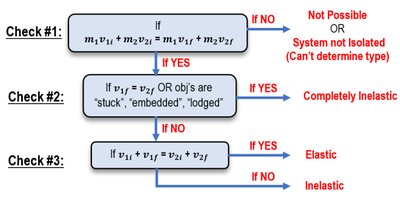
To determine the type of collision, follow a series of checks based on the characteristics of each type:
Check #1: Is momentum conserved?
Check #2: Are final velocities equal or objects "stuck"? If yes, completely inelastic.
Check #3: Is ? If yes, elastic; if no, inelastic.
Center of Mass
The center of mass (C.O.M) is a point representing the average position of all the mass in a system. It is useful for simplifying the analysis of systems of objects.
Definition: The C.O.M is the weighted average of the positions of all masses in the system.
Formula:
Properties: The C.O.M is closer to objects with greater mass.
Example: Two objects (m1=10kg, m2=10kg) placed at x=0 and x=4.
Summary Table: Key Equations
Concept | Equation (LaTeX) | Description |
|---|---|---|
Momentum | Momentum of an object | |
Impulse | Impulse delivered by a force | |
Conservation of Momentum | Momentum before and after interaction | |
Center of Mass | Position of center of mass |
Additional info: These notes expand on brief points and fill in missing context for clarity and completeness, suitable for exam preparation.
