 뒤로
뒤로Momentum, Impulse, and Collisions – Step-by-Step Physics Guidance
스터디 가이드 - 스마트 노트
 자료에 맞춘 맞춤형 노트, 핵심 정의, 예시, 맥락을 확장해 제공합니다.
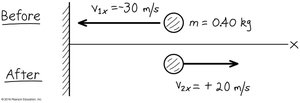
Q8.1. What is the impulse of the net force on a 0.40 kg ball that moves to the left at 30 m/s and, after hitting a wall, moves to the right at 20 m/s?
Background
Topic: Impulse and Change in Momentum
This question tests your understanding of impulse, which is the change in momentum of an object due to a net force acting over a time interval.
Key Terms and Formulas
Impulse (): The product of the net force and the time interval, or the change in momentum.
Momentum ():
Impulse-Momentum Theorem:
Step-by-Step Guidance
Identify the mass of the ball ( kg), the initial velocity ( m/s, left), and the final velocity ( m/s, right).
Recall that impulse is equal to the change in momentum: .
Substitute the given values for , , and into the formula, being careful with the signs (direction matters).
Set up the calculation for but do not compute the final value yet.
Try solving on your own before revealing the answer!
Final Answer: 20 kg·m/s to the right
Using :
kg·m/s, to the right.
The impulse is positive, indicating a direction to the right.
Q8.2. When stopping a car from 90 km/h to rest, is the impulse greater if the car hits a wall or if it stops gradually in gelatin?
Background
Topic: Impulse and Change in Momentum
This question examines whether the method of stopping (sudden vs. gradual) affects the impulse experienced by the car.
Key Terms and Formulas
Impulse ():
Impulse depends on the change in velocity, not on how quickly the change occurs.
Step-by-Step Guidance
Recognize that in both cases, the car starts at the same initial velocity and ends at rest ().
Recall that impulse is determined by the change in momentum, which depends only on the initial and final velocities and the mass.
Consider whether the stopping method (sudden or gradual) changes the total change in momentum.
Set up the impulse calculation for both cases using .
Try solving on your own before revealing the answer!
Final Answer: The impulse is the same in both cases (C)
Impulse depends only on the change in momentum, which is the same for both stopping methods since the initial and final velocities are the same.
Q8.3. When a 3.00-kg rifle fires a 0.00500-kg bullet at 300 m/s, which force is greater: the force the rifle exerts on the bullet, or the force the bullet exerts on the rifle?
Background
Topic: Newton's Third Law and Conservation of Momentum
This question tests your understanding of action-reaction force pairs during a collision or explosion.
Key Terms and Formulas
Newton's Third Law: For every action, there is an equal and opposite reaction.
Action-Reaction Pair: The force the rifle exerts on the bullet and the force the bullet exerts on the rifle are equal in magnitude and opposite in direction.
Step-by-Step Guidance
Recall Newton's Third Law and how it applies to interactions between two objects.
Identify the action and reaction forces in the context of the rifle and bullet.
Consider whether the masses or velocities of the objects affect the magnitude of the forces during the interaction.
Think about whether the forces can be different in magnitude according to Newton's laws.
Try solving on your own before revealing the answer!
Final Answer: Both forces have the same magnitude (C)
By Newton's Third Law, the force the rifle exerts on the bullet is equal in magnitude and opposite in direction to the force the bullet exerts on the rifle.
Q8.4. Car #1 crashes into a stationary wall and stops. Identical car #2 crashes head-on into and sticks to identical car #3 moving at the same speed in the opposite direction. Which car loses more momentum and kinetic energy?
Background
Topic: Conservation of Momentum and Kinetic Energy in Collisions
This question compares the changes in momentum and kinetic energy for two different collision scenarios.
Key Terms and Formulas
Momentum ():
Kinetic Energy (KE):
Inelastic Collision: Objects stick together after collision.
Step-by-Step Guidance
Analyze the initial and final velocities for each car in both scenarios.
Calculate the change in momentum for car #1 and car #2 using .
Calculate the change in kinetic energy for each car using .
Compare the results to determine which car loses more momentum and/or kinetic energy.
Try solving on your own before revealing the answer!
Final Answer: Car #1 loses the same amount of momentum, but more kinetic energy, in its collision than does car #2 (C)
Both cars lose the same momentum, but car #1 (hitting the wall) loses more kinetic energy because the head-on collision with sticking conserves less kinetic energy.
Q8.5. Two objects with different masses collide and stick together. After the collision, how do the total momentum and kinetic energy compare to before?
Background
Topic: Inelastic Collisions
This question tests your understanding of conservation of momentum and the loss of kinetic energy in perfectly inelastic collisions.
Key Terms and Formulas
Conservation of Momentum: Total momentum is conserved in all collisions.
Kinetic Energy: Not always conserved in inelastic collisions.
Step-by-Step Guidance
Recall that in a perfectly inelastic collision, the objects stick together after colliding.
Apply conservation of momentum to the system before and after the collision.
Consider what happens to the total kinetic energy in a perfectly inelastic collision.
Compare the total momentum and kinetic energy before and after the collision.
Try solving on your own before revealing the answer!
Final Answer: The system has the same total momentum but less total kinetic energy (B)
Momentum is conserved, but kinetic energy is lost in the form of heat, sound, or deformation during a perfectly inelastic collision.
Q8.6. Two objects with different masses collide and bounce off each other. After the collision, how do the total momentum and kinetic energy compare to before?
Background
Topic: Elastic Collisions
This question tests your understanding of conservation of momentum and kinetic energy in elastic collisions.
Key Terms and Formulas
Elastic Collision: Both momentum and kinetic energy are conserved.
Conservation of Momentum:
Conservation of Kinetic Energy:
Step-by-Step Guidance
Recall the definitions of elastic and inelastic collisions.
Apply the conservation laws for momentum and kinetic energy to the system.
Consider whether both quantities are conserved in this type of collision.
Compare the total momentum and kinetic energy before and after the collision.
Try solving on your own before revealing the answer!
Final Answer: The system has the same total momentum and the same total kinetic energy (A)
In an elastic collision, both momentum and kinetic energy are conserved.
Q8.7. Block A (1.00 kg) and block B (3.00 kg) collide and stick together on a frictionless surface. After the collision, how does the kinetic energy of block A compare to that of block B?
Background
Topic: Kinetic Energy Distribution in Inelastic Collisions
This question explores how kinetic energy is shared between two masses after a perfectly inelastic collision.
Key Terms and Formulas
Kinetic Energy:
After sticking together, both blocks move with the same velocity.
Step-by-Step Guidance
Recognize that after the collision, both blocks move together with the same velocity.
Write the expression for kinetic energy for each block using their respective masses and the common velocity.
Set up the ratio using the formula for kinetic energy.
Simplify the ratio to compare the kinetic energies of the two blocks.
Try solving on your own before revealing the answer!
Final Answer: One-third the kinetic energy (B)
Since both blocks move with the same velocity, the ratio of their kinetic energies is the ratio of their masses: .
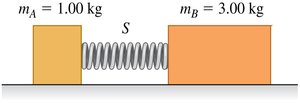
Q8.8. After releasing two blocks (1.00 kg and 3.00 kg) from a compressed spring on a frictionless surface, how does the magnitude of momentum of block A compare to block B?
Background
Topic: Conservation of Momentum in Explosions
This question tests your understanding of how momentum is distributed between two objects pushed apart by a spring.
Key Terms and Formulas
Conservation of Momentum: The total momentum of the system is zero if it starts from rest.
Momentum:
Step-by-Step Guidance
Recognize that the system starts from rest, so the total momentum before release is zero.
After release, the momenta of the two blocks must be equal in magnitude and opposite in direction.
Set up the equation (in magnitude).
Solve for the ratio using the given masses.
Try solving on your own before revealing the answer!
Final Answer: (C)
By conservation of momentum, the magnitudes of the momenta are equal: .
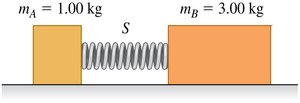
Q8.9. After releasing two blocks (1.00 kg and 3.00 kg) from a compressed spring, how does the kinetic energy of block A compare to block B?
Background
Topic: Kinetic Energy Distribution in Explosions
This question explores how kinetic energy is shared between two masses after being pushed apart by a spring.
Key Terms and Formulas
Kinetic Energy:
From conservation of momentum:
Step-by-Step Guidance
Recall from the previous question that .
Express in terms of using the masses.
Write the kinetic energy expressions for both blocks and set up the ratio .
Simplify the ratio to compare the kinetic energies.
Try solving on your own before revealing the answer!
Final Answer: (D)
Block A, being lighter, ends up with more kinetic energy than block B after the spring pushes them apart.
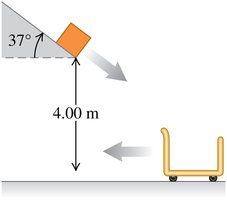
Q8.10. An open cart rolls left; a package lands in it from a chute. Which quantities are conserved just before and after the package lands?
Background
Topic: Conservation of Momentum and Energy in Inelastic Collisions
This question tests your understanding of which quantities are conserved in a collision where two objects combine.
Key Terms and Formulas
Horizontal Momentum: Conserved if no external horizontal forces act.
Vertical Momentum: Not conserved if gravity acts during the collision.
Kinetic Energy: Not conserved in inelastic collisions.
Step-by-Step Guidance
Consider the forces acting on the system in the horizontal and vertical directions.
Determine if any external forces act in the horizontal direction during the collision.
Analyze whether kinetic energy is conserved when the package lands in the cart.
Decide which quantities remain unchanged before and after the package lands.
Try solving on your own before revealing the answer!
Final Answer: The horizontal component of total momentum (A)
Only the horizontal component of momentum is conserved; vertical momentum and kinetic energy are not conserved due to gravity and the inelastic nature of the collision.
Q8.11. A yellow block and a red rod are joined. The center of mass is marked. Which has greater mass?
Background
Topic: Center of Mass
This question tests your understanding of how the center of mass relates to the distribution of mass in a system.
Key Terms and Formulas
Center of Mass: The point where the mass of a system is considered to be concentrated.
For two objects:
Step-by-Step Guidance
Observe the position of the center of mass relative to the two objects.
Recall that the center of mass is closer to the object with greater mass.
Use the center of mass formula to reason about which object is heavier.
Decide which object the center of mass is closer to and what that implies about their masses.
Try solving on your own before revealing the answer!
Final Answer: The yellow block has the greater mass (A)
The center of mass is closer to the yellow block, indicating it has more mass than the red rod.
Q8.12. Block A (1.00 kg) moves right at 6.00 m/s; block B (3.00 kg) is at rest. What is the velocity of the center of mass before collision?
Background
Topic: Center of Mass Velocity
This question tests your ability to calculate the velocity of the center of mass for a two-object system.
Key Terms and Formulas
Center of Mass Velocity:
Step-by-Step Guidance
Identify the masses and velocities: kg, m/s; kg, m/s.
Write the formula for the velocity of the center of mass.
Substitute the given values into the formula.
Set up the calculation but do not compute the final value yet.
Try solving on your own before revealing the answer!
Final Answer: 1.50 m/s to the right (C)
m/s to the right.
Q8.13. After collision, what is the velocity of the center of mass of blocks A and B?
Background
Topic: Conservation of Center of Mass Velocity
This question tests your understanding that, in the absence of external forces, the velocity of the center of mass remains constant.
Key Terms and Formulas
Conservation of Momentum: The velocity of the center of mass does not change if no external forces act.
Step-by-Step Guidance
Recall that the velocity of the center of mass is conserved if the system is isolated.
Use the result from the previous question for the initial center of mass velocity.
Reason whether any external forces act on the system during the collision.
Conclude what happens to the center of mass velocity after the collision.
Try solving on your own before revealing the answer!
Final Answer: 1.50 m/s to the right (C)
The velocity of the center of mass remains unchanged at 1.50 m/s to the right, since no external forces act on the system.
Q-RT8.1. Rank the following objects in order of the magnitude of their momentum, from largest to smallest:
Mass = 2.0 kg, kinetic energy = 2.0 J
Mass = 1.0 kg, kinetic energy = 2.0 J
Mass = 2.0 kg, kinetic energy = 4.0 J
Mass = 4.0 kg, kinetic energy = 4.0 J
Background
Topic: Relationship Between Kinetic Energy and Momentum
This question tests your ability to relate kinetic energy and momentum for different masses and energies.
Key Terms and Formulas
Kinetic Energy:
Momentum:
Express in terms of and :
Therefore,
Step-by-Step Guidance
For each object, use the formula to calculate the magnitude of momentum.
Substitute the given values for and for each object.
Set up the expressions for each object's momentum, but do not compute the final values yet.
Compare the expressions to determine the ranking from largest to smallest.
Try solving on your own before revealing the answer!
Final Answer: D > C > A > B
Ranking by gives: (4.0 kg, 4.0 J) > (2.0 kg, 4.0 J) > (2.0 kg, 2.0 J) > (1.0 kg, 2.0 J).
