 뒤로
뒤로Motion Along a Straight Line: Displacement, Velocity, and Acceleration
스터디 가이드 - 스마트 노트
 자료에 맞춘 맞춤형 노트, 핵심 정의, 예시, 맥락을 확장해 제공합니다.
Motion Along a Straight Line
Displacement and Position Vectors
In kinematics, the position vector \( \vec{x} \) describes the location of an object in space relative to an origin. The initial position is denoted as \( \vec{x}_i \) and the final position as \( \vec{x}_f \). The displacement is the change in position and is a vector quantity.
Displacement Formula:
Displacement has both magnitude and direction, distinguishing it from distance, which is a scalar.
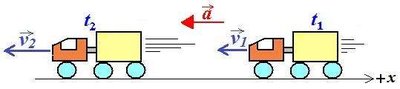
Example: If a truck moves from an initial position \( \vec{x}_i \) to a final position \( \vec{x}_f \), the displacement is the vector from the starting point to the ending point.

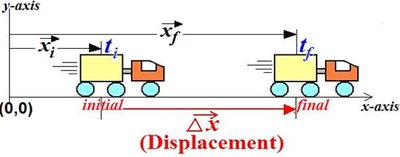
Distance vs. Displacement
Distance is the total length of the path traveled, regardless of direction, while displacement is the straight-line vector from the initial to the final position.
Distance is always positive and can be greater than or equal to the magnitude of displacement.
Example: If a runner goes 50 m forward and returns 50 m back to the start, the distance is 100 m, but the displacement is 0 m.
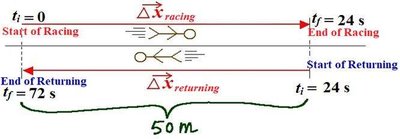
Average Velocity and Average Speed
Average velocity is defined as the displacement divided by the time interval, and it is a vector. Average speed is the total distance traveled divided by the time interval, and it is a scalar.
Average Velocity Formula:
Average Speed Formula:
Example: If a person travels 50 m in 24 s, the average velocity is m/s.
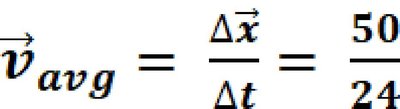
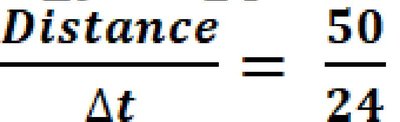
Round Trip Motion: Zero Displacement
When an object returns to its starting point, the displacement is zero, but the distance is the sum of the path lengths. In this case, the average velocity is zero, but the average speed is not.
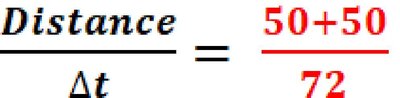
Example: For a round trip of 50 m out and 50 m back in 72 s:
Displacement = 0
Average velocity = 0
Average speed = m/s

Position-Time and Velocity-Time Graphs
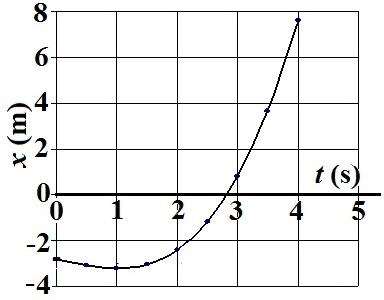
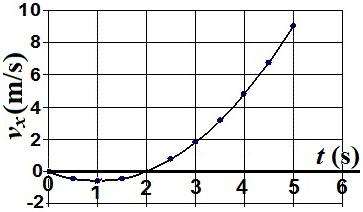
Graphs are essential tools for visualizing motion. A position-time graph shows how position changes with time, while a velocity-time graph shows how velocity changes with time.
Position-Time Graph: The slope at any point gives the instantaneous velocity.
Velocity-Time Graph: The slope gives the acceleration, and the area under the curve gives the displacement.
Example: A curve on a position-time graph that gets steeper indicates increasing velocity.
Instantaneous Velocity and Acceleration
Instantaneous velocity is the velocity at a specific instant, found as the derivative of position with respect to time. Acceleration is the rate of change of velocity with respect to time.
Instantaneous Velocity:
Instantaneous Acceleration:
Example: If a car's velocity increases uniformly, its acceleration is constant.
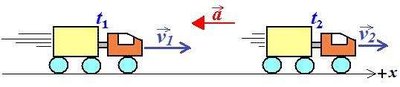
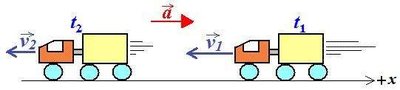
Equations of Motion for Constant Acceleration
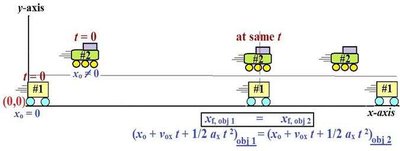
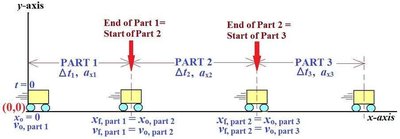
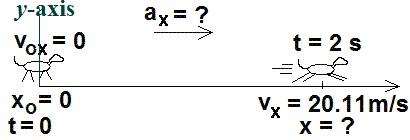
When acceleration is constant, the following kinematic equations describe the motion:
These equations allow calculation of position, velocity, or time when other quantities are known.
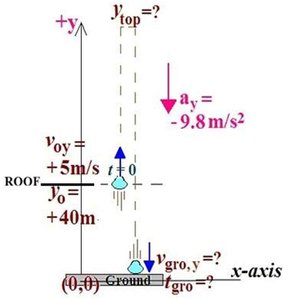
Projectile Motion in One Dimension
Vertical motion under gravity is a special case of one-dimensional motion with constant acceleration. The acceleration due to gravity is downward.
Example: An object thrown upward from a roof with initial velocity and initial height will reach a maximum height and then fall to the ground.
The equations of motion apply, with .
Summary Table: Displacement, Velocity, and Speed
Quantity | Symbol | Definition | Vector/Scalar |
|---|---|---|---|
Displacement | Change in position: | Vector | |
Distance | - | Total path length traveled | Scalar |
Average Velocity | Vector | ||
Average Speed | - | Scalar |
