 뒤로
뒤로Motion, Kinematics, and Vectors: Study Notes for College Physics
스터디 가이드 - 스마트 노트
 자료에 맞춘 맞춤형 노트, 핵심 정의, 예시, 맥락을 확장해 제공합니다.
Motion and Kinematics
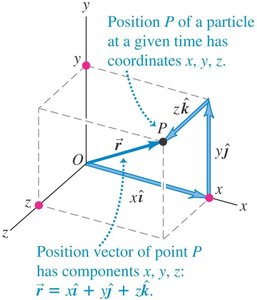
Position Vector
The position vector describes the location of a particle in space relative to an origin. It is fundamental in representing motion in one, two, or three dimensions.
Definition: The position vector \( \vec{r} \) has components along the x, y, and z axes:
Application: Used to specify the exact location of a particle at any given time.
Example: If a particle is at coordinates (2, 3, 5), its position vector is .
Displacement Vector
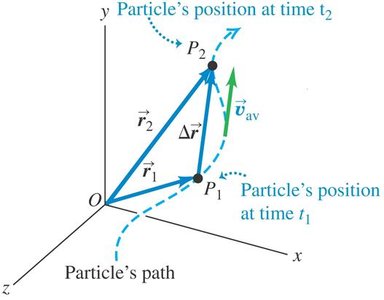
The displacement vector represents the change in position of a particle between two points in space.
Definition:
Key Point: Displacement is a vector quantity, indicating both magnitude and direction.
Example: If a particle moves from (1, 2, 3) to (4, 6, 8), the displacement is .
Average Velocity
Average velocity is the displacement divided by the time interval over which the displacement occurs. It is a vector quantity.
Formula:
Direction: Same as the direction of displacement.
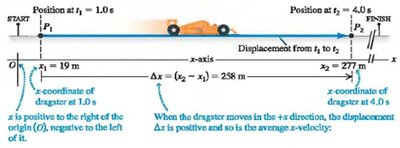
Example: If a dragster moves from m at s to m at s, m, s, so m/s.
Instantaneous Velocity
Instantaneous velocity is the rate of change of position at a specific instant. It is the derivative of the position vector with respect to time.
Formula:
Component Form:
Example: For ,
Position-Time (x-t) Graphs
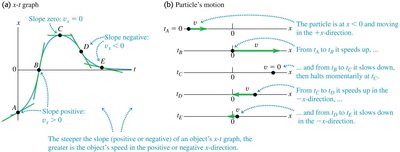
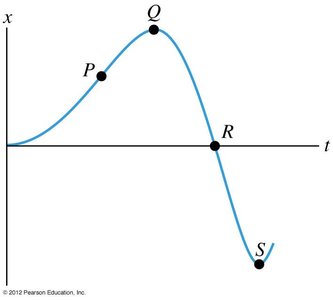
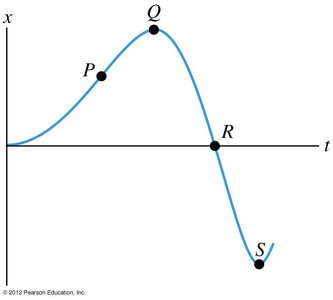
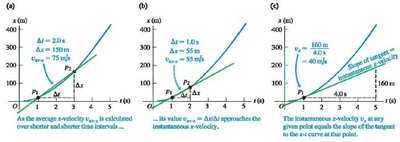
An x-t graph plots position as a function of time. The slope of the graph at any point gives the velocity.
Average velocity: Slope of the line joining two points.
Instantaneous velocity: Slope of the tangent at a point.
Speed: Steeper slope indicates greater speed.
Worked Example: Mars Rover Motion
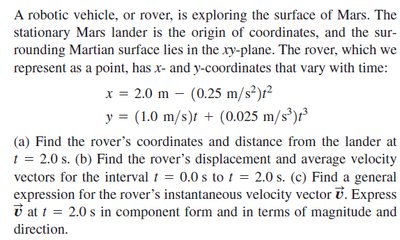
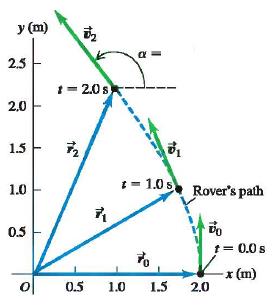
Consider a Mars rover with position given by and .
Find: Coordinates and distance at s, displacement and average velocity for to $t = 2.0$ s, and instantaneous velocity at $t = 2.0$ s.
Application: Illustrates calculation of vector quantities in kinematics.
Acceleration
Acceleration Vector
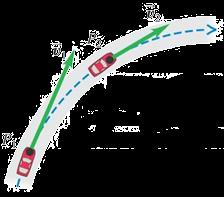
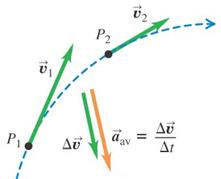
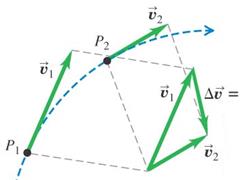
Acceleration is the rate of change of velocity. It is a vector quantity and can be decomposed into components.
Average acceleration:
Instantaneous acceleration:
Direction: Same as the change in velocity.
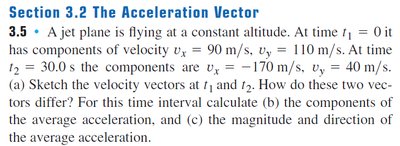
Acceleration Example: Jet Plane
Given velocity components at two times, calculate average acceleration and its direction.
Application: Useful for analyzing motion in two dimensions.
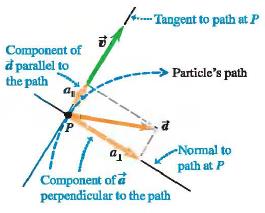
Acceleration Components: Tangential and Perpendicular
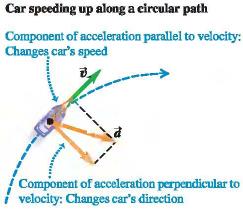
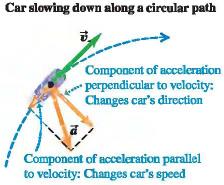
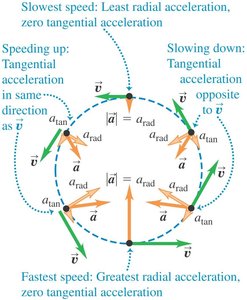
The acceleration vector can be split into components parallel and perpendicular to the velocity vector.
Tangential component: Changes the speed.
Perpendicular component: Changes the direction of motion.
Motion with Constant Acceleration
Kinematic Equations
For motion with constant acceleration, the following equations apply:
Projectile Motion
Projectile Trajectory
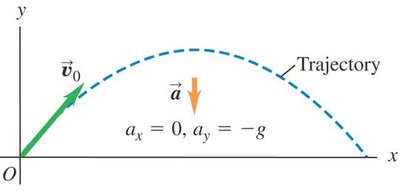
A projectile follows a curved path under the influence of gravity. Its motion can be analyzed in horizontal and vertical components.
Horizontal motion: Constant velocity,
Vertical motion: Constant acceleration,
Equations:
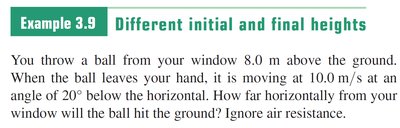
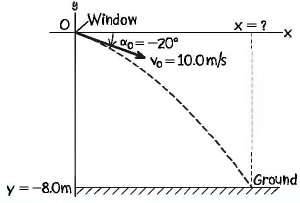
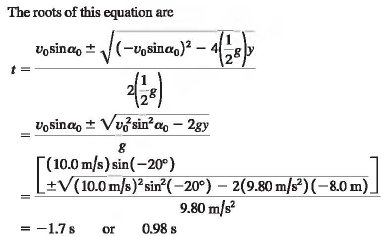
Projectile Motion Example: Different Initial and Final Heights
Calculate the horizontal distance a ball travels when thrown from a window above the ground, given initial velocity and angle.
Application: Demonstrates use of kinematic equations and quadratic formula for time of flight.
Motion in a Circle
Uniform and Non-Uniform Circular Motion
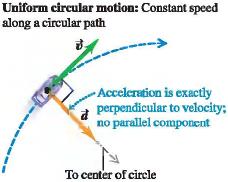
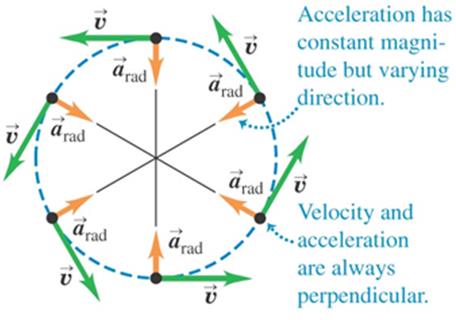
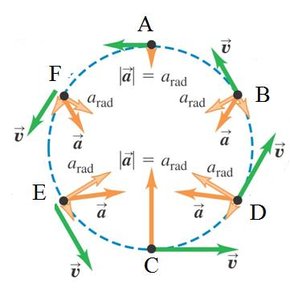
Motion in a circle can be uniform (constant speed) or non-uniform (changing speed). The acceleration in circular motion is called centripetal acceleration.
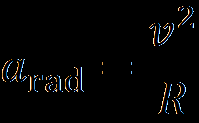
Radial acceleration:
Period: Time for one revolution,
Frequency:
Angular speed:
Speed:

Centripetal Acceleration
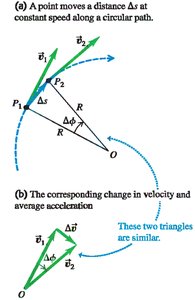
In uniform circular motion, the acceleration is always directed toward the center of the circle.
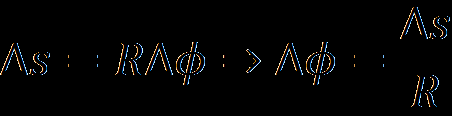
Formula:
Direction: Perpendicular to velocity, toward the center.
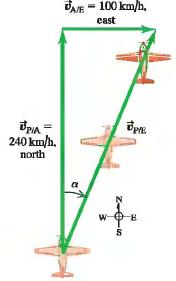
Relative Velocity
Frames of Reference
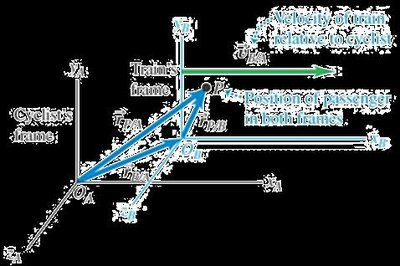
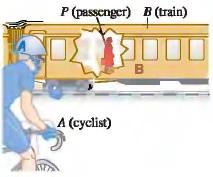
Relative velocity describes how the velocity of an object appears from different frames of reference.
Formula:
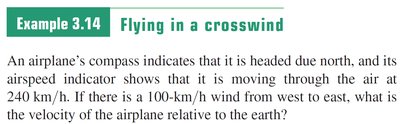
Application: Used in problems involving moving observers, such as trains, cars, or airplanes.
Summary Table: Kinematic Quantities
Quantity | Definition | Formula | Vector/Scalar |
|---|---|---|---|
Position | Location in space | Vector | |
Displacement | Change in position | Vector | |
Velocity | Rate of change of position | Vector | |
Acceleration | Rate of change of velocity | Vector | |
Speed | Magnitude of velocity | Scalar |
Additional info: These notes cover the fundamental concepts of kinematics, including vectors, motion in one and two dimensions, projectile motion, circular motion, and relative velocity, as outlined in chapters 2 and 3 of a typical college physics textbook.
