 뒤로
뒤로Newton’s Laws of Motion and Applications: Forces, Equilibrium, and Dynamics
스터디 가이드 - 스마트 노트
 자료에 맞춘 맞춤형 노트, 핵심 정의, 예시, 맥락을 확장해 제공합니다.
Chapter 4: Newton’s Laws of Motion
Dynamics and the Concept of Force
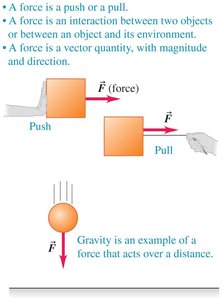
Dynamics is the branch of physics concerned with the study of forces and their effects on motion. A force is any interaction that, when unopposed, will change the motion of an object. Forces can be categorized as pushes or pulls, and they are vector quantities, possessing both magnitude and direction.
Contact forces: Forces that arise from physical contact between objects (e.g., friction, tension, normal force).
Action-at-a-distance forces: Forces that act without direct contact (e.g., gravity, electromagnetic force).
Types of Forces
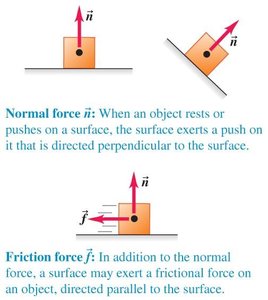
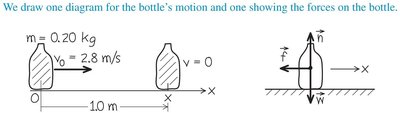
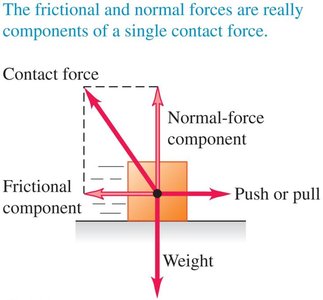
Normal force (\(\vec{n}\)): The perpendicular contact force exerted by a surface on an object resting on it.
Frictional force (\(\vec{f}\)): The force parallel to the surface that opposes the relative motion or tendency of such motion of two surfaces in contact.
Resolving Forces into Components
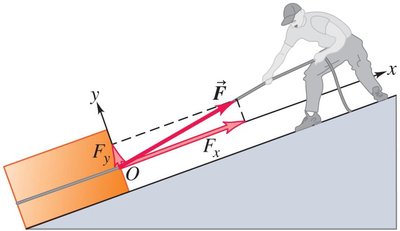
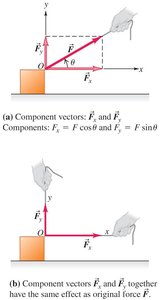
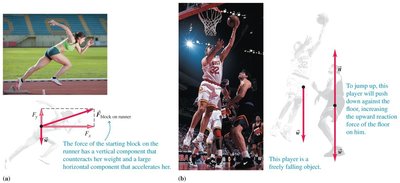
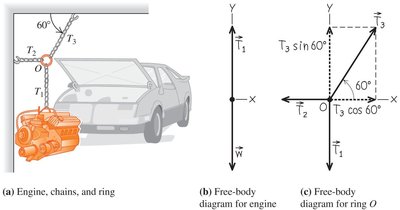
Forces can be resolved into perpendicular components, typically along the x- and y-axes. This is essential for analyzing forces acting at angles.
Given a force \(\vec{F}\) at an angle \(\theta\):
\(F_x = F \cos \theta\)
\(F_y = F \sin \theta\)
Superposition of Forces and Resultant Force
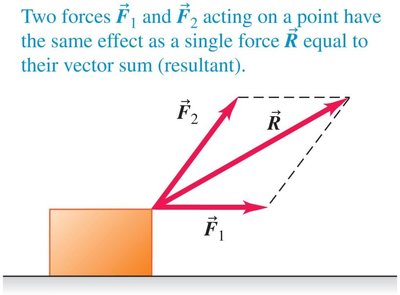
When multiple forces act on an object, the resultant force is the vector sum of all individual forces. This principle is known as the superposition of forces.
\(\vec{R} = \vec{F}_1 + \vec{F}_2 + \vec{F}_3 + \ldots\)
The magnitude of the resultant: \(R = \sqrt{R_x^2 + R_y^2}\)
Newton’s First Law of Motion (Law of Inertia)
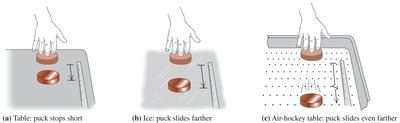
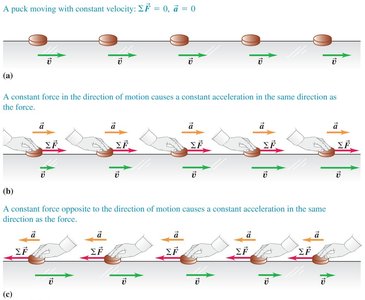
Newton’s First Law states that an object at rest remains at rest, and an object in motion continues in motion with constant velocity unless acted upon by a net external force. This property is called inertia.
Objects resist changes to their state of motion.
Friction is a common force that opposes motion and brings moving objects to rest.
Net Force and Equilibrium
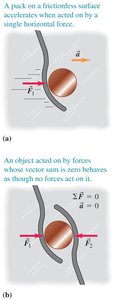
The effect of forces on an object depends on the net force. If the vector sum of all forces is zero, the object is in equilibrium and does not accelerate.
\(\sum \vec{F} = 0 \implies \vec{a} = 0\) (equilibrium)
\(\sum \vec{F} \neq 0 \implies \vec{a} \neq 0\) (acceleration)
Inertial and Non-inertial Reference Frames
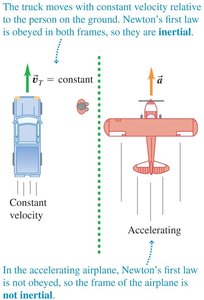
An inertial frame of reference is one in which Newton’s laws hold true. In non-inertial (accelerating) frames, fictitious forces appear to act on objects.
Newton’s Second Law of Motion
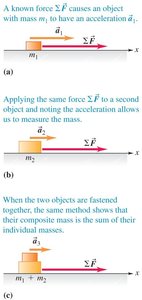
Newton’s Second Law quantifies the relationship between force, mass, and acceleration:
\(\sum \vec{F} = m \vec{a}\)
Force is measured in newtons (N): \(1\,\mathrm{N} = 1\,\mathrm{kg} \cdot 1\,\mathrm{m}/\mathrm{s}^2\)
Free-Body Diagrams
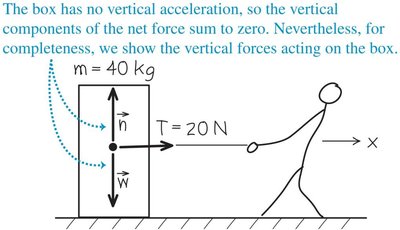
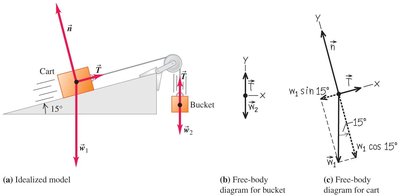
A free-body diagram is a graphical illustration used to visualize the forces acting on a single object. It is essential for solving problems involving forces and motion.
Identify all forces acting on the object (gravity, normal, friction, tension, etc.).
Represent each force as an arrow pointing in the direction of the force.
Mass and Weight
Mass is a measure of the amount of matter in an object, while weight is the force of gravity acting on that mass. Weight depends on the local gravitational acceleration (g).
\(w = m g\)
Mass is constant; weight varies with location (e.g., Earth vs. Moon).
Measurement of Mass
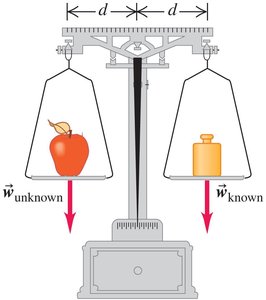
Mass can be measured by comparing the gravitational force on an unknown object to that on a standard mass using a balance.
Newton’s Third Law of Motion
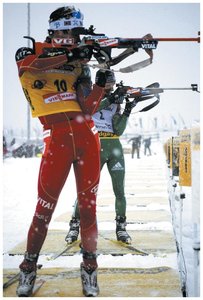
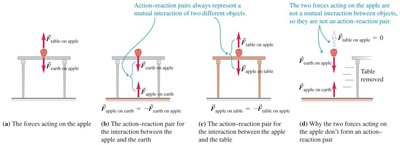
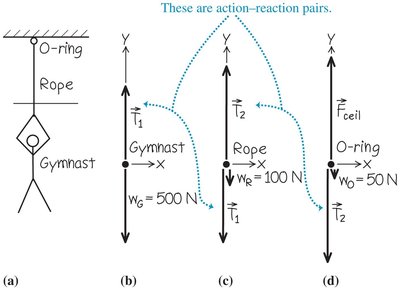
Newton’s Third Law states: For every action, there is an equal and opposite reaction. Forces always occur in pairs, acting on different objects.
Action-reaction pairs do not cancel because they act on different bodies.
Examples: Rifle recoil, walking, jumping.
Tension and Free-Body Diagrams in Complex Systems
For objects connected by ropes or cables, tension transmits force through the connecting medium. Free-body diagrams help analyze forces in such systems.
Chapter 5: Applications of Newton’s Laws
Equilibrium of a Particle
An object is in equilibrium if the net force acting on it is zero. This can occur at rest or at constant velocity.
\(\sum \vec{F} = 0\)
Component form: \(\sum F_x = 0\), \(\sum F_y = 0\)
Equilibrium in Two Dimensions
When forces act in more than one direction, resolve all forces into x and y components and set the sum of each to zero for equilibrium.
Systems of Connected Objects
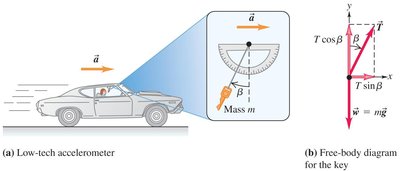
When analyzing systems with multiple objects (e.g., pulleys, carts, and buckets), draw separate free-body diagrams for each object and apply Newton’s laws to each.
Non-Equilibrium (Dynamic) Problems
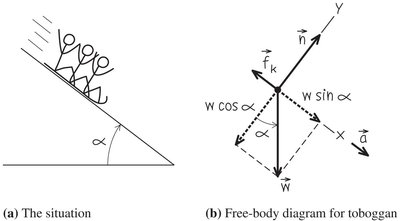
When the net force is not zero, objects accelerate according to Newton’s second law. Analyze all forces, resolve into components, and solve for acceleration.
Frictional Forces
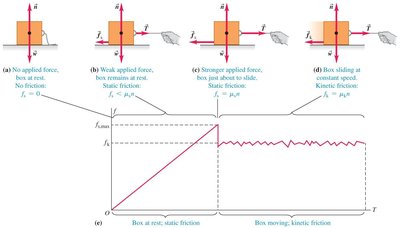
Friction opposes the relative motion of surfaces in contact. There are two main types:
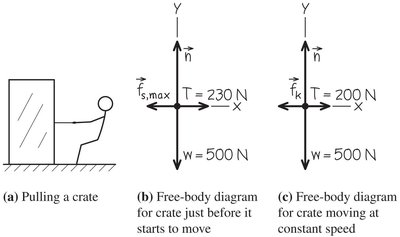
Static friction (\(f_s\)): Prevents motion up to a maximum value \(f_{s,\text{max}} = \mu_s n\).
Kinetic friction (\(f_k\)): Opposes motion once sliding begins, \(f_k = \mu_k n\).
\(\mu_s\) and \(\mu_k\) are the coefficients of static and kinetic friction, respectively.
Applications Involving Friction
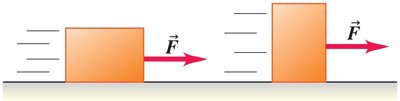
Frictional forces are included in free-body diagrams and affect the net force and resulting acceleration or equilibrium conditions.
Forces in Fluids (Drag Force)
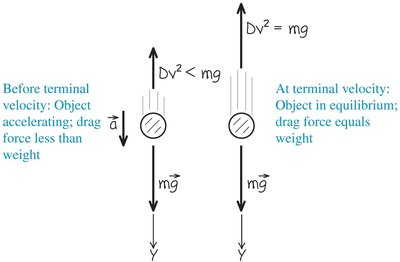
Objects moving through fluids experience a resistive force called drag. At terminal velocity, the drag force equals the weight, and the object moves at constant speed.
Elastic Forces and Hooke’s Law
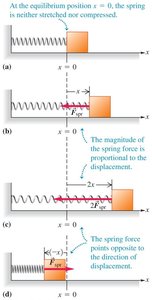
Elastic materials such as springs exert a restoring force when stretched or compressed. Hooke’s Law describes this force:
\(F_{\text{spring}} = -k \Delta L\)
Where \(k\) is the spring constant and \(\Delta L\) is the displacement from equilibrium.
Variety of Force Laws in Nature
In addition to contact forces, nature exhibits several fundamental interactions:
Gravitational
Electromagnetic
Strong nuclear
Weak nuclear
Physicists seek a unified field theory to explain all fundamental forces under a single framework.
