 뒤로
뒤로Oscillations and Waves: Study Notes for College Physics
스터디 가이드 - 스마트 노트
 자료에 맞춘 맞춤형 노트, 핵심 정의, 예시, 맥락을 확장해 제공합니다.
Wave Motion and Types of Waves
Introduction to Wave Motion
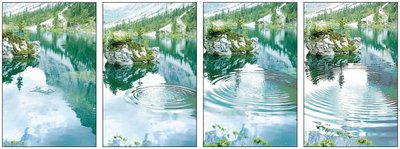
Waves are disturbances that transfer energy from one place to another without the permanent displacement of the medium's particles. The study of waves is fundamental in physics, as it explains phenomena in sound, light, and water waves.
Wave Propagation: A wave travels through a medium, but the individual particles of the medium oscillate around their equilibrium positions rather than moving with the wave.
Energy Transport: All types of traveling waves transport energy through the medium.
Wave Generation: A single pulse is initiated by a vibration and transmitted by internal forces in the medium. Continuous waves are generated by continuous vibrations, often simple harmonic motion (SHM), resulting in sinusoidal waves.
Wave Characteristics
Waves are described by several key characteristics that define their behavior and properties:
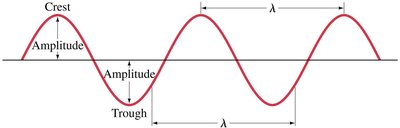
Amplitude (A): The maximum displacement from the equilibrium position.
Wavelength (\( \lambda \)): The distance between two consecutive points in phase (e.g., crest to crest or trough to trough).
Frequency (f): The number of cycles passing a point per second (measured in hertz, Hz).
Period (T): The time required for one complete cycle (\( T = 1/f \)).
Wave Velocity (v): The speed at which the wave propagates through the medium, given by \( v = \lambda f \).
Types of Waves
Transverse and Longitudinal Waves
Waves can be classified based on the direction of particle motion relative to the direction of wave propagation:
Transverse Waves: The particles of the medium move perpendicular to the direction of wave propagation (e.g., waves on a string, electromagnetic waves).
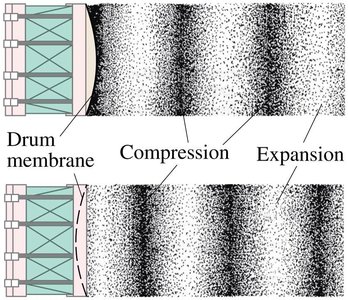
Longitudinal Waves: The particles move parallel to the direction of wave propagation (e.g., sound waves in air).
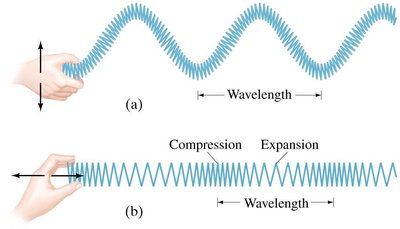
Example: Sound waves are longitudinal, while waves on a string are transverse.
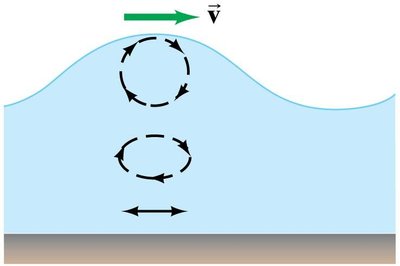
Surface Waves: These travel along the boundary between two media and combine both transverse and longitudinal motion.
Energy Transported by Waves
Wave Intensity and Energy
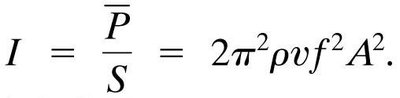
The energy transported by a wave is proportional to the square of its amplitude. The intensity of a wave is defined as the power transmitted per unit area:
Intensity (I): \( I = \frac{\overline{P}}{S} = 2\pi^2 \rho v f^2 A^2 \)
For spherical waves, intensity decreases with the square of the distance from the source: \( I \propto \frac{1}{r^2} \)

Reflection and Transmission of Waves
Reflection and Transmission at Boundaries
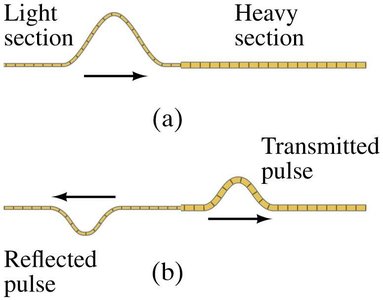
When a wave encounters a boundary between two media, part of the wave is reflected and part is transmitted. The behavior depends on the properties of the media:
If the wave reaches a free end, the reflection is upright.
If the wave hits a fixed end or a denser medium, the reflection is inverted.
The transmitted wave may have a different wavelength if the wave speed changes in the new medium.
Wave Fronts and Rays
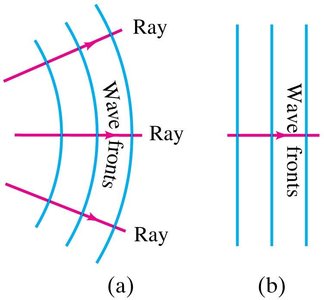
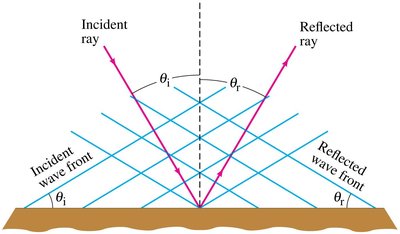
In two or three dimensions, waves can be represented by wave fronts (lines or surfaces of constant phase) and rays (perpendicular to wave fronts, indicating direction of propagation).
Law of Reflection
The law of reflection states that the angle of incidence equals the angle of reflection for wave fronts striking a boundary.
Interference and Superposition
Principle of Superposition
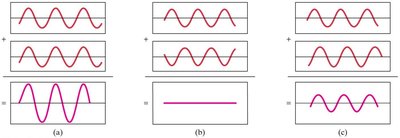
When two or more waves overlap in space, the resultant displacement at any point is the algebraic sum of the displacements due to each wave. This is known as the principle of superposition.
Constructive Interference: Occurs when waves add to produce a larger amplitude.
Destructive Interference: Occurs when waves add to produce a smaller (or zero) amplitude.
Summary Table: Key Properties of Waves
Property | Description | Formula |
|---|---|---|
Amplitude (A) | Maximum displacement from equilibrium | - |
Wavelength (\( \lambda \)) | Distance between successive crests or troughs | - |
Frequency (f) | Number of cycles per second | \( f = \frac{1}{T} \) |
Period (T) | Time for one complete cycle | \( T = \frac{1}{f} \) |
Wave Velocity (v) | Speed of wave propagation | \( v = \lambda f \) |
Intensity (I) | Power per unit area | \( I = 2\pi^2 \rho v f^2 A^2 \) |
Additional info:
Standing waves, resonance, refraction, and diffraction are also important wave phenomena, but are not detailed here.
For more advanced study, see mathematical representations of traveling waves and the analysis of wave equations.
