 뒤로
뒤로Physics 251 Exam 1 – Step-by-Step Study Guidance
스터디 가이드 - 스마트 노트
 자료에 맞춘 맞춤형 노트, 핵심 정의, 예시, 맥락을 확장해 제공합니다.
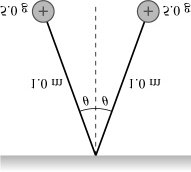
Q1. Two tiny 5.0-g spheres are suspended from 1.0-m-long threads. After being charged to +91 nC, they repel each other and hang at rest, forming an angle θ with the vertical. What is the angle θ?
Background
Topic: Electrostatics – Forces and Equilibrium
This question tests your understanding of the equilibrium of forces on charged objects, including gravitational, tension, and electrostatic forces.
Key Terms and Formulas
Electrostatic Force:
Gravitational Force:
Tension in the thread (T)
Equilibrium: The sum of forces in both x and y directions must be zero.
Geometry: The distance between the spheres can be related to the angle θ and the length of the threads.
Step-by-Step Guidance
Draw a free-body diagram for one sphere, showing the forces: tension (T), gravity (mg), and the electrostatic repulsion ().
Express the horizontal (x) and vertical (y) components of the tension force in terms of θ.
Set up the equilibrium equations: In the vertical direction, . In the horizontal direction, .
Express the electrostatic force using the charges and the distance between the spheres. The distance between the spheres is , where is the length of the thread.
Combine the equations to eliminate T and solve for θ. Set up the equation but stop before plugging in the numbers.
Try solving on your own before revealing the answer!
Final Answer: 4.1°
Using the equilibrium equations and substituting the values, you find that .
This small angle results from the balance between the relatively weak electrostatic repulsion and the weight of the spheres.
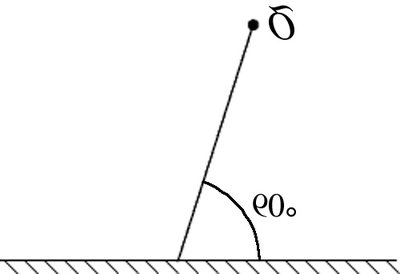
Q2. A point charge Q of mass 8.50 g hangs from a 25.0-cm thread. When a horizontal electric field of 1750 N/C is applied, the charge hangs at an angle. What is the magnitude of Q?
Background
Topic: Forces on Charges in Electric Fields
This question tests your ability to analyze the equilibrium of a charged object in a gravitational field and an external electric field.
Key Terms and Formulas
Electric Force:
Gravitational Force:
Tension in the thread (T)
Equilibrium: The sum of forces in both x and y directions must be zero.
Step-by-Step Guidance
Draw a free-body diagram for the charge, showing the forces: tension (T), gravity (mg), and electric force ().
Write the equilibrium equations: (vertical), (horizontal).
Divide the horizontal equation by the vertical equation to eliminate T: .
Rearrange to solve for Q: .
Set up the equation with the given values, but do not calculate the final value yet.
Try solving on your own before revealing the answer!
Final Answer: 27.5 µC
Plugging in the values for mass, gravity, electric field, and the angle, you find .
This shows how the equilibrium angle depends on the balance of electric and gravitational forces.
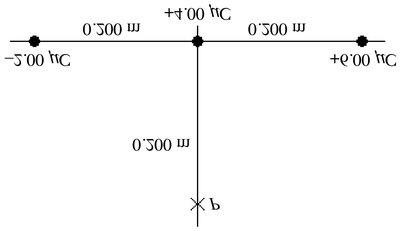
Q3. Three point charges of -2.00 µC, +4.00 µC, and +6.00 µC are placed along the x-axis. What is the electric potential at point P (relative to infinity) due to these charges?
Background
Topic: Electric Potential Due to Point Charges
This question tests your ability to calculate the electric potential at a point due to multiple point charges.
Key Terms and Formulas
Electric Potential from a Point Charge:
Superposition Principle: The total potential is the sum of the potentials from each charge.
k (Coulomb's constant):
Step-by-Step Guidance
Identify the distances from each charge to point P using the diagram.
Write the expression for the potential at P due to each charge: .
Add the potentials from all three charges to get the total potential at P.
Set up the sum with the correct signs and distances, but do not compute the final value yet.
Try solving on your own before revealing the answer!
Final Answer: +307 kV
After summing the contributions from each charge, the total potential at P is .
This positive value indicates that the positive charges dominate the potential at point P.
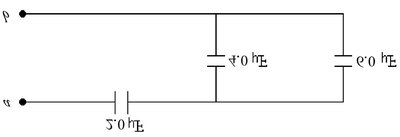
Q4. Three capacitors are connected as shown. What is the equivalent capacitance between points a and b?
Background
Topic: Equivalent Capacitance in Series and Parallel Circuits
This question tests your ability to combine capacitors in series and parallel to find the total (equivalent) capacitance.
Key Terms and Formulas
Capacitors in Series:
Capacitors in Parallel:
Step-by-Step Guidance
Identify which capacitors are in series and which are in parallel from the diagram.
Combine the parallel capacitors first, if any.
Then, combine the result with any series capacitors to find the total equivalent capacitance.
Set up the equations for each step, but do not calculate the final value yet.
Try solving on your own before revealing the answer!
Final Answer: 1.7 µF
After combining the capacitors using the correct series and parallel rules, the equivalent capacitance is .
This is less than any individual capacitor, as expected for a series-parallel combination.
Q5. An electric furnace consumes 24 kW when connected to a 240-V line. What is the resistance of the furnace?
Background
Topic: Electric Power and Resistance
This question tests your understanding of the relationship between power, voltage, and resistance in electric circuits.
Key Terms and Formulas
Power:
Alternatively, and
Step-by-Step Guidance
Write the formula relating power, voltage, and resistance: .
Rearrange the formula to solve for resistance: .
Substitute the given values for voltage and power, but do not calculate the final value yet.
Try solving on your own before revealing the answer!
Final Answer: 2.4 Ω
Plugging in the values, the resistance of the furnace is .
This is a typical value for a high-power heating element.
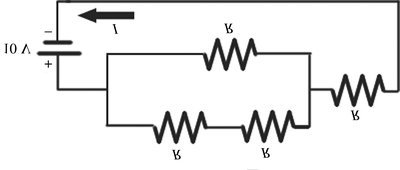
Q6. Four identical resistors are connected to a 10 V battery as shown. The total current is 0.20 A. What is the value of each resistor R?
Background
Topic: Series and Parallel Resistors, Ohm's Law
This question tests your ability to analyze a resistor network and use Ohm's Law to find unknown resistance.
Key Terms and Formulas
Ohm's Law:
Equivalent Resistance for Series:
Equivalent Resistance for Parallel:
Step-by-Step Guidance
Analyze the circuit to determine how the resistors are connected (series/parallel).
Calculate the equivalent resistance using the total voltage and current: .
Set up the equation relating to the individual resistor value R, but do not solve for R yet.
Try solving on your own before revealing the answer!
Final Answer: 30 Ω
After analyzing the circuit and solving for R, each resistor has a value of .
This matches the total current and voltage given in the problem.
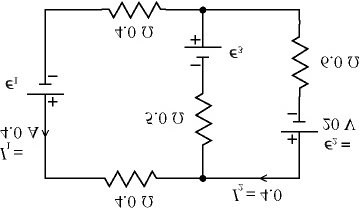
Q7. Consider the circuit shown. Calculate the emfs ε1 and ε3.
Background
Topic: Kirchhoff's Rules for Multi-Loop Circuits
This question tests your ability to apply Kirchhoff's loop and junction rules to solve for unknown emfs in a complex circuit.
Key Terms and Formulas
Kirchhoff's Loop Rule: The sum of the potential differences around any closed loop is zero.
Ohm's Law:
Step-by-Step Guidance
Label all currents and assign directions (already done in the diagram).
Write Kirchhoff's loop equations for each independent loop in the circuit.
Express the voltage drops across each resistor using Ohm's Law.
Set up the system of equations to solve for the unknown emfs, but do not solve for their values yet.
Try solving on your own before revealing the answer!
Final Answer: ε1 = 28 V, ε3 = 44 V
By solving the system of equations from Kirchhoff's rules, you find and .
This demonstrates the power of Kirchhoff's rules for analyzing complex circuits.
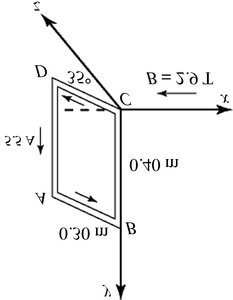
Q8. A rigid rectangular loop (0.30 m × 0.40 m) carries a current of 5.5 A. A uniform external magnetic field of 2.9 T in the negative x direction is present. Segment CD is in the xz-plane and forms a 35° angle with the z-axis. Find the magnitude of the external torque needed to keep the loop in static equilibrium.
Background
Topic: Torque on a Current Loop in a Magnetic Field
This question tests your understanding of the torque experienced by a current-carrying loop in a magnetic field.
Key Terms and Formulas
Magnetic Moment:
Torque:
Area of rectangle:
Step-by-Step Guidance
Calculate the area of the loop using its dimensions.
Find the magnetic moment using the current and area.
Set up the torque equation using the given angle and magnetic field.
Substitute the known values, but do not compute the final torque yet.
Try solving on your own before revealing the answer!
Final Answer: 1.1 N·m
After substituting all values, the required torque is .
This torque balances the magnetic torque to keep the loop in equilibrium.
Q9. A circular loop of radius 0.10 m is rotating in a uniform external magnetic field of 0.20 T. Find the magnetic flux through the loop due to the external field when the plane of the loop and the magnetic field vector are (a) parallel, (b) perpendicular, (c) at an angle of 30° with each other.
Background
Topic: Magnetic Flux
This question tests your understanding of how to calculate magnetic flux through a loop for different orientations.
Key Terms and Formulas
Magnetic Flux:
Area of a circle:
θ is the angle between the magnetic field and the normal to the plane of the loop.
Step-by-Step Guidance
Calculate the area of the loop using its radius.
For each case, determine the correct value of based on the orientation.
Set up the flux equation for each scenario, but do not compute the final values yet.
Try solving on your own before revealing the answer!
Final Answer:
(a) Zero
(b)
(c)
The flux depends on the cosine of the angle between the field and the normal to the loop.
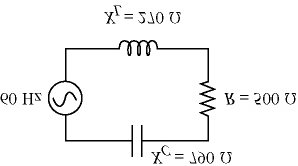
Q10. The 60-Hz ac source of the series circuit shown has a voltage amplitude of 120 V. The capacitive reactance is 790 Ω, the inductive reactance is 270 Ω, and the resistance is 500 Ω. (a) What is the capacitance of the capacitor? (b) What is the inductance of the inductor?
Background
Topic: AC Circuits – Reactance and Impedance
This question tests your ability to relate reactance to capacitance and inductance in an AC circuit.
Key Terms and Formulas
Capacitive Reactance:
Inductive Reactance:
Frequency: Hz
Step-by-Step Guidance
For the capacitor, rearrange the formula for to solve for .
For the inductor, rearrange the formula for to solve for .
Substitute the given values for reactance and frequency, but do not calculate the final values yet.
Try solving on your own before revealing the answer!
Final Answer:
(a)
(b)
These values are found by solving the reactance formulas for C and L using the given frequency and reactances.
