뒤로
뒤로Physics I: Core Topics Overview and Chapter Structure
스터디 가이드 - 스마트 노트
 자료에 맞춘 맞춤형 노트, 핵심 정의, 예시, 맥락을 확장해 제공합니다.
Physics I: Core Topics Overview
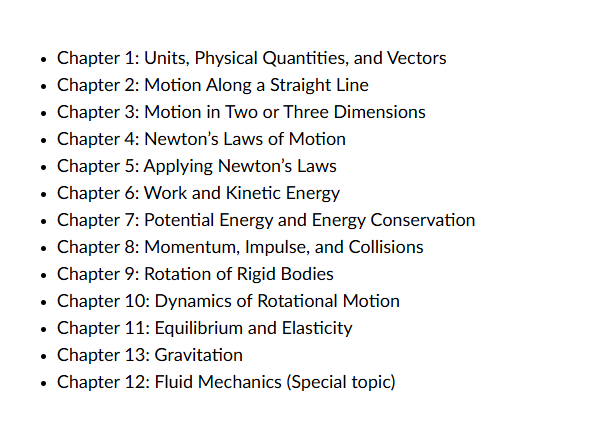
This document outlines the foundational chapters typically covered in a college-level introductory physics course. Each chapter addresses a major area of classical mechanics and related physical principles, providing a structured pathway for systematic study and mastery of the subject.
Chapter Structure and Main Topics
Chapter 1: Units, Physical Quantities, and Vectors
Introduction to the International System of Units (SI)
Measurement and estimation of physical quantities
Vector and scalar quantities; vector operations
Chapter 2: Motion Along a Straight Line
Kinematics in one dimension
Displacement, velocity, and acceleration
Equations of motion for constant acceleration
Chapter 3: Motion in Two or Three Dimensions
Vector description of motion
Projectile and circular motion
Relative velocity
Chapter 4: Newton's Laws of Motion
Newton's three laws and their applications
Concepts of force, mass, and inertia
Chapter 5: Applying Newton's Laws
Friction, drag, and tension
Dynamics of systems of particles
Chapter 6: Work and Kinetic Energy
Definition of work
Kinetic energy and the work-energy theorem
Chapter 7: Potential Energy and Energy Conservation
Potential energy (gravitational, elastic, etc.)
Conservation of mechanical energy
Chapter 8: Momentum, Impulse, and Collisions
Linear momentum and impulse
Conservation of momentum
Elastic and inelastic collisions
Chapter 9: Rotation of Rigid Bodies
Rotational kinematics and dynamics
Moment of inertia
Chapter 10: Dynamics of Rotational Motion
Torque and angular acceleration
Rotational analogs of Newton's laws
Chapter 11: Equilibrium and Elasticity
Conditions for static equilibrium
Elastic properties of materials
Chapter 12: Fluid Mechanics (Special topic)
Properties of fluids
Buoyancy, pressure, and fluid dynamics
Chapter 13: Gravitation
Newton's law of universal gravitation
Gravitational potential energy
Orbits and planetary motion
How to Use This Syllabus
Each chapter should be studied sequentially, as concepts often build upon one another. Mastery of these topics provides a strong foundation for further studies in physics and engineering.