 뒤로
뒤로Physics I: Units, Physical Quantities & Vectors – Mini Study Guide
스터디 가이드 - 스마트 노트
 자료에 맞춘 맞춤형 노트, 핵심 정의, 예시, 맥락을 확장해 제공합니다.
Algebra and Mathematical Foundations for Physics
Simplifying Algebraic Expressions
Algebraic manipulation is essential for solving physics equations. Simplifying expressions involves reducing the number of terms and combining like terms.
Distribute constants/variables into parentheses.
Group like terms together.
Combine like terms by addition or subtraction.
Example: $2x + 3 + 4(x + 2) = 4x + 6 - 3(x + 2)$ simplifies to $x$ terms and constants.
Exponents in Expressions
Exponents represent repeated multiplication. Understanding exponent rules is crucial for manipulating physical equations.
Product Rule: $a^m \times a^n = a^{m+n}$
Quotient Rule: $a^m / a^n = a^{m-n}$
Zero Exponent: $a^0 = 1$
Negative Exponent: $a^{-n} = 1/a^n$
Power Rule: $(a^m)^n = a^{m \cdot n}$
Power of a Product: $(ab)^n = a^n b^n$
Power of a Quotient: $(a/b)^n = a^n / b^n$
Solving Equations
Solving for unknowns in physics often requires algebraic manipulation.
Apply operations to both sides of the equation.
Isolate the variable of interest.
Check the solution by substitution.
Graphing Equations
Graphing is used to visualize relationships between variables. In physics, plotting points on a 2D coordinate system is common.
Isolate $y$ in terms of $x$.
Calculate $y$ for several $x$ values.
Plot $(x, y)$ pairs and connect with a line or curve.
Trigonometry in Physics
Right Triangle Relationships
Trigonometric functions relate angles and sides in right triangles, which are fundamental for vector analysis.
Sine: $\sin(\theta) = \text{opposite} / \text{hypotenuse}$
Cosine: $\cos(\theta) = \text{adjacent} / \text{hypotenuse}$
Tangent: $\tan(\theta) = \text{opposite} / \text{adjacent}$
Pythagorean Theorem: $a^2 + b^2 = c^2$
Calculus in Physics
Derivatives
The derivative represents the instantaneous rate of change, often used for velocity and acceleration.
$f(x) = c \rightarrow f'(x) = 0$
$f(x) = cx \rightarrow f'(x) = c$
$f(x) = x^n \rightarrow f'(x) = n x^{n-1}$
$f(x) = g(x) + h(x) \rightarrow f'(x) = g'(x) + h'(x)$
Integrals
The integral is the area under a curve, used for calculating quantities like displacement from velocity.
$\int c dx = cx + C$
$\int x^n dx = \frac{x^{n+1}}{n+1} + C$
$\int [g(x) + h(x)] dx = G(x) + H(x) + C$
Definite Integral: $\int_a^b f(x) dx = F(b) - F(a)$
Units, Physical Quantities, and the S.I. System
Physical Quantities and Units
Physics measures quantities such as mass, length, and time, which must be expressed in compatible units.
S.I. Units: Standard units used in physics (kilogram, meter, second, newton).
Imperial Units: Used in some countries (pound, foot, second).
Example: Force $F = m \cdot a$; $[N] = [kg] \cdot [m/s^2]$
Metric Prefixes
Metric prefixes denote powers of ten for base units.
Common Prefixes: kilo- ($10^3$), centi- ($10^{-2}$), milli- ($10^{-3}$), micro- ($10^{-6}$), mega- ($10^6$), etc.
Shifting from larger to smaller units increases the numerical value; shifting from smaller to larger decreases it.
Prefix | Symbol | Factor |
|---|---|---|
kilo- | k | $10^3$ |
centi- | c | $10^{-2}$ |
milli- | m | $10^{-3}$ |
micro- | μ | $10^{-6}$ |
mega- | M | $10^6$ |
Scientific Notation
Scientific notation is used to express very large or small numbers in a compact form.
Standard form: $A \times 10^B$ where $1 \leq A < 10$
Example: $5,972,000,000,000,000,000,000,000$ kg $= 5.97 \times 10^{24}$ kg
Unit Conversions
Converting units is essential for ensuring equations are dimensionally consistent.
Use conversion factors to cancel units.
Multiply conversion factors as many times as the exponent requires.
Quantity | Conversion Factor |
|---|---|
Mass | 1 kg = 2.2 lbs |
Length | 1 ft = 0.305 m |
Volume | 1 gal = 3.79 L |
Density and Dimensional Analysis
Density
Density is mass divided by volume, a key concept in material science and mechanics.
$\rho = \frac{m}{V}$
Volume formulas: Prism $V = l \cdot w \cdot h$, Sphere $V = \frac{4}{3}\pi R^3$, Cylinder $V = \pi R^2 h$
Dimensional Analysis
Dimensional analysis checks the consistency of units in equations and helps determine unknown units.
Replace variables with units, ignore numbers, and check if both sides match.
Example: Hooke's Law $F = kx$; units of $k$ are $[N/m]$.
Significant Figures
Counting Significant Figures
Significant figures indicate the precision of measurements.
Eliminate leading zeros.
Trailing zeros are only significant if there is a decimal point.
Count all non-zero digits and middle zeros.
Math with Significant Figures
Add/Subtract: Round to the least number of decimal places.
Multiply/Divide: Round to the least number of significant figures.
Vectors and Scalars
Introduction to Vectors and Scalars
Physical quantities may have magnitude only (scalars) or magnitude and direction (vectors).
Scalar: Mass, time, temperature.
Vector: Force, displacement, velocity.
Displacement vs. Distance
Distance is the total length traveled (scalar), while displacement is the change in position (vector).
Distance: Always positive.
Displacement: Can be positive or negative, depending on direction.
Vector Math and Addition
Vectors are added graphically (tip-to-tail) or by components. The resultant vector is the shortest path from start to end.
Order does not matter for addition (commutative).
Subtracting vectors involves reversing direction.
Vector Composition and Decomposition
Vectors can be decomposed into components or composed from components.
$A_x = A \cos(\theta)$
$A_y = A \sin(\theta)$
$A = \sqrt{A_x^2 + A_y^2}$
$\theta = \tan^{-1}(A_y/A_x)$
Unit Vectors
Unit vectors ($\hat{i}$, $\hat{j}$, $\hat{k}$) represent directions along the x, y, and z axes, respectively.
Vector addition: $\vec{A} = A_x \hat{i} + A_y \hat{j}$
Dot Product and Cross Product
Dot Product (Scalar Product)
The dot product of two vectors yields a scalar and measures the parallel component.
$\vec{A} \cdot \vec{B} = |A||B|\cos\theta$
Using components: $\vec{A} \cdot \vec{B} = A_x B_x + A_y B_y + A_z B_z$
Cross Product (Vector Product)
The cross product yields a vector perpendicular to both original vectors, with direction given by the right-hand rule.
$|\vec{C}| = |\vec{A} \times \vec{B}| = |A||B|\sin\theta$
Component form: $\vec{A} \times \vec{B} = (A_y B_z - A_z B_y) \hat{i} + (A_z B_x - A_x B_z) \hat{j} + (A_x B_y - A_y B_x) \hat{k}$
Vector Products Using Components
Cross products can be calculated using unit vector components, following the determinant method.
Build a table of x, y, z components.
Apply the formula for each component.
Practice and Application
Throughout the notes, practice problems reinforce concepts such as unit conversions, density calculations, vector addition, and dot/cross products.
Relevant Images
Metric Ruler (Measurement Example)
Measurement tools such as metric rulers are used to determine length in millimeters, a fundamental physical quantity.

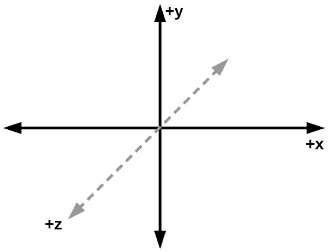
3D Coordinate Axes (Vector Direction Example)
Vectors in physics are often represented in a 3D coordinate system, with axes labeled +x, +y, and +z. This is essential for understanding vector products and directions.
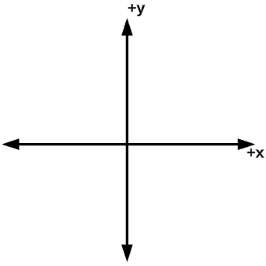
2D Coordinate Axes (Vector Addition Example)
Vector addition and decomposition are commonly performed in a 2D coordinate system, with axes labeled +x and +y.
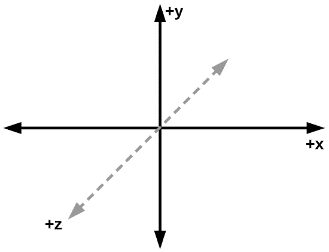
3D Coordinate Axes (Cross Product Direction Example)
The cross product of two vectors results in a vector perpendicular to both, often visualized in a 3D coordinate system.
Additional info: These notes expand on brief points and fill in academic context for completeness, including formulas, definitions, and examples. Only images directly relevant to measurement and vector direction are included.
