 뒤로
뒤로Physics Study Guide: Gravitation, Friction, and Orbits
스터디 가이드 - 스마트 노트
 자료에 맞춘 맞춤형 노트, 핵심 정의, 예시, 맥락을 확장해 제공합니다.
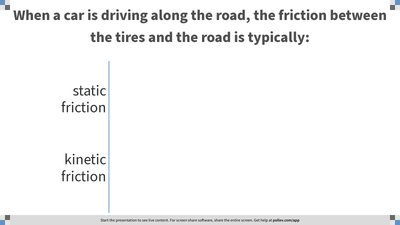
Q1. When a car is driving along the road, the friction between the tires and the road is typically:
Background
Topic: Friction in Physics
This question tests your understanding of the types of friction (static and kinetic) that act between a car's tires and the road while driving.
Key Terms:
Static friction: The force that prevents relative motion between two surfaces in contact when no motion occurs.
Kinetic friction: The force that opposes the motion of two surfaces sliding past each other.
Step-by-Step Guidance
Consider what happens when a car is moving forward without skidding. The tires are rolling, not sliding.
Recall that static friction acts when there is no relative motion between the surfaces (the tire and the road), while kinetic friction acts when there is sliding.
Think about which type of friction is stronger and more desirable for safe driving.
Set up your answer by identifying which frictional force is typically present when the car is not skidding.
Try solving on your own before revealing the answer!
Final Answer: Static friction
When a car is driving along the road without skidding, the friction between the tires and the road is typically static friction. This is because the tires are rolling and not sliding, so there is no relative motion at the contact point.
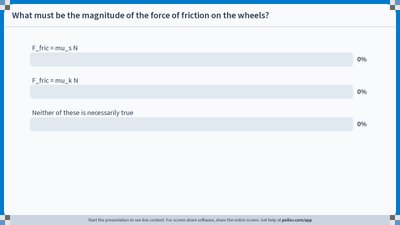
Q2. What must be the magnitude of the force of friction on the wheels?
Background
Topic: Frictional Forces and Circular Motion
This question tests your understanding of how frictional forces are calculated and their relationship to the normal force, especially in the context of a car rounding a curve.
Key Terms and Formulas:
(static friction)
(kinetic friction)
= normal force
= coefficient of static friction
= coefficient of kinetic friction
Step-by-Step Guidance
Identify whether the tires are slipping or not. If the car is not skidding, the friction is static.
Recall the formulas for static and kinetic friction: and .
Consider whether the magnitude of the frictional force must always equal one of these expressions, or if it can be less.
Set up your reasoning for which formula applies in the context of a car rounding a curve without skidding.
Try solving on your own before revealing the answer!
Final Answer: Neither of these is necessarily true
The magnitude of the frictional force on the wheels does not have to be exactly or ; it can be less than these maximum values. The actual frictional force depends on the requirements for centripetal force and whether the tires are slipping.
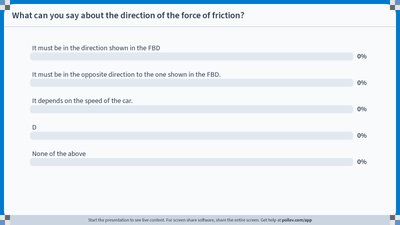
Q3. What can you say about the direction of the force of friction?
Background
Topic: Direction of Frictional Forces in Circular Motion
This question tests your understanding of how the direction of frictional force can change depending on the speed of a car rounding a banked curve.
Key Terms:
Free-body diagram (FBD): A diagram showing all forces acting on an object.
Banked curve: A curve in the road that is tilted to help vehicles turn safely.
Frictional force direction: Can point up or down the bank depending on the car's speed.
Step-by-Step Guidance
Examine the free-body diagram and note the direction of the frictional force shown.
Recall that the direction of friction depends on whether the car's speed is above or below the ideal speed for the banked curve.
Think about how friction acts to prevent slipping: it can point up the bank (if the car is moving too slowly) or down the bank (if the car is moving too fast).
Set up your answer by considering how the direction of friction changes with speed.
Try solving on your own before revealing the answer!
Final Answer: It depends on the speed of the car
The direction of the force of friction depends on the speed of the car. If the car is going slower than the ideal speed, friction points up the bank; if faster, it points down the bank.
