뒤로
뒤로Physics Syllabus Overview: Kinematics, Kinetics, Work, Energy, and Vibration
스터디 가이드 - 스마트 노트
 자료에 맞춘 맞춤형 노트, 핵심 정의, 예시, 맥락을 확장해 제공합니다.
Course Syllabus Overview
This syllabus outlines the main topics and assessment structure for a college-level Physics course focusing on the mechanics of particles and rigid bodies. The course covers foundational concepts such as kinematics, kinetics, work, energy, impulse, momentum, and vibration, with a clear division between particle and rigid body mechanics.
Course Structure and Topics
Weeks 1–4: Particle Mechanics
Kinematics of a Particle: Study of motion without considering forces. Key equations describe displacement, velocity, and acceleration as functions of time.
Kinetics of a Particle: Analysis of forces and their effects on particle motion, including Newton's laws of motion.
Work and Energy: Exploration of the work-energy principle, kinetic and potential energy, and conservation of energy.
Impulse and Momentum: Examination of momentum, impulse, and their conservation in collisions and other interactions.
Week 5: TEST 1 (25%)
Weeks 6–10: Rigid Body Mechanics
Vector Kinematics and Kinetics: Extension of kinematics and kinetics to rigid bodies, including rotational motion and vector analysis.
Planar Kinetics: Study of forces and motion in two-dimensional systems involving rigid bodies.
Work and Energy/Impulse and Momentum (Rigid Body): Application of work-energy and impulse-momentum principles to rigid bodies.
Vibration: Introduction to oscillatory motion, simple harmonic motion, and vibration analysis.
Week 11: TEST 2 (25%)
Weeks 12–13: Revision and Swotvac
Exam Period: Final Exam (50%)
Assessment Structure
Assessment | Weight |
|---|---|
Test 1 | 25% |
Test 2 | 25% |
Final Exam | 50% |
Topic Breakdown by Week
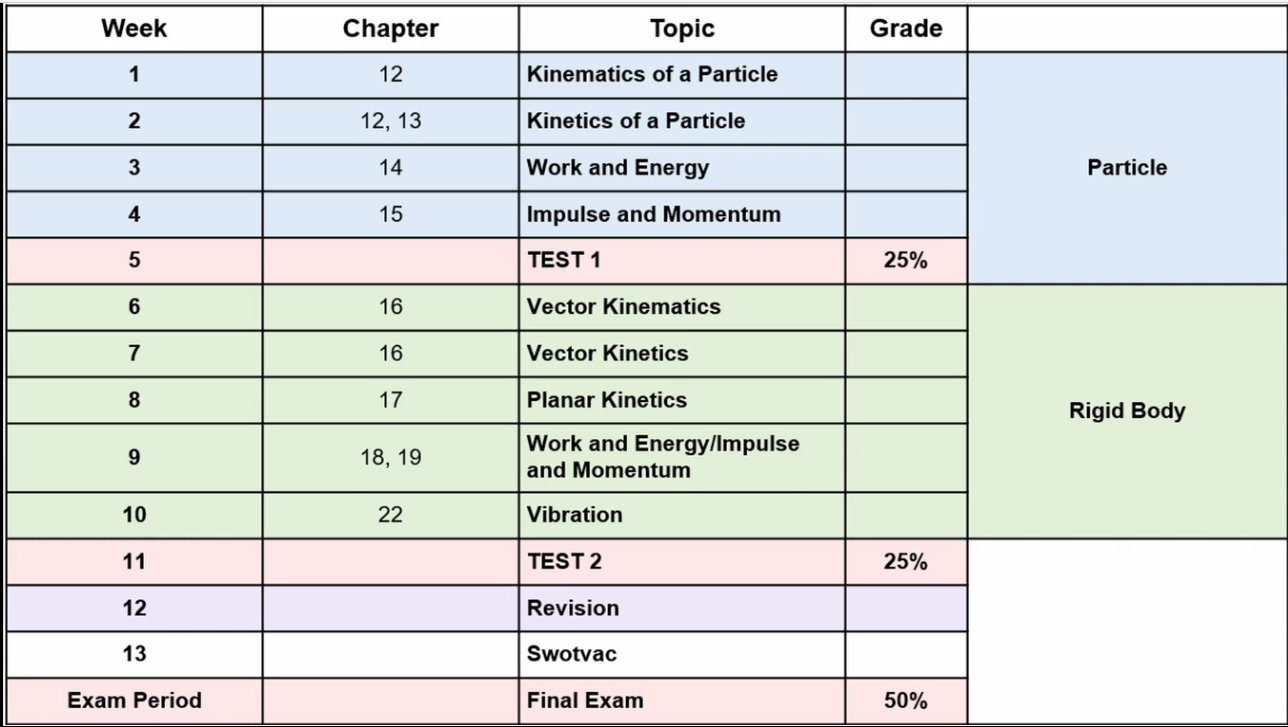
Week | Chapter | Topic | Grade |
|---|---|---|---|
1 | 12 | Kinematics of a Particle | |
2 | 12, 13 | Kinetics of a Particle | |
3 | 14 | Work and Energy | |
4 | 15 | Impulse and Momentum | |
5 | TEST 1 | 25% | |
6 | 16 | Vector Kinematics | |
7 | 16 | Vector Kinetics | |
8 | 17 | Planar Kinetics | |
9 | 18, 19 | Work and Energy/Impulse and Momentum | |
10 | 22 | Vibration | |
11 | TEST 2 | 25% | |
12 | Revision | ||
13 | Swotvac | ||
Exam Period | Final Exam | 50% |
Key Physics Concepts Covered
Kinematics: Describes motion using displacement, velocity, and acceleration.
Kinetics: Explains motion by analyzing forces and Newton's laws.
Work and Energy: Involves the calculation of work done by forces and the principles of energy conservation.
Work:
Kinetic Energy:
Potential Energy: (for gravitational potential energy)
Work-Energy Principle:
Impulse and Momentum: Focuses on the change in momentum due to forces over time.
Momentum:
Impulse:
Impulse-Momentum Theorem:
Rigid Body Mechanics: Extends particle mechanics to objects with size and shape, including rotational motion and planar kinetics.
Vibration: Introduces oscillatory motion, such as simple harmonic motion.
Simple Harmonic Motion:
Angular Frequency:
Course Preparation and Study Tips
Review lecture notes and textbook chapters before each week.
Practice solving problems related to each topic, especially those involving calculations and conceptual understanding.
Use the revision and Swotvac weeks to consolidate knowledge and address any weak areas.
Prepare thoroughly for tests and the final exam, as they constitute the majority of the course grade.