 뒤로
뒤로Properties of Fluids: Volume, Density, Pressure, and Buoyancy
스터디 가이드 - 스마트 노트
 자료에 맞춘 맞춤형 노트, 핵심 정의, 예시, 맥락을 확장해 제공합니다.
Properties of Fluids
Definition and Types of Fluids
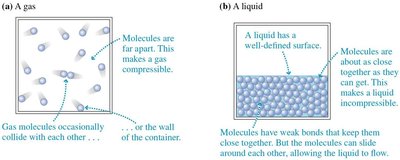
Fluids are substances that can flow, including both liquids and gases. The molecular arrangement and interactions in fluids determine their physical properties such as compressibility and flow behavior.
Liquids are essentially incompressible because their molecules are closely packed together.
Gases are compressible due to the significant empty space between molecules.
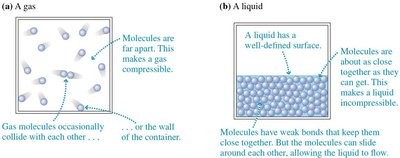
Additional info: The ability of molecules to move past each other allows both liquids and gases to flow, but the degree of compressibility distinguishes them.
Volume and Density
Volume
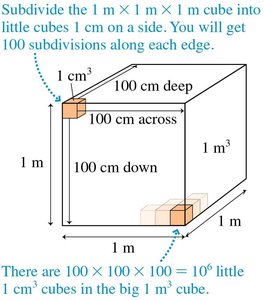
Volume is the amount of space a system occupies. The SI unit for volume is the cubic meter (m3), but cubic centimeters (cm3) are also commonly used for smaller quantities.
Density
Density (ρ) is defined as the mass per unit volume of a substance:
SI units: kg/m3
Common alternative: g/cm3
Density is an intrinsic property of a material and does not depend on the size or shape of the sample.
Example: Density of Broken Pieces
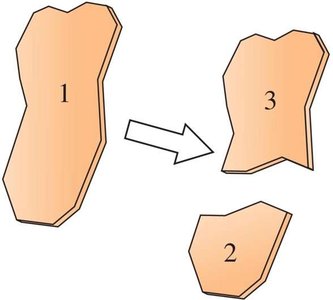
If a piece of glass is broken into two pieces, the density of each piece remains the same as the original, since density is a property of the material itself, not the amount present.
Pressure in Fluids
Definition of Pressure
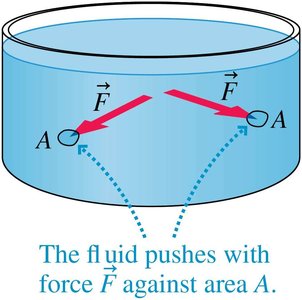
Pressure (p) is the ratio of force to the area over which the force is applied:
SI unit: pascal (Pa), where 1 Pa = 1 N/m2
Pressure is a scalar quantity and acts perpendicular to surfaces.
Pressure in Liquids and Gases
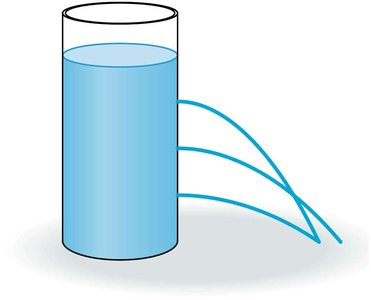
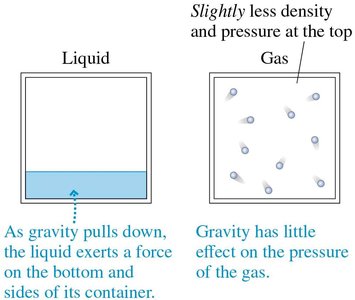
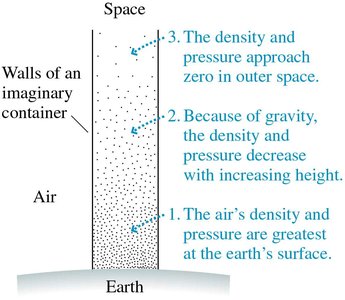
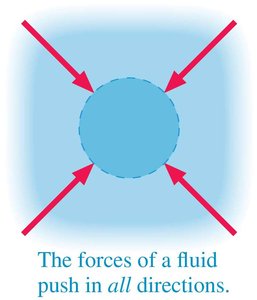
Pressure exists at all points within a fluid, not just at the container walls. In liquids, pressure increases with depth due to gravity, while in gases, pressure is nearly uniform unless affected by gravity over large distances.
Causes of Pressure
Gravitational contribution: Gravity pulls down on the fluid, increasing pressure with depth.
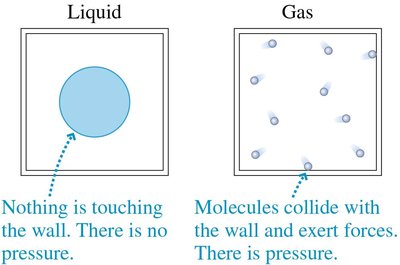
Thermal contribution: Collisions of molecules with container walls create pressure, especially in gases.
Atmospheric Pressure
Atmospheric pressure decreases with altitude. At sea level, the standard atmospheric pressure is:
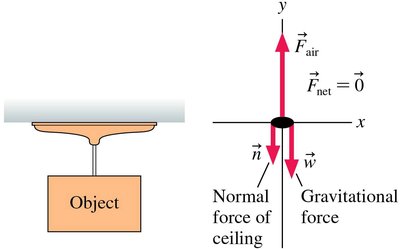
Example: Suction Cup and Air Pressure
A suction cup sticks to a ceiling due to the pressure difference between the vacuum inside the cup and the atmospheric pressure outside. The maximum force the air can exert is:
Pressure in Liquids: Hydrostatics
Hydrostatic Pressure
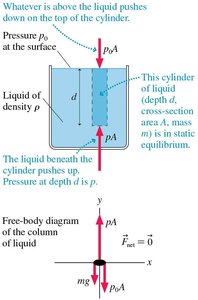
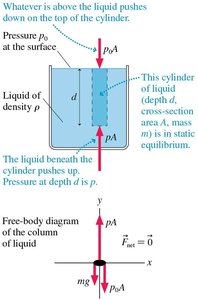
The pressure at a depth d in a liquid of density ρ is given by:
p0: Pressure at the surface
g: Acceleration due to gravity
d: Depth below the surface
Hydrostatic Equilibrium
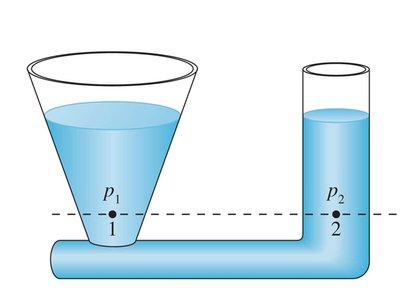
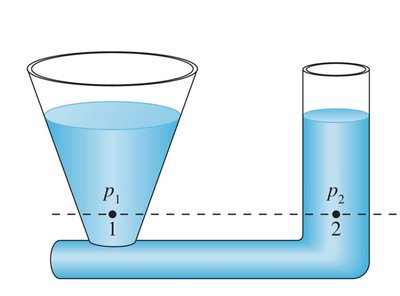
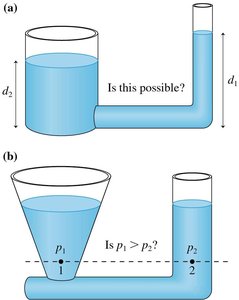
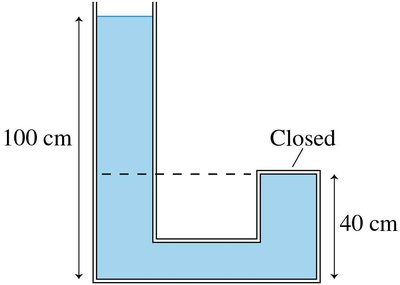
In a connected liquid at rest, the pressure is the same at all points on a horizontal line. This principle is used in manometers and other fluid measurement devices.
Example: Pressure in a Closed Tube
In a closed tube filled with liquid, the pressure at a given depth is determined by the height of the liquid column above that point, regardless of the tube's shape.
Gauge Pressure and Barometers
Gauge Pressure
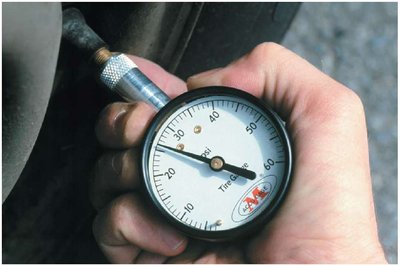
Gauge pressure is the pressure in excess of atmospheric pressure:
Barometers
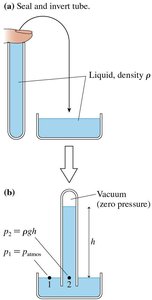
Barometers measure atmospheric pressure by the height of a liquid column:
Buoyancy and Archimedes' Principle
Buoyant Force
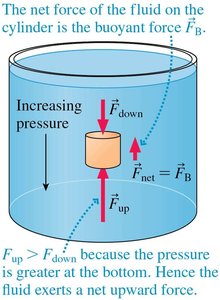
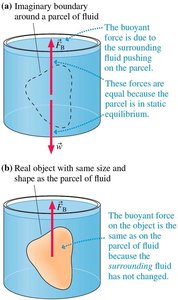
The upward force exerted by a fluid on a submerged or floating object is called the buoyant force. It arises because pressure increases with depth, so the bottom of the object experiences more pressure than the top.
Archimedes' Principle
Archimedes' principle states that the buoyant force on an object is equal to the weight of the fluid displaced by the object:
ρf: Density of the fluid
Vf: Volume of fluid displaced
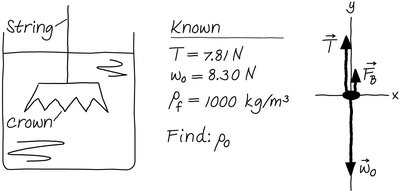
Example: Is the Crown Gold?
By measuring the tension in a string suspending a crown underwater, the buoyant force can be determined. Comparing the crown's density to that of gold reveals if it is pure gold.
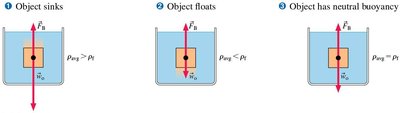
Floating, Sinking, and Neutral Buoyancy
Object sinks: Average density greater than fluid density.
Object floats: Average density less than fluid density.
Neutral buoyancy: Average density equals fluid density.
Surface Tension, Capillarity, and Fluid Motion
Surface Tension and Bubbles
Surface tension causes bubbles and droplets to form spheres. The pressure inside a bubble is greater than outside, given by:
For a bubble (two surfaces): For a droplet (one surface): where γ is the surface tension and R is the radius.
Capillary Action
Capillary action is the rise or fall of a liquid in a narrow tube due to adhesive and cohesive forces. The height h to which a liquid rises is:
θcontact: Contact angle between liquid and tube
r: Tube radius
Fluid Dynamics: Continuity and Bernoulli's Equation
Equation of Continuity
For an incompressible fluid, the volume flow rate is constant throughout a tube:
v: Fluid speed
A: Cross-sectional area
Bernoulli's Equation
Bernoulli's equation relates pressure and speed along a streamline for an ideal fluid:
Pressure is higher where the fluid moves slower, and lower where it moves faster.
Pressure Units Table
Unit | Abbreviation | Uses | Conversion to Pa |
|---|---|---|---|
pascal | Pa | SI unit, general | 1 Pa = 1 N/m2 |
atmosphere | atm | gases, blood pressure, barometric pressure | 1 atm = 101 kPa |
millimeters of mercury | mm Hg | U.S. engineering, industry | 1 mm Hg = 133 Pa |
pounds per square inch | psi | U.S. engineering, industry | 1 psi = 6.89 kPa |
