 뒤로
뒤로Quantum Mechanics in Three Dimensions: Particle in a Box
스터디 가이드 - 스마트 노트
 자료에 맞춘 맞춤형 노트, 핵심 정의, 예시, 맥락을 확장해 제공합니다.
Quantum Mechanics in Three Dimensions
Kinetic Energy and the Schrödinger Equation
In quantum mechanics, the behavior of a particle in three dimensions is governed by the three-dimensional Schrödinger equation. The kinetic energy operator in three dimensions is expressed as the sum of the kinetic energies in each spatial direction.
Kinetic Energy Operator: The kinetic energy for a particle of mass m is given by:
Time-Dependent Schrödinger Equation:
Normalization Condition: The wave function must satisfy:
Stationary States: For a state of definite energy, the wave function can be separated as:
Time-Independent Schrödinger Equation:
Particle in a Three-Dimensional Box
Potential and Boundary Conditions
The three-dimensional box (also called an infinite potential well) is a fundamental quantum system where a particle is confined within a cubical region of side L with infinitely high potential walls.
Potential Energy Function:
for , otherwise
for , otherwise
for , otherwise
Boundary Conditions: The wave function must vanish at the walls: at .
Separation of Variables and Solution
The time-independent Schrödinger equation inside the box can be solved using separation of variables, assuming a solution of the form .
Separation of Variables: Leads to three independent equations for , , and , each resembling the one-dimensional particle in a box problem.
Allowed Solutions:
,
,
,
General Solution:
Normalization: The constant is determined by the normalization condition.
Energy Levels and Quantum Numbers
The energy levels of a particle in a three-dimensional box depend on three quantum numbers: , , and .
Energy Eigenvalues:
Quantum Numbers:
Degeneracy: Different combinations of quantum numbers can yield the same energy (degenerate states).
Probability Distributions and Nodal Planes
The probability density describes the likelihood of finding the particle at a given location. Nodal planes are regions where the probability density is zero.
Nodal Planes: For each quantum number greater than one, there is a nodal plane perpendicular to the corresponding axis.
Examples:
For , there is a nodal plane at where the probability density is zero.
For , the nodal plane is at .
For , the nodal plane is at .
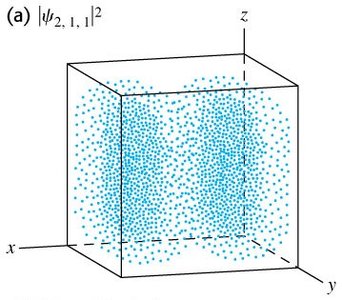
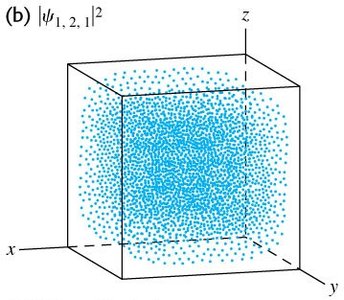
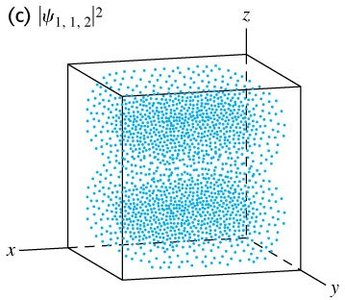
Energy Level Diagram and Degeneracy
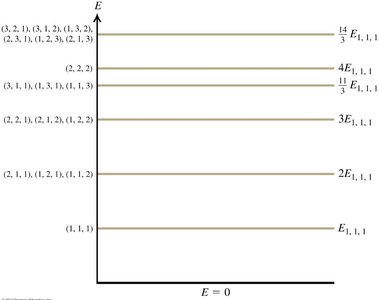
The energy levels for a particle in a cubical box can be represented graphically, showing the degeneracy (number of states with the same energy) for each level. Degeneracy arises from the symmetry of the box; if the box is not symmetric (i.e., ), degeneracy is lifted.
Energy Level Structure: The lowest energy state is . Higher energy levels correspond to higher quantum numbers and may be degenerate.
Degeneracy Table: The number of distinct quantum states for each energy level is shown in the diagram below.
Summary Table: Energy Levels and Degeneracy
Quantum Numbers (n_X, n_Y, n_Z) | Energy (in units of ) | Degeneracy |
|---|---|---|
(1,1,1) | 1 | |
(2,1,1), (1,2,1), (1,1,2) | 2 | 3 |
(2,2,1), (2,1,2), (1,2,2) | 3 | 3 |
(2,2,2) | 4 | 1 |
(3,1,1), (1,3,1), (1,1,3) | 3 | |
(3,2,1), (3,1,2), (2,3,1), (2,1,3), (1,3,2), (1,2,3) | 6 |
Additional info: Degeneracy is a direct consequence of the symmetry of the box. If the box dimensions are not equal, the degeneracy is removed, and each energy level becomes unique to its quantum numbers.
