 뒤로
뒤로Ray Optics and Optical Instruments: Reflection, Refraction, Lenses, and Applications
스터디 가이드 - 스마트 노트
 자료에 맞춘 맞춤형 노트, 핵심 정의, 예시, 맥락을 확장해 제공합니다.
Ray Optics and Optical Instruments
Reflection of Light
Reflection is the process by which light bounces off a surface. There are two main types of reflection: specular and diffuse.
Specular Reflection
Definition: Occurs when light reflects off a smooth surface, such as a mirror, causing parallel incident rays to remain parallel after reflection.
Key Property: Produces clear images because the reflected rays maintain their relative angles.
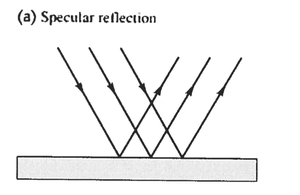
Diffuse Reflection
Definition: Occurs when light reflects off a rough or irregular surface, causing parallel incident rays to scatter in many directions.
Key Property: Does not produce clear images, but allows us to see most objects around us.
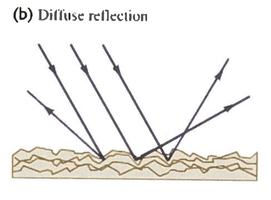
Law of Reflection
Statement: The angle of incidence (θa) equals the angle of reflection (θr), and both rays, along with the normal to the surface, lie in the same plane.
Equation:
Reflection at a Plane Mirror
The image formed is upright and the same size as the object (lateral magnification = 1).
The image appears as far behind the mirror as the object is in front.
The image is reversed left to right.
Magnification Equation: , where is the image height and is the object height. For a plane mirror, .
Refraction of Light
Refraction is the bending of light as it passes from one medium to another with a different optical density.
Index of Refraction
Definition: The index of refraction (n) of a medium is the ratio of the speed of light in vacuum (c) to the speed of light in the medium (v).
Equation:
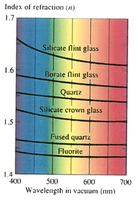
Typical values: Air (≈1.00), Water (≈1.33), Glass (≈1.5–1.7)
Snell's Law of Refraction
Statement: Describes how light bends when passing between two media with different indices of refraction.
Equation:
Where and are the indices of refraction, and and are the angles of incidence and refraction, respectively.
Total Internal Reflection and Critical Angle
Definition: Occurs when light attempts to move from a medium with higher index of refraction to one with lower index, and the angle of incidence exceeds a certain critical value.
Critical Angle Equation: (for )
Applications: Fiber Optics and Endoscopy
Fiber Optics: Use total internal reflection to transmit light signals over long distances with minimal loss.
Medical Endoscopy: Optical fibers are used in devices like endoscopes and colonoscopes to view internal organs with minimal invasion.
Dispersion and Color
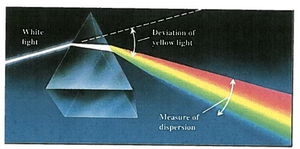
Dispersion is the dependence of the index of refraction on the wavelength of light, causing different colors to refract at different angles.
Index of Refraction vs. Wavelength
Generally, the index of refraction decreases as wavelength increases (red light bends less than blue/violet light).
Prisms and the Visible Spectrum
When white light passes through a prism, dispersion causes the light to spread into its constituent colors, forming a visible spectrum.
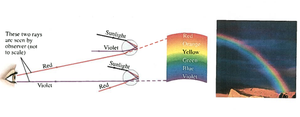
Rainbows
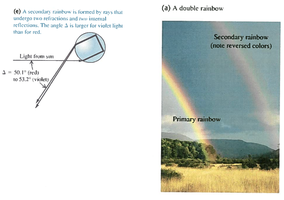
Rainbows are formed by the refraction, reflection, and dispersion of sunlight in water droplets.
Each droplet acts as a tiny prism, producing a spectrum of colors visible to an observer positioned between the Sun and the rain.
Thin Lenses: Ray Tracing and Equations
Lenses are optical devices that refract light to form images. There are two main types: converging (convex) and diverging (concave) lenses.
Ray Diagrams for Lenses
Converging Lens: Focuses parallel rays to a point (real focus).
Diverging Lens: Causes parallel rays to spread out as if from a point (virtual focus).
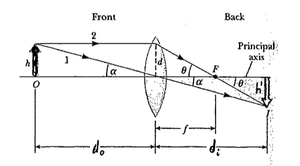
Thin Lens Equation and Magnification
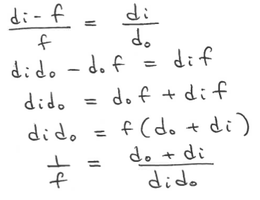
Thin Lens Equation:
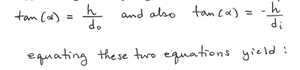
Magnification:
Where is the focal length, is the object distance, is the image distance, is the object height, and is the image height.
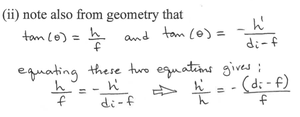
Summary Table: Sign Conventions for Lenses and Mirrors
Quantity | Converging Lens / Concave Mirror | Diverging Lens / Convex Mirror |
|---|---|---|
Focal length (f) | + | - |
Object distance (s or do) | + (real object, left of lens/mirror) | - (virtual object, right of lens/mirror) |
Image distance (s' or di) | + (real image, right of lens/left of mirror) | - (virtual image, left of lens/right of mirror) |
Magnification (M) | + (upright image) | - (inverted image) |
Applications: Human Eye and Corrective Lenses
The eye forms images on the retina using a variable-focus lens (accommodation).
Nearsightedness (Myopia): Corrected with a diverging lens.
Farsightedness (Hyperopia): Corrected with a converging lens.
Lens Power: Defined as the reciprocal of the focal length in meters; unit is the diopter (D).
Image Formation with Spherical Mirrors
Concave Mirror: Reflecting surface is the inner side; can form real or virtual images depending on object position.
Convex Mirror: Reflecting surface is the outer side; always forms virtual, upright, and reduced images.
Equations: Same as for lenses: and
Additional info: The notes above are based on standard college-level physics content for ray optics and optical instruments, including applications in biology and medicine.
