 뒤로
뒤로Ray Optics: Fundamentals and Applications
스터디 가이드 - 스마트 노트
 자료에 맞춘 맞춤형 노트, 핵심 정의, 예시, 맥락을 확장해 제공합니다.
Ray Optics: Fundamentals and Applications
Introduction to Ray Optics
Ray optics, also known as geometric optics, is a model of light that describes its propagation in terms of rays. This model is valid when diffraction effects are negligible, typically when the dimensions involved are much larger than the wavelength of light. - Light rays are conceptual lines indicating the direction of light energy flow. - Objects can be self-luminous (emit their own light) or reflective (reflect light from other sources). - Ray diagrams are used to simplify the visualization of light paths and image formation. 
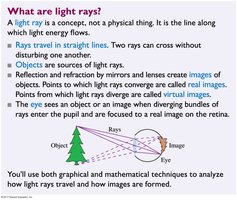
Ray Model of Light
The ray model is used when diffraction is not significant. Light rays travel in straight lines and can cross without disturbing each other. - The speed of light in a medium is , where is the index of refraction. - Rays interact with matter via reflection, refraction, or scattering. - Each point on an object acts as a source of light rays. - The eye forms images by focusing diverging bundles of rays onto the retina. 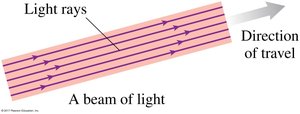
Sources and Types of Light Rays
- Self-luminous objects (e.g., the sun) emit light. - Reflective objects (e.g., a tree) reflect light from other sources. - Point sources emit rays in all directions, while parallel bundles (e.g., laser beams) consist of rays traveling in parallel. 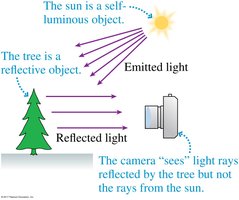
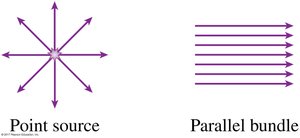
Ray Diagrams and Image Formation
Ray diagrams are graphical representations showing only a few rays to simplify the analysis of image formation. - Rays originate from every point on an object and travel outward in all directions. - The height of the image () and object () are related to their respective distances (, ): 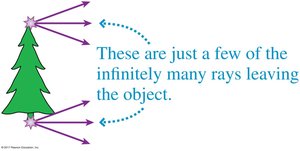

Apertures and Shadows
An aperture is a small opening that allows light rays to pass through, forming an image on a screen. - The geometry of rays through an aperture can create shadows and images, depending on the shape and size of the opening. 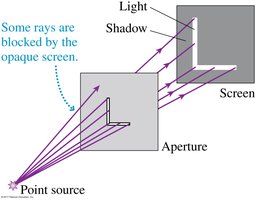
Reflection of Light
Reflection occurs when light rays bounce off a surface. There are two main types: - Specular reflection: Mirror-like reflection from a smooth surface. - Diffuse reflection: Reflection from a rough surface, causing rays to scatter in many directions. The law of reflection states that the angle of incidence () equals the angle of reflection (): 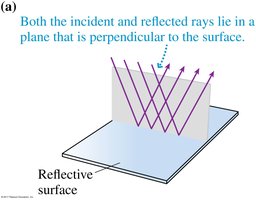
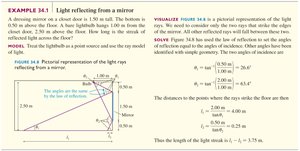
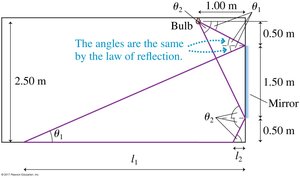
Example: Light Reflecting from a Mirror
This example demonstrates the application of the law of reflection to determine the path of light rays and the distances involved. - The angles of incidence and reflection are equal. - The distances to the points where rays strike the floor can be calculated using trigonometry and the law of reflection. 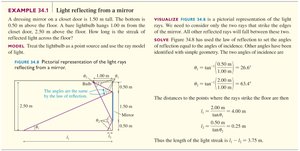
Diffuse Reflection
Diffuse reflection occurs when light reflects from a surface with tiny irregularities. - Each ray obeys the law of reflection at its point of incidence, but the surface irregularities cause the reflected rays to leave in many random directions. 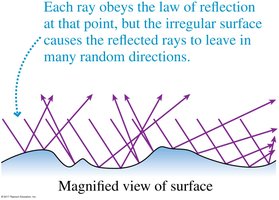
Plane Mirrors and Virtual Images
A plane mirror creates a virtual image that appears to be the same distance behind the mirror as the object is in front. - The reflected rays diverge from the virtual image point, and the eye perceives the image as coming from this point. 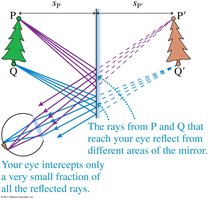
Refraction of Light
Refraction is the change in direction of light rays at the boundary between two transparent media. - Part of the light reflects, obeying the law of reflection. - Part of the light transmits into the second medium, changing direction according to Snell's law: where and are the indices of refraction of the two media.
Summary Table: Types of Reflection
Type | Surface | Ray Behavior |
|---|---|---|
Specular Reflection | Smooth | Rays reflect in a single direction |
Diffuse Reflection | Rough | Rays scatter in many directions |
Importance of Optics
Optics is fundamental to modern technology and science. - Applications include cameras, headlights, laser pointers, optical scanners, and photonics. - The ray model is the foundation for designing optical instruments. 
Conclusion
Ray optics provides a powerful framework for understanding the behavior of light in everyday phenomena and technological applications. By mastering the principles of ray propagation, reflection, and refraction, students gain essential tools for analyzing and designing optical systems. Additional info: The notes have been expanded to include definitions, examples, and equations for completeness and academic quality.
