 뒤로
뒤로Rotational Motion: Concepts, Equations, and Applications
스터디 가이드 - 스마트 노트
 자료에 맞춘 맞춤형 노트, 핵심 정의, 예시, 맥락을 확장해 제공합니다.
Rotational Motion
Angular Position, Displacement, Velocity, and Acceleration
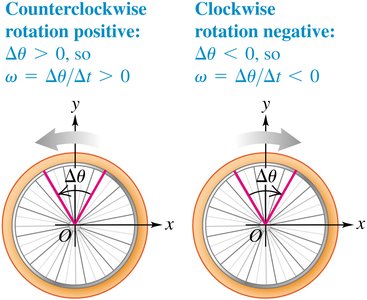
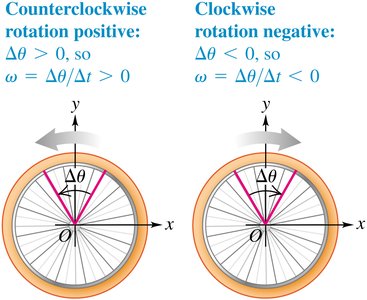
Rotational motion describes the movement of objects around a fixed axis. The fundamental quantities are angular position, angular displacement, angular velocity, and angular acceleration. - Angular position (\theta): The orientation of a line with respect to a reference axis, measured in radians. - Angular displacement (\Delta\theta): The change in angular position. 1 revolution = 360° = radians. - Angular velocity (\omega): The rate of change of angular position, (unit: rad/s). - Angular acceleration (\alpha): The rate of change of angular velocity, (unit: rad/s2). 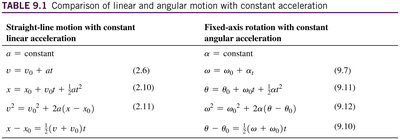
Equations of Rotational Motion with Constant Angular Acceleration
For constant angular acceleration, the following equations are analogous to linear kinematics:
Straight-line motion with constant linear acceleration | Fixed-axis rotation with constant angular acceleration |
|---|---|
Period of Rotational Motion
The period () is the time for one complete revolution. For constant angular velocity: - radians - -
Example: Rotation of a Bicycle Wheel
Consider a bicycle wheel with initial angular velocity rad/s and angular acceleration rad/s2. To find the angle and angular velocity at s: - - 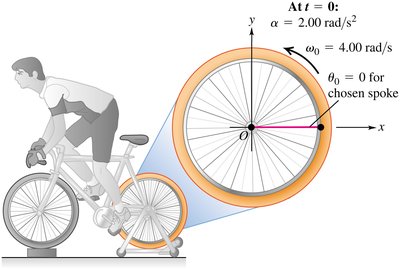
Linear and Angular Velocity
Relation Between Linear and Angular Velocity
For a point at distance from the axis of rotation: - Linear velocity: - Angular velocity: (rad/s) 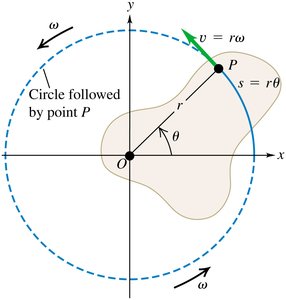
Example: Merry-Go-Round
If Sofia is twice as far from the axis as Rasheed, her speed is twice Rasheed's speed, since . 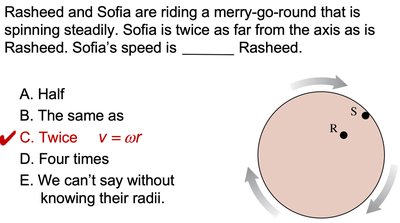
Linear and Angular Acceleration
Relation Between Linear and Angular Acceleration
- Tangential acceleration: - Radial (centripetal) acceleration: - Total acceleration: 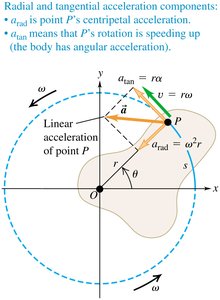
Example: Throwing a Discus
For a discus with rad/s2, rad/s, and m: - m/s2 - m/s2 - 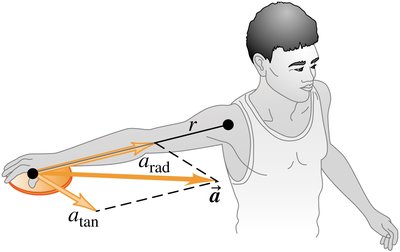
Rotational Motion in Systems
Bicycle Gears
When two sprockets are connected by a chain, their angular speeds are related to their radii and number of teeth: - - If the number of teeth is and , then 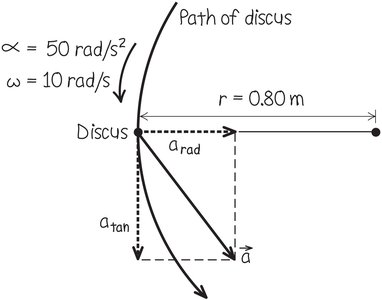
Example: Propeller Design
To limit the tip speed of a propeller, use . For a maximum tip speed and given angular velocity, solve for : - 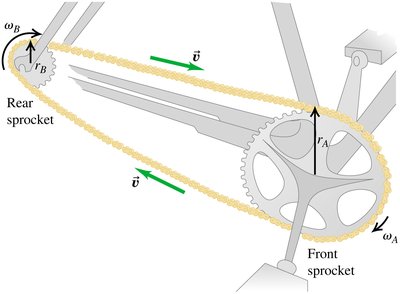
Kinetic Energy of Rotation
Rotational Kinetic Energy
The kinetic energy of a rotating rigid body is: - where is the moment of inertia. For discrete masses: 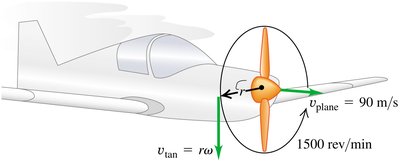
Moment of Inertia
Definition and Calculation
The moment of inertia () quantifies how mass is distributed relative to the axis of rotation. - for point masses - for continuous bodies 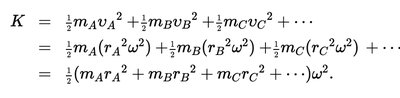
Example: Rotational Kinetic Energy of a Sculpture
For three point masses connected by rods, calculate for different axes and use . 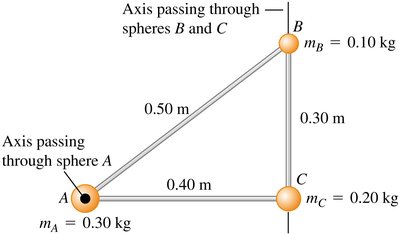
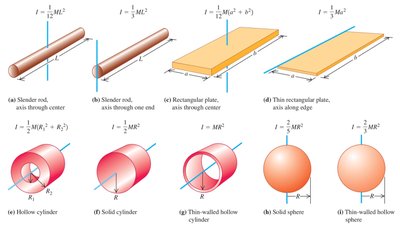
Moment of Inertia for Common Shapes
Shape | Moment of Inertia |
|---|---|
Solid sphere | |
Solid cylinder | |
Thin rod (center) | |
Thin rod (end) | |
Rectangular plate (center) |
Example: Sphere vs Cylinder
For a sphere and cylinder of mass and radius : - Sphere: 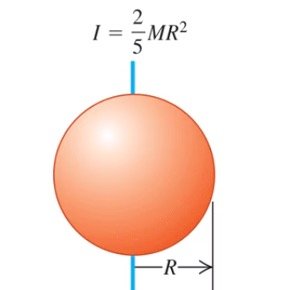 - Cylinder:
 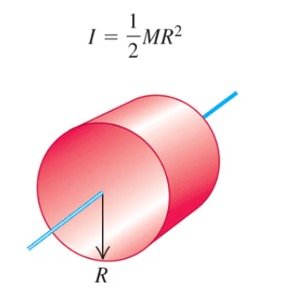 The cylinder has a larger moment of inertia for the same mass and radius.
Summary Table: Linear vs Angular Motion
Linear Motion | Angular Motion |
|---|---|
Displacement: | Angular displacement: |
Velocity: | Angular velocity: |
Acceleration: | Angular acceleration: |
Kinetic energy: | Rotational kinetic energy: |
Key Concepts and Applications
- Rotational motion is governed by angular quantities analogous to linear motion. - The moment of inertia depends on mass distribution and axis of rotation. - Rotational kinetic energy is proportional to both moment of inertia and angular velocity squared. - Real-world applications include bicycle gears, propeller design, and sports (e.g., discus throwing). Additional info: Academic context and formulas were expanded for completeness and clarity.
