 뒤로
뒤로Sources of Magnetic Field: Biot-Savart Law, Ampère’s Law, and Applications
스터디 가이드 - 스마트 노트
 자료에 맞춘 맞춤형 노트, 핵심 정의, 예시, 맥락을 확장해 제공합니다.
Sources of Magnetic Field
Introduction
This chapter explores the origins and properties of magnetic fields produced by moving charges and electric currents. It covers the Biot-Savart Law, Ampère’s Law, and their applications to various current configurations, including straight conductors, loops, solenoids, and toroids. The chapter also discusses the magnetic force between parallel conductors and the magnetic properties of materials.
Magnetic Field of a Moving Point Charge
Definition and Direction
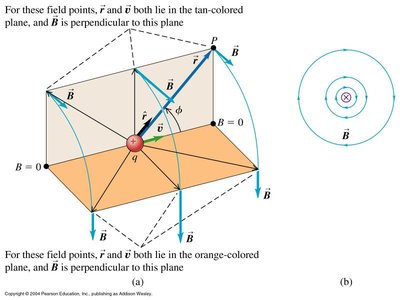
Magnetic field (B) is produced by moving electric charges.
The direction of B is given by the right-hand rule: point your thumb in the direction of the velocity v of a positive charge, and your fingers curl in the direction of B.
The magnitude of the magnetic field at a distance r from a moving charge q is:
Where \mu_0 is the permeability of free space ( T·m/A), v is the speed of the charge, \phi is the angle between v and the position vector r.
Forces Between Moving Charges
Electric and Magnetic Forces
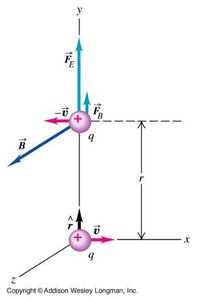
Two moving charges exert both electric and magnetic forces on each other.
The electric force is given by Coulomb’s law:
The magnetic force between two parallel moving charges is:
Magnetic forces are much weaker than electric forces at non-relativistic speeds.
Biot-Savart Law
Magnetic Field Due to a Current Element
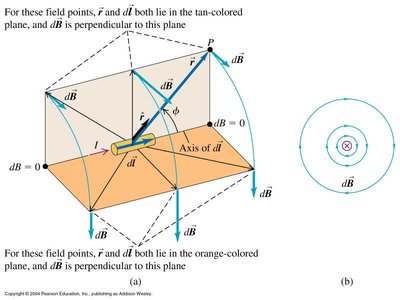
The Biot-Savart Law gives the magnetic field dB at a point due to a small segment of current-carrying conductor:
I is the current, d\vec{s} is the length element, \hat{r} is the unit vector from the element to the field point, and r is the distance.
The direction of dB is perpendicular to both d\vec{s} and \hat{r} (right-hand rule).
Total Magnetic Field
The total magnetic field is found by integrating over the entire current distribution:
Magnetic Field of a Straight Current-Carrying Conductor
Field Calculation Using Biot-Savart Law
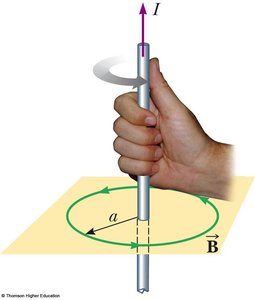
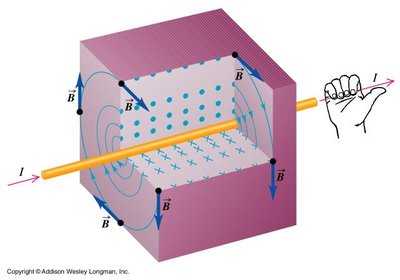
For a long, straight wire carrying current I, the magnetic field at a perpendicular distance a is:
The field lines are concentric circles around the wire, and the direction is given by the right-hand rule.
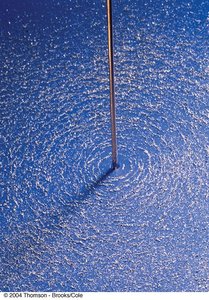
Experimental Visualization
Iron filings and compass needles can be used to visualize the circular magnetic field around a wire.
Magnetic Field of a Circular Loop
Field at the Center of the Loop
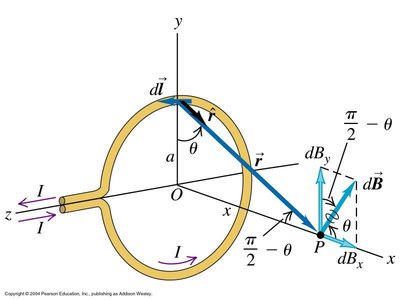
For a loop of radius a carrying current I, the field at the center is:
For N loops,
Field on the Axis of the Loop
At a distance x from the center along the axis:
Magnetic Force Between Parallel Conductors
Force Per Unit Length
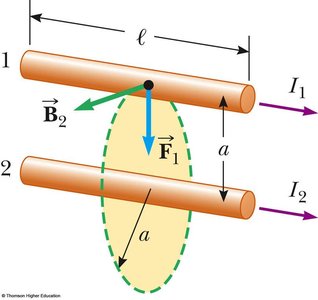
Two parallel wires carrying currents I_1 and I_2 separated by distance a exert a force per unit length on each other:
Parallel currents attract; anti-parallel currents repel.
Ampère’s Law
Statement and Application
Ampère’s Law relates the integrated magnetic field around a closed loop to the current passing through the loop:
Useful for calculating B in highly symmetric situations (e.g., straight wires, solenoids, toroids).
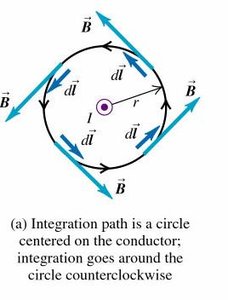
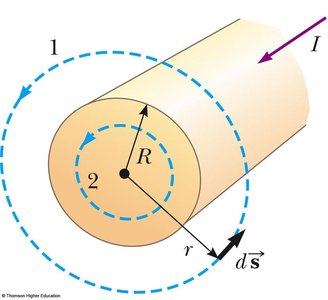
Field Inside and Outside a Long Straight Wire
Outside the wire ():
Inside the wire ():
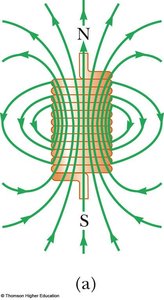
Magnetic Field of a Solenoid
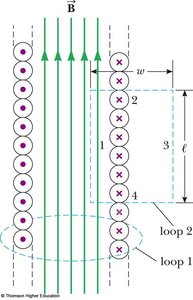
Field Inside a Long Solenoid
A solenoid is a coil of wire with many turns, producing a nearly uniform magnetic field inside.
The field inside a long solenoid is:
Where n is the number of turns per unit length.
Magnetic Field of a Toroid
Field Inside a Toroid
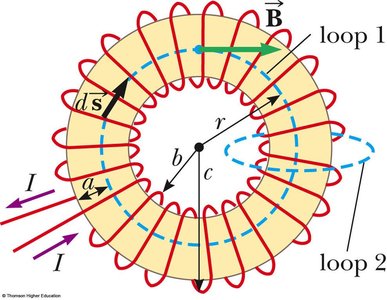
A toroid is a solenoid bent into a circular shape.
The magnetic field inside a toroid of N turns and current I at radius r is:
Magnetic Moments and Materials
Magnetic Dipole Moment
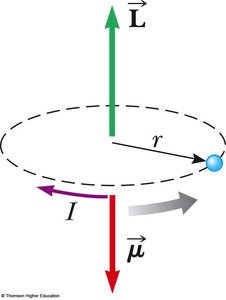
Any current loop has a magnetic dipole moment \mu:
Where A is the area of the loop.
Ferromagnetism, Paramagnetism, and Diamagnetism
Ferromagnetic materials (e.g., iron, cobalt, nickel) have domains with aligned magnetic moments, resulting in strong magnetism.
Paramagnetic materials have weak, positive magnetism due to unpaired electrons.
Diamagnetic materials develop a weak, negative magnetism in opposition to an applied field.
Earth’s Magnetic Field
Origin and Properties
The Earth’s magnetic field resembles that of a giant bar magnet tilted with respect to the rotational axis.
It is believed to originate from convection currents in the liquid outer core.
The field reverses polarity every few million years.
Summary Table: Key Magnetic Field Formulas
Configuration | Magnetic Field Expression |
|---|---|
Moving Point Charge | |
Long Straight Wire | |
Circular Loop (center) | |
Solenoid (interior) | |
Toroid (inside) | |
Parallel Wires (force/length) |
