 뒤로
뒤로Sources of Magnetic Fields and Magnetic Materials
스터디 가이드 - 스마트 노트
 자료에 맞춘 맞춤형 노트, 핵심 정의, 예시, 맥락을 확장해 제공합니다.
Sources of Magnetic Fields
Magnetic Field of a Straight Current-Carrying Wire
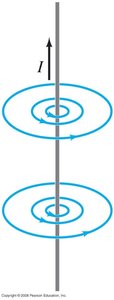
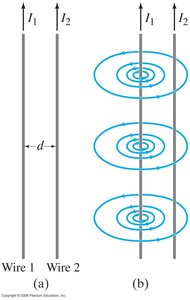
The magnetic field B produced by a straight wire carrying a current I forms concentric circles around the wire. The direction of the field is given by the right-hand rule: if the thumb points in the direction of the current, the fingers curl in the direction of the magnetic field lines.
Magnitude of B: The field strength increases with current and decreases with distance from the wire.
Formula: For a point at distance r from a long straight wire, the field is given by: where is the permeability of free space.
Ampère's Law
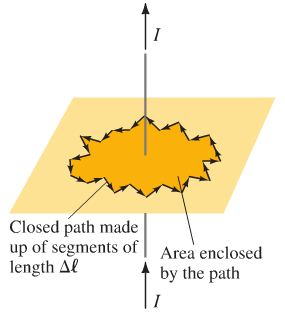
Ampère's Law relates the integrated magnetic field around a closed loop to the electric current passing through the loop. It is a fundamental law of electromagnetism, valid for steady (time-independent) currents.
Integral Form: where is the net current enclosed by the path.
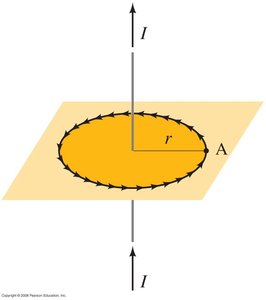
Symmetry: The path (Ampèrean loop) is chosen to exploit the symmetry of the problem, simplifying calculations.
Application: Cylindrical Conductor
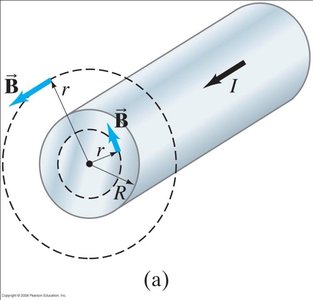
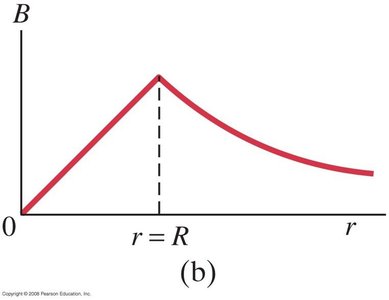
For a long, straight cylindrical conductor of radius R carrying a uniform current I:
Outside the Conductor (r > R): The field is as for a thin wire:
Inside the Conductor (r < R): The enclosed current is proportional to the area:
Application: Coaxial Cable
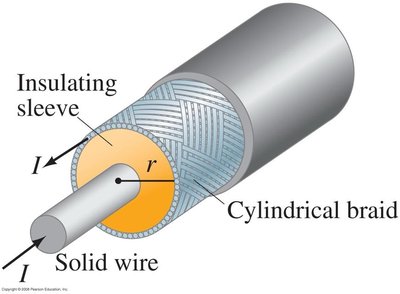
In a coaxial cable, currents in the central wire and the outer cylindrical braid flow in opposite directions. By Ampère's Law, the magnetic field outside the cable is zero, making coaxial cables self-shielding.
Solenoids and Toroids
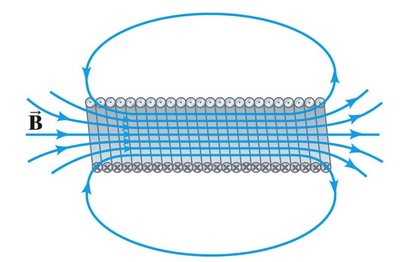
A solenoid is a long coil of wire with many turns. The magnetic field inside is nearly uniform and parallel to the axis, while outside it is much weaker. For a solenoid of length l with N turns and current I:
, where is the number of turns per unit length.
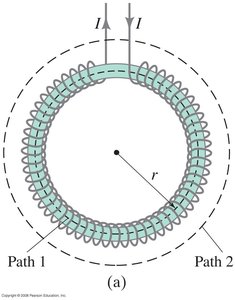
A toroid is a solenoid bent into a circular ring. The field inside a toroid of radius r is:
Outside the toroid, .
Ampère's Law in Differential Form
Using Stokes' theorem, Ampère's Law can be written in differential form:
Here, is the current density vector.
Force Between Parallel Currents
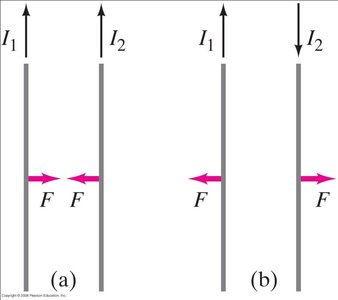
Two parallel wires carrying currents exert forces on each other due to their magnetic fields. The force per unit length between two long, parallel wires separated by distance d is:
Parallel currents attract; antiparallel currents repel (Newton's third law applies).
Biot-Savart Law
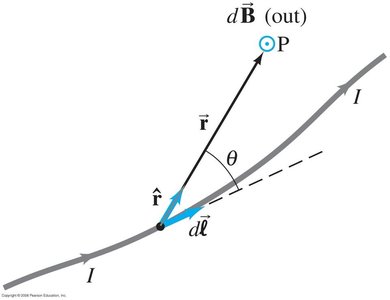
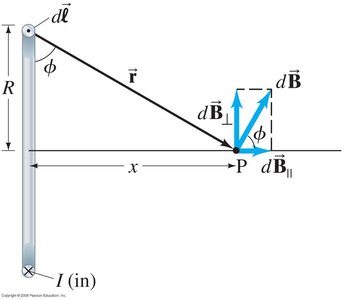
The Biot-Savart Law gives the magnetic field produced at a point by a small segment of current-carrying wire:
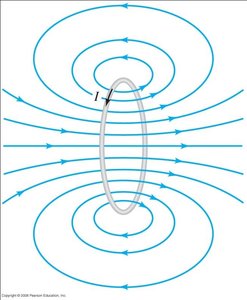
For a current loop, the field at a point on the axis is: For , , where is the magnetic dipole moment.
Comparison: Electric vs Magnetic Dipole
Both electric and magnetic dipoles produce characteristic field patterns, but their sources and equations differ. The field of a magnetic dipole falls off as at large distances, similar to an electric dipole.
Magnetic Materials
Ferromagnetism
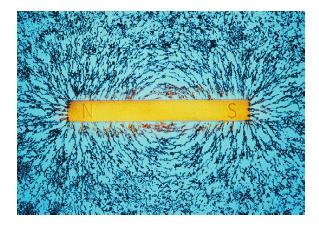
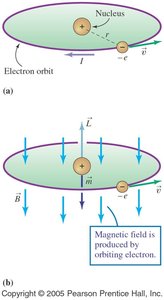
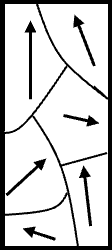
Materials such as iron (Fe), cobalt (Co), and nickel (Ni) are ferromagnetic. They can produce strong magnetic fields and behave as permanent magnets. On the atomic scale, magnetism arises from electron motion and spin. In ferromagnetic materials, atomic magnetic moments align parallel within regions called domains.
Magnetic Domains
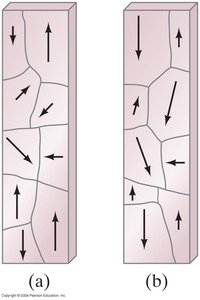
On a macroscopic scale, ferromagnetic materials are divided into domains with aligned magnetic moments. In the absence of an external field, domains are randomly oriented. When an external field is applied, domains align to reduce the system's potential energy.
Curie Temperature and Magnetic Susceptibility
Spontaneous alignment of atomic moments in ferromagnets is disrupted above a critical temperature, the Curie temperature (). Above , thermal motion overcomes magnetic ordering, and the material becomes paramagnetic.
Material | Curie Temperature (K) |
|---|---|
Fe | 1043 |
Co | 1388 |
Ni | 627 |
Gd | 292 |
Hysteresis and Magnetic Hardness
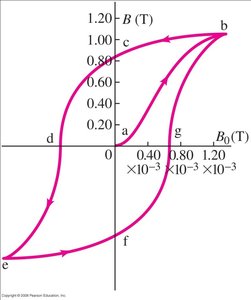
The hysteresis curve shows the relationship between the magnetic field B and the applied field B0 in ferromagnetic materials. The area within the loop represents the energy required to reorient the magnetic dipoles. Materials with wide loops are hard ferromagnets (good for permanent magnets); those with narrow loops are soft (good for electromagnets).
Electromagnets and Magnetic Permeability
Placing a soft ferromagnetic core inside a solenoid greatly increases the magnetic field. The total field is the sum of the solenoid's field and the field due to the magnetized material:
(field without core)
(with core, )
Applications: Relays
A relay is an electromagnetic switch. A soft magnetic material inside a solenoid becomes magnetized when current flows, attracting a movable iron piece to close a separate circuit. This allows a small control current to switch a larger load current.
Summary: The sources of magnetic fields include currents in wires, solenoids, and loops, described by Ampère's Law and the Biot-Savart Law. Ferromagnetic materials exhibit strong, temperature-dependent magnetism due to domain alignment, with important applications in electromagnets and switching devices.
