 뒤로
뒤로Step-by-Step Guidance for Phys 114 Practice Midterm Exam 1 (Kinematics, Dynamics, and Forces)
스터디 가이드 - 스마트 노트
 자료에 맞춘 맞춤형 노트, 핵심 정의, 예시, 맥락을 확장해 제공합니다.
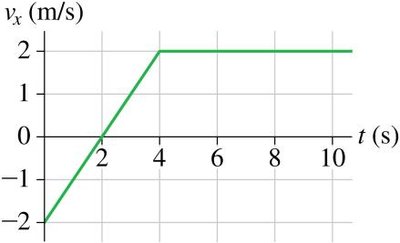
Q1. What is the acceleration of the object at s?
Background
Topic: Kinematics – Acceleration from a Velocity-Time Graph
This question tests your ability to determine acceleration by analyzing the slope of a velocity vs. time graph.
Key Terms and Formulas:
Acceleration (): The rate of change of velocity with respect to time.
Formula:
Slope of vs. graph: The acceleration at any point is the slope of the tangent to the curve at that point.
Step-by-Step Guidance
Identify the section of the graph at s. Is the graph linear or curved at this point?
Determine the change in velocity () and the change in time () over the interval that includes s.
Calculate the slope of the line in this region using two points on the straight segment that contains s.
Apply the formula to find the acceleration.
Try solving on your own before revealing the answer!
Final Answer: -1.0 m/s2
Using the slope between s and s, m/s2. The sign depends on the direction of the slope.
The acceleration is constant in this region, so the value at s is the same as the slope of the line.
Q2. What is the displacement of the object in the first 6 seconds?
Background
Topic: Kinematics – Displacement from a Velocity-Time Graph
This question tests your ability to calculate displacement by finding the area under a velocity vs. time graph.
Key Terms and Formulas:
Displacement (): The net change in position of an object.
Formula:
For straight-line segments, this is the area under the curve between the given times.
Step-by-Step Guidance
Break the graph into segments where the velocity is linear or constant (e.g., $0 s, $2 s, $4 s).
For each segment, calculate the area under the curve (this may involve triangles and rectangles).
Add the areas together, being careful with signs (areas below the time axis are negative).
The sum gives the total displacement over the first $6$ seconds.
Try solving on your own before revealing the answer!
Final Answer: +4.0 m
The area under the curve from $0 s is the sum of a triangle (negative), a triangle (positive), and a rectangle (positive).
Adding these areas gives the net displacement.
