 뒤로
뒤로Study Guidance: Magnetic Fields, Forces, and Motion of Charged Particles
스터디 가이드 - 스마트 노트
 자료에 맞춘 맞춤형 노트, 핵심 정의, 예시, 맥락을 확장해 제공합니다.
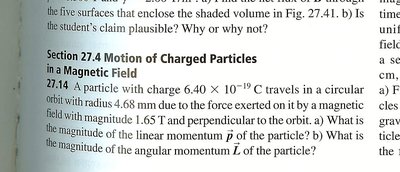
Q1. A particle with charge C travels in a circular orbit with radius 4.68 mm due to the force exerted on it by a magnetic field with magnitude 1.65 T and perpendicular to the orbit.
Background
Topic: Motion of Charged Particles in Magnetic Fields
This question tests your understanding of how a charged particle moves in a magnetic field, specifically how to calculate linear and angular momentum when the particle is in circular motion due to the Lorentz force.
Key Terms and Formulas
Linear momentum:
Angular momentum:
Magnetic force: (for perpendicular motion)
Centripetal force:
Step-by-Step Guidance
Set the magnetic force equal to the centripetal force:
Solve for the velocity of the particle:
Use the velocity to find the linear momentum:
Use the velocity and radius to find the angular momentum:
Try solving on your own before revealing the answer!
Final Answer:
Linear momentum:
Angular momentum:
Plug in the values for , , and to get the numeric results.
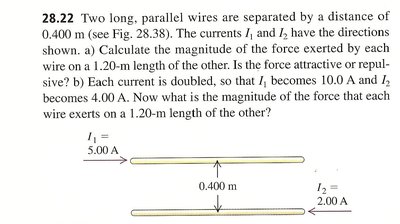
Q2. Two long, parallel wires are separated by a distance of 0.400 m. The currents and have the directions shown. (a) Calculate the magnitude of the force exerted by each wire on a 1.20-m length of the other. Is the force attractive or repulsive? (b) Each current is doubled, so that $I_1$ becomes 10.0 A and $I_2$ becomes 4.00 A. Now what is the magnitude of the force that each wire exerts on a 1.20-m length of the other?
Background
Topic: Magnetic Forces Between Parallel Currents
This question tests your ability to use Ampère's law and the formula for the force between two parallel current-carrying wires.
Key Terms and Formulas
Force per unit length between two wires:
Total force:
T·m/A
Step-by-Step Guidance
Identify the known values: A, A, m, m.
Write the formula for the force:
Plug in the values for the first scenario.
For the second scenario, double the currents and repeat the calculation.
Try solving on your own before revealing the answer!
Final Answer:
For (a):
For (b):
The direction depends on whether the currents are in the same or opposite directions (attractive if same, repulsive if opposite).
Q3. An electromagnet produces a magnetic field with magnitude in a cylindrical region with a radius of between its poles. A straight wire carrying a current passes through the center of this region and is perpendicular to both the axis of the cylindrical region and the magnetic field. (a) What is the force on the wire?
Background
Topic: Magnetic Force on a Current-Carrying Wire
This question tests your understanding of the force experienced by a wire carrying current in a magnetic field, specifically when the wire is perpendicular to the field.
Key Terms and Formulas
Magnetic force:
For perpendicular orientation:
Step-by-Step Guidance
Identify the known values: , (diameter of the region), .
Write the formula for the force:
Plug in the values for , , and .
Try solving on your own before revealing the answer!

Final Answer:
Force:
Use the given values for , , and to compute the result.
