뒤로
뒤로Study Notes: Hooke's Law and Physical Explanation of Friction
스터디 가이드 - 스마트 노트
 자료에 맞춘 맞춤형 노트, 핵심 정의, 예시, 맥락을 확장해 제공합니다.
Hooke's Law
Direct Proportionality Between Force and Displacement
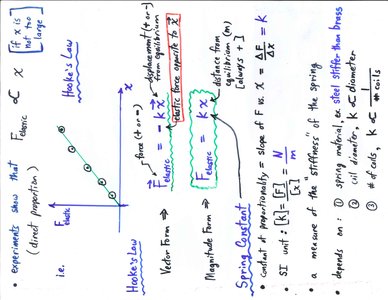
Hooke's Law describes the relationship between the force applied to a spring and the resulting displacement. It is a fundamental principle in mechanics, especially in the study of elastic materials.
Definition: The force required to stretch or compress a spring is directly proportional to the displacement from its equilibrium position.
Mathematical Form:
Vector Form:
Magnitude Form:
Spring Constant (k): A measure of the stiffness of the spring. The SI unit is .
Graphical Representation: The slope of the force vs. displacement graph gives the spring constant .
Factors Affecting k:
Material of the spring (stiffer materials have higher k)
Diameter of the spring
Number of coils
Applications: Used in measuring forces, designing suspension systems, and understanding elastic properties of materials.
Example: If a spring has a spring constant of and is stretched by , the force required is .
Physical Explanation of Friction
Microscopic Origin of Friction Forces
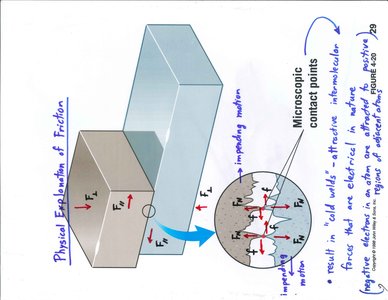
Friction is a resistive force that opposes the relative motion of two surfaces in contact. Its physical origin can be explained by the interactions at microscopic contact points.
Microscopic Contact Points: Surfaces are not perfectly smooth; they have microscopic asperities that interact when pressed together.
Nature of Forces: At these contact points, forces are primarily electrical in nature, resulting from intermolecular interactions.
Result in Cold Welds: Attractive forces at contact points can lead to cold welds, where atoms from each surface bond together.
Impediment to Motion: These microscopic bonds and interactions resist the motion, resulting in friction.
Applications: Understanding friction is crucial in engineering, material science, and everyday phenomena such as walking, driving, and machinery operation.
Example: When a block slides over a surface, frictional forces at microscopic contact points oppose the motion, requiring an applied force to maintain movement.