 뒤로
뒤로Traveling Waves and Sound: Physics Study Notes
스터디 가이드 - 스마트 노트
 자료에 맞춘 맞춤형 노트, 핵심 정의, 예시, 맥락을 확장해 제공합니다.
Traveling Waves and Sound
15.1 An Introduction to Waves
Waves are organized disturbances that travel through a medium or space, transferring energy without transferring matter. The wave model is fundamental in physics, describing behaviors common to all types of waves.
Transverse Waves: Particles in the medium move perpendicular to the direction of wave travel.
Longitudinal Waves: Particles in the medium move parallel to the direction of wave travel.
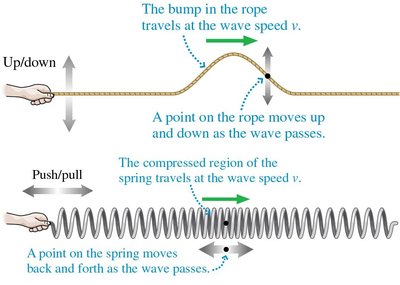
Types of Waves:
Mechanical Waves: Require a material medium (e.g., sound in air, water waves).
Electromagnetic Waves: Do not require a medium; they are oscillations of the electromagnetic field (e.g., light, radio waves).
The medium must be elastic, providing a restoring force to return particles to equilibrium after displacement. Waves transfer energy, not matter.
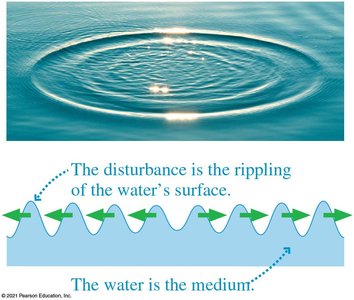
15.1.1 Earthquake Waves
Earthquakes generate two main types of seismic waves:
P Waves (Primary): Longitudinal, faster, less destructive.
S Waves (Secondary): Transverse, slower, more destructive.
These waves travel through the Earth's crust, transferring energy from the earthquake's source.
15.2 Waves on a String
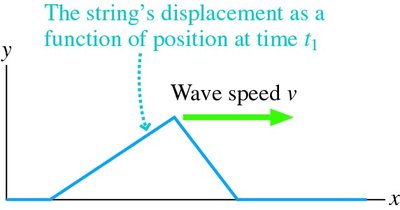
When a transverse wave pulse moves along a stretched string, each point on the string moves up and down as the pulse passes. The pulse continues due to the internal dynamics of the medium.
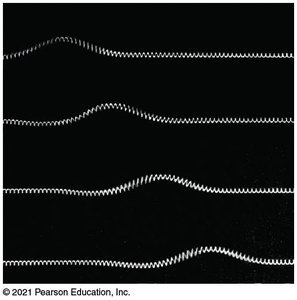
15.2.1 Wave Speed
The speed at which a disturbance travels through a medium is called the wave speed (v). For a string, the wave speed depends on the tension and the linear density (mass per unit length):
Linear Density (μ): $\mu = \frac{m}{l}$ (kg/m)
Wave Speed on a String: $v_{\text{string}} = \sqrt{\frac{T_s}{\mu}}$
Where $T_s$ is the tension in the string. The wave speed is a property of the medium, not the wave itself.
15.2.2 Sound Waves in a Gas
Sound waves are longitudinal waves that travel through gases, liquids, or solids. The speed of sound in a gas depends on the properties of the gas:
Speed of Sound in a Gas: $v_{\text{sound}} = \sqrt{\frac{\gamma R T}{M}} = \sqrt{\frac{\gamma k_B T}{m}}$
Where $\gamma$ is the adiabatic index, $R$ is the ideal gas constant, $T$ is temperature in Kelvin, $M$ is molar mass, $k_B$ is Boltzmann's constant, and $m$ is molecular mass.
The speed of sound increases with temperature.
The speed of sound decreases as the molecular mass increases.
The speed of sound does not depend on the pressure of the gas.
15.2.3 Electromagnetic Waves
Electromagnetic waves can travel through a vacuum. The speed of light in a vacuum is a universal constant:
Speed of Light in Vacuum: $c = 3.00 \times 10^8$ m/s
Speed of Light in a Medium: $v = \frac{c}{n}$, where $n$ is the index of refraction.
15.2.4 Example: Distance to a Lightning Strike
Sound travels approximately 1 km in 3 s (or 1 mi in 5 s). By counting the seconds between seeing lightning and hearing thunder, you can estimate the distance to the lightning strike.
15.2.5 Example: Spider Sensing Vibrations
A spider detects vibrations in its web. If the web's linear density is $1.0 \times 10^{-5}$ kg/m and the tension is 0.15 N, the wave speed is:
$v_{\text{string}} = \sqrt{\frac{0.15}{1.0 \times 10^{-5}}} = 120$ m/s
Time to travel 0.30 m: $\Delta t = \frac{0.30}{120} = 2.5 \times 10^{-3}$ s
15.2.6 Example: Tsunami
A tsunami is a shallow-water wave. Its speed depends on ocean depth $d$:
Speed of Shallow-Water Wave: $v = \sqrt{g d}$
As the tsunami approaches land (shallower water), it slows down and its width decreases proportionally.
15.3 Snapshot and History Graphs
Waves can be analyzed using two types of graphs:
Snapshot Graph: Shows displacement as a function of position at a single instant.
History Graph: Shows displacement of a single point as a function of time.
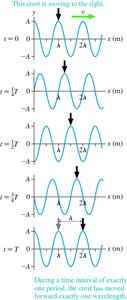
Sinusoidal waves are generated by simple harmonic motion (SHM) oscillators. The displacement $y(x, t)$ is a function of both position and time. The wavelength ($\lambda$) is the spatial period, and the period ($T$) is the temporal period.
15.3.1 Mathematical Description of Sinusoidal Waves
The general equation for a sinusoidal traveling wave is:
$y(x, t) = A \sin(kx - \omega t + \phi_0)$
Where:
$A$ = amplitude
$k = \frac{2\pi}{\lambda}$ = wave number (rad/m)
$\omega = 2\pi f$ = angular frequency (rad/s)
$\phi_0$ = phase constant
$f$ = frequency (Hz)
$T = 1/f$ = period (s)
15.4 Sound and Light
Sound waves are longitudinal waves consisting of compressions and rarefactions. The pressure oscillates around atmospheric pressure. Ultrasound imaging uses high-frequency sound waves and their reflections at tissue boundaries for medical imaging.
Light waves are electromagnetic waves. All electromagnetic waves travel at the same speed in a vacuum, but their wavelength and frequency can vary.
15.5 Circular and Spherical Waves
Wave fronts are lines (or surfaces) of constant phase, such as the crests of ripples on a pond. Circular waves spread in two dimensions, while spherical waves spread in three. Far from the source, spherical waves appear as plane waves.
Power and Intensity:
Power (P): Rate of energy transfer (W = J/s).
Intensity (I): Power per unit area, $I = \frac{P}{A}$ (W/m2).
For a spherical wave, intensity at distance $r$ is $I = \frac{P}{4\pi r^2}$.
15.6 Decibels
The human ear can detect a wide range of sound intensities. The sound intensity level in decibels (dB) is defined as:
$\beta = 10 \log_{10}\left(\frac{I}{I_0}\right)$
Where $I_0 = 1.0 \times 10^{-12}$ W/m2 is the threshold of hearing.
15.7 The Doppler Effect
The Doppler effect is the change in frequency of a wave due to the relative motion of the source and observer.
Source Approaching Observer: $f' = f \left(\frac{v}{v - v_s}\right)$
Source Receding from Observer: $f' = f \left(\frac{v}{v + v_s}\right)$
Observer Moving Toward Source: $f' = f \left(\frac{v + v_o}{v}\right)$
Observer Moving Away from Source: $f' = f \left(\frac{v - v_o}{v}\right)$
Where $f$ is the emitted frequency, $v$ is the wave speed, $v_s$ is the source speed, and $v_o$ is the observer speed.
The Doppler effect also applies to light waves, resulting in redshift (source moving away) or blueshift (source moving toward).
Summary Table: Key Wave Quantities
Quantity | Symbol | Equation | SI Unit |
|---|---|---|---|
Wave Speed (string) | v | $v = \sqrt{\frac{T_s}{\mu}}$ | m/s |
Wave Speed (sound in gas) | v | $v = \sqrt{\frac{\gamma R T}{M}}$ | m/s |
Wavelength | $\lambda$ | $\lambda = \frac{v}{f}$ | m |
Frequency | f | $f = \frac{1}{T}$ | Hz |
Angular Frequency | $\omega$ | $\omega = 2\pi f$ | rad/s |
Wave Number | k | $k = \frac{2\pi}{\lambda}$ | rad/m |
Intensity | I | $I = \frac{P}{A}$ | W/m2 |
Sound Level | $\beta$ | $\beta = 10 \log_{10}\left(\frac{I}{I_0}\right)$ | dB |
