 뒤로
뒤로Traveling Waves: Fundamental Concepts and Applications
스터디 가이드 - 스마트 노트
 자료에 맞춘 맞춤형 노트, 핵심 정의, 예시, 맥락을 확장해 제공합니다.
Traveling Waves
Introduction to Waves
Traveling waves are fundamental phenomena in physics, representing organized disturbances that propagate through a medium with a well-defined speed. Understanding waves is essential for analyzing a wide range of physical systems, from water waves to sound and light.

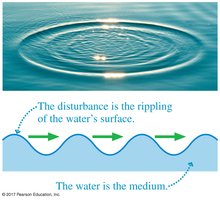
Wave: A disturbance that travels through a medium, transferring energy without permanently displacing the medium's particles.
Medium: The substance or material through which the wave propagates (e.g., water, air, string).
Example: Ripples on a pond are a classic example of a traveling wave, where the water acts as the medium.
Types of Waves
Waves are classified based on the direction of particle displacement relative to the direction of wave propagation.
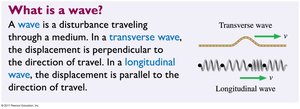
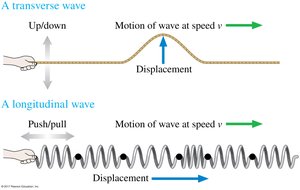
Transverse Wave: The displacement of particles is perpendicular to the direction of wave travel. Example: Waves on a string, electromagnetic waves.
Longitudinal Wave: The displacement of particles is parallel to the direction of wave travel. Example: Sound waves, compression waves in springs.
Wave Properties
Several key properties characterize waves and determine their behavior in different media.
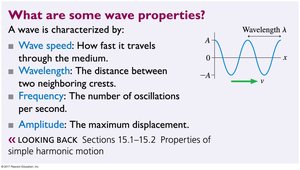
Wave Speed (v): The rate at which the wave propagates through the medium.
Wavelength (λ): The distance between two consecutive crests or troughs.
Frequency (f): The number of oscillations per second, measured in Hertz (Hz).
Amplitude (A): The maximum displacement from equilibrium.
Formula for wave speed:
where is wavelength and is period.
Sound and Light Waves
Sound and light are two of the most important types of waves encountered in physics.
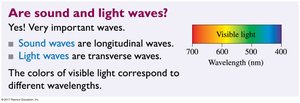
Sound Waves: Longitudinal waves that propagate through air or other media.
Light Waves: Transverse electromagnetic waves that travel through vacuum and transparent materials.
Visible Light: The colors of visible light correspond to different wavelengths, ranging from approximately 400 nm (violet) to 700 nm (red).
Energy Transport by Waves
Waves carry energy as they propagate, and the rate of energy transfer is described by the wave's intensity.
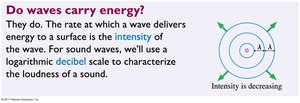
Intensity (I): The power delivered per unit area by the wave.
Decibel Scale: Used to characterize the loudness of sound waves, based on a logarithmic scale.
Example: The intensity of sound decreases as the distance from the source increases.
The Doppler Effect
The Doppler effect describes the change in frequency and wavelength of a wave due to the relative motion between the source and the observer.
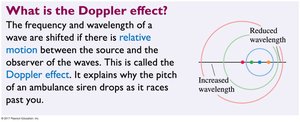
Doppler Effect: When the source moves toward the observer, the observed frequency increases; when it moves away, the frequency decreases.
Application: Explains why the pitch of an ambulance siren changes as it passes by.
Applications of Waves
Waves are ubiquitous in nature and technology, playing crucial roles in communication, medical imaging, and environmental phenomena.
Communications: Radios, cell phones, and fiber optics rely on wave propagation.
Medical Imaging: Ultrasound uses high-frequency sound waves.
Environmental: Waves are present in oceans, the atmosphere, and the earth.
Mathematical Description of Waves
Wave Speed on a String
The speed of a transverse wave on a stretched string depends on the tension and the linear density of the string.


Wave Speed Formula:
Linear Density: , where is mass and is length.
Snapshot and History Graphs
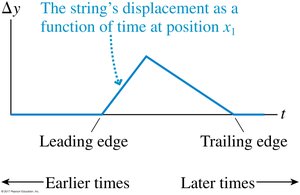
Wave motion can be visualized using two types of graphs: snapshot graphs (displacement vs. position at a fixed time) and history graphs (displacement vs. time at a fixed position).
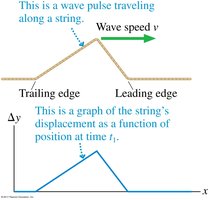
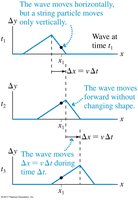
Snapshot Graph: Shows the shape of the wave at a specific instant.
History Graph: Shows how a single point in the medium oscillates over time.
Sinusoidal Waves
Sinusoidal waves are generated by sources oscillating with simple harmonic motion. Each particle in the medium undergoes SHM with frequency and amplitude .
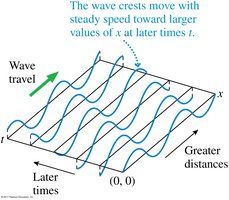
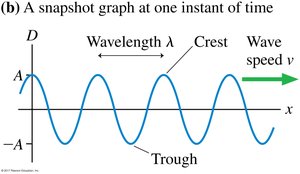
Amplitude (A): Maximum displacement.
Wavelength (λ): Distance spanned by one cycle.
Period (T): Time for one complete oscillation.
Frequency (f):
Mathematical Formulation
The displacement of a sinusoidal traveling wave is described by:
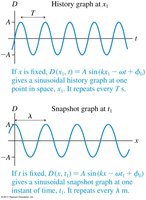
Wave Equation:
Angular Frequency:
Wave Number:
Wave Speed:
Wave Equation for a String
Applying Newton's second law to a small segment of string yields the wave equation:
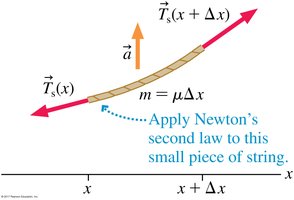
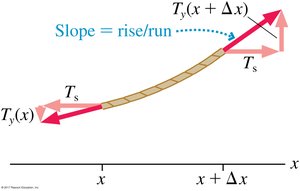

Wave Equation:
This equation governs the dynamics of wave motion on a string.
Summary Table: Key Wave Properties
Property | Definition | Formula |
|---|---|---|
Wave Speed | Speed at which wave propagates | |
Wavelength | Distance between crests | |
Frequency | Oscillations per second | |
Amplitude | Maximum displacement | |
Wave Number | Spatial frequency | |
Angular Frequency | Temporal frequency |
Conclusion
Traveling waves are central to understanding many physical phenomena. Their mathematical description, properties, and applications span across physics, engineering, and everyday life. Mastery of these concepts is essential for further study in acoustics, optics, and electromagnetic theory.
