 뒤로
뒤로Wave Nature of Light: Interference and Diffraction
스터디 가이드 - 스마트 노트
 자료에 맞춘 맞춤형 노트, 핵심 정의, 예시, 맥락을 확장해 제공합니다.
Wave Nature of Light: Interference and Diffraction
Wavefronts and Rays
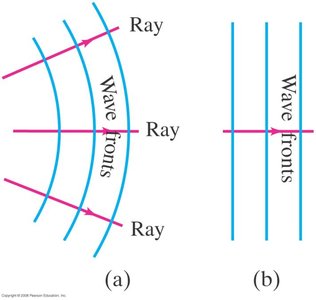
The propagation of waves, such as sound or electromagnetic waves, can be described using wavefronts. A wavefront is a surface over which the phase of the wave is constant. For a point source in three dimensions, wavefronts are spherical; far from the source, they become nearly planar (plane waves). Rays are lines perpendicular to the wavefronts, indicating the direction of energy propagation.
Huygens' Principle
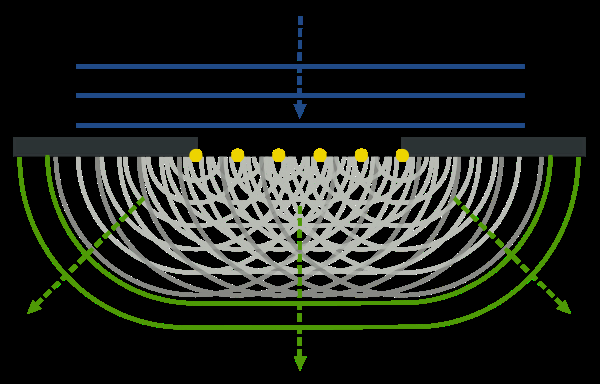
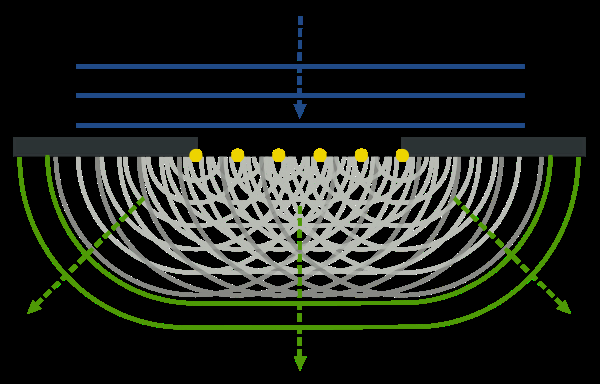
Huygens' Principle states that every point on a wavefront acts as a source of secondary spherical wavelets. The new wavefront at a later time is the surface tangent to these secondary wavelets. This principle explains the propagation, reflection, refraction, and diffraction of waves.
Diffraction
Diffraction is the bending of waves around obstacles or through openings. It becomes significant when the size of the obstacle or aperture is comparable to the wavelength of the wave. Huygens' principle provides a framework for understanding diffraction patterns.
Young's Double-Slit Experiment
Experimental Setup
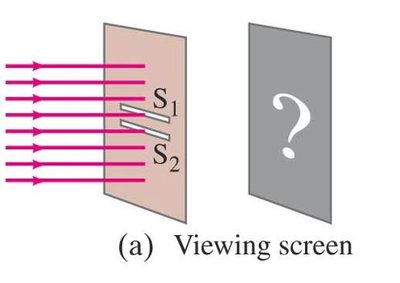
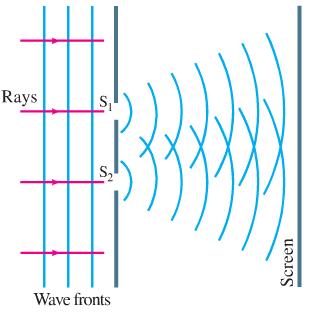
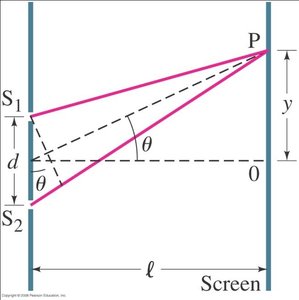
Young's experiment provided direct evidence for the wave nature of light. A beam of monochromatic light passes through two closely spaced slits, S1 and S2, producing an interference pattern of bright and dark fringes on a screen.
Interference Pattern Formation
The two slits act as coherent sources, emitting waves with a constant phase difference. The superposition of these waves leads to constructive and destructive interference, forming a pattern of alternating bright and dark bands (fringes) on the screen.
Conditions for Constructive and Destructive Interference
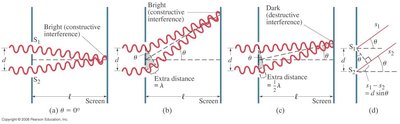
Constructive interference (bright fringes): Occurs when the path difference between the two waves is an integer multiple of the wavelength: , where
Destructive interference (dark fringes): Occurs when the path difference is a half-integer multiple of the wavelength:
Path Difference and Fringe Position
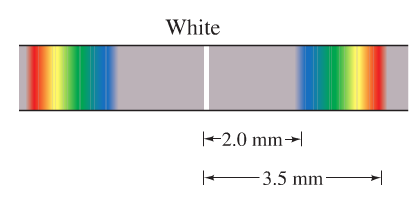
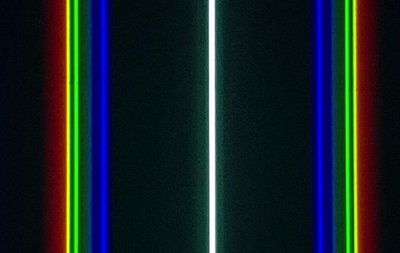
The position of the fringes depends on the wavelength and the geometry of the setup. For white light, the central fringe is white, while other fringes show a spectrum due to the wavelength dependence.
Mathematical Description
Path difference:
Fringe position on the screen: for small angles, where is the distance from the slits to the screen.
Intensity Distribution
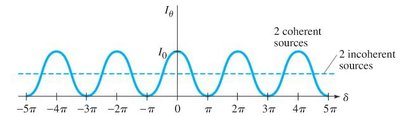
The intensity at a point on the screen due to two coherent sources is given by:
Electric field:
Intensity:
Diffraction Grating
Principle and Equation
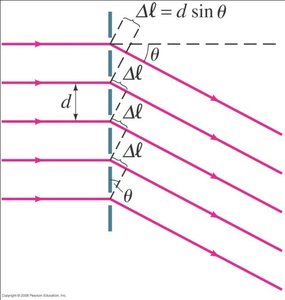
A diffraction grating consists of many equally spaced slits. It produces sharp interference maxima at angles given by:
, where is the slit separation and is the order of the maximum.
Single-Slit Diffraction
Qualitative Description
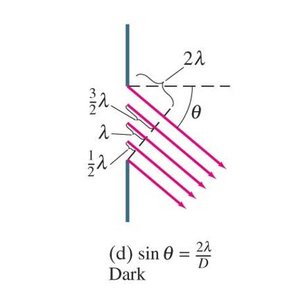
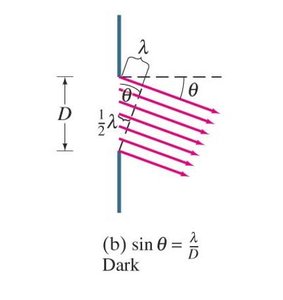
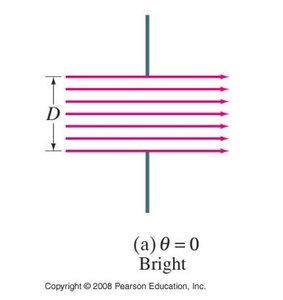
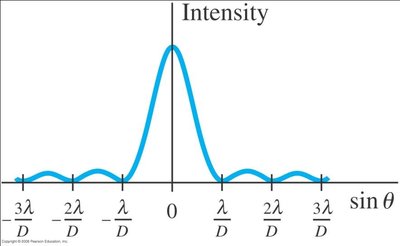
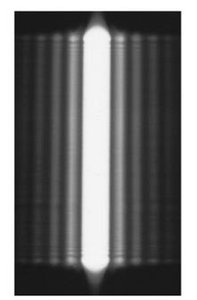
When monochromatic light passes through a single slit of width (comparable to ), it produces a central bright maximum and several dimmer maxima and minima on either side. The minima (dark fringes) occur at angles where:
,
Intensity Distribution
The intensity pattern for a single slit is given by:
Combined Interference and Diffraction (Double-Slit with Finite Width)
When the slits in Young's experiment have a finite width, the observed pattern is a combination of the double-slit interference and the single-slit diffraction envelope. The resulting intensity is:
Diffraction by Circular Apertures and Resolution
Airy Disk and Angular Resolution
Light passing through a circular aperture forms a central bright spot (Airy disk) surrounded by concentric rings. The angular radius of the first dark ring is given by:
, where is the aperture diameter.
Rayleigh Criterion
The Rayleigh criterion states that two point sources are just resolvable when the center of one Airy disk falls on the first minimum of the other. The minimum resolvable angle is:
X-ray Diffraction and Bragg's Law
Principle
X-rays have wavelengths on the order of atomic spacings in crystals. When X-rays are incident on a crystal, they are diffracted by the regularly spaced planes of atoms. Constructive interference occurs when the path difference between rays reflected from successive planes equals an integer multiple of the wavelength.
Bragg's Law:
Applications
X-ray diffraction is a powerful tool for determining the structure of crystals, molecules (such as DNA), and other materials at the atomic scale.
