 뒤로
뒤로Wave-Particle Duality and Quantum Concepts: Matter Waves, Photons, and Atomic Structure
스터디 가이드 - 스마트 노트
 자료에 맞춘 맞춤형 노트, 핵심 정의, 예시, 맥락을 확장해 제공합니다.
Matter Waves and the Wave-Particle Duality
Introduction to Quantum Duality
Quantum mechanics introduces the concept that all particles exhibit both wave-like and particle-like properties, a phenomenon known as wave-particle duality. This duality extends to both matter (such as electrons and atoms) and electromagnetic radiation (such as light).
Classical Waves: In classical physics, waves transfer energy and momentum without transporting matter.
Quantum Waves: In quantum physics, particles are associated with waves that satisfy a differential equation. This leads to the concept of matter waves.
Photons: Electromagnetic waves can be described as particles called photons, which are massless and carry energy and momentum.
de Broglie Wavelength of Matter
Louis de Broglie proposed that every particle with momentum p has an associated wavelength, given by:
where is Planck's constant and is the momentum of the particle. For a particle of mass and velocity :
This formula applies to all matter, from electrons to macroscopic objects, though the wavelength becomes extremely small for large masses.
Example (Football): The de Broglie wavelength of a 0.20 kg football moving at 15 m/s is:
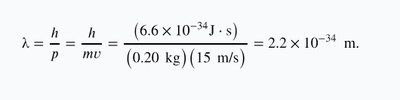

Interpretation: For macroscopic objects, the wavelength is so small that quantum effects are unobservable.
Wavelength of an Electron
For microscopic particles like electrons, the de Broglie wavelength is significant and can be measured experimentally. For example, the wavelength of an electron accelerated through a potential difference of 100 V can be calculated using energy and momentum relations.

Electron Diffraction and Electron Microscopy
Electron Diffraction
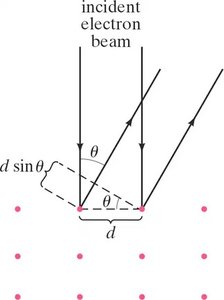
When electrons pass through a crystal lattice, they exhibit diffraction patterns, confirming their wave-like nature. The condition for constructive interference is given by Bragg's law:
d: Spacing between crystal planes
θ: Angle of incidence/reflection
n: Order of the maximum
Electron Microscopy
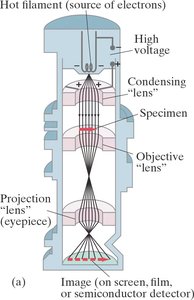
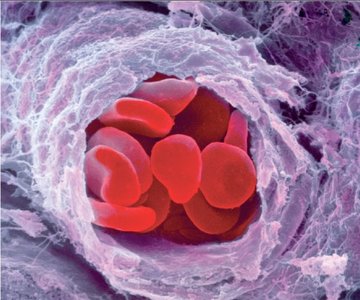
Electron microscopes use accelerated electrons (with short de Broglie wavelengths) to achieve much higher resolution than optical microscopes. The electron beam is focused using electromagnetic lenses to form highly magnified images of specimens.
Atomic Structure and Quantization
Bohr Model of the Atom
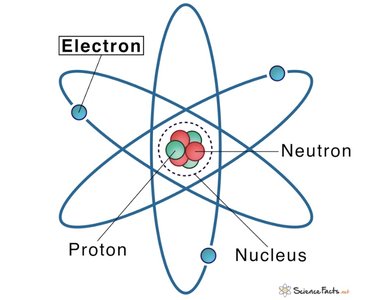
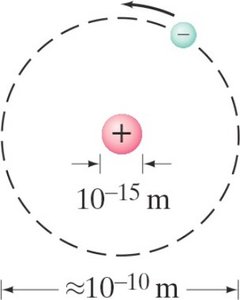
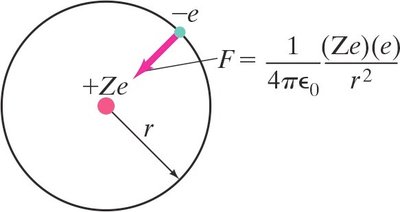
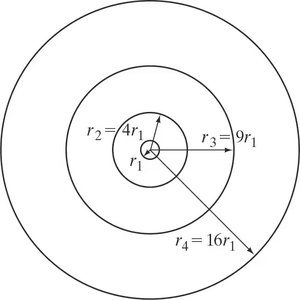
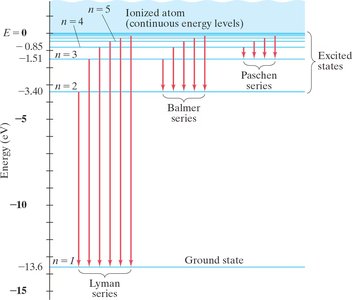
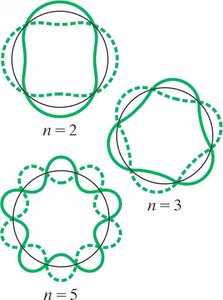
The Bohr model describes electrons in atoms as occupying quantized orbits with specific energies. Transitions between these orbits result in the emission or absorption of photons with discrete energies, producing spectral lines.
Quantization of Angular Momentum: Only certain orbits are allowed, where the angular momentum is an integer multiple of .
Stationary States: Electrons in these orbits do not radiate energy.
Energy Transitions: When an electron jumps between orbits, a photon is emitted or absorbed with energy .
Energy Levels and Spectra
Atoms have discrete energy levels. The hydrogen atom, for example, exhibits spectral lines corresponding to transitions between these levels. The energy difference between levels determines the frequency of emitted or absorbed light:
Photons and the Photoelectric Effect
Photon Energy and Momentum
Light can be described as a stream of photons, each with energy and momentum:
Energy:
Momentum:
The Photoelectric Effect
When light of sufficient frequency strikes a metal surface, electrons are ejected. This effect can only be explained if light consists of photons with quantized energy. The maximum kinetic energy of ejected electrons is:
where is the work function of the material.

Compton Effect: Photon Momentum
Compton Scattering
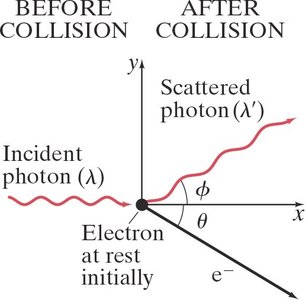
The Compton effect demonstrates that photons carry momentum. When X-rays scatter off electrons, the wavelength of the scattered photon increases, consistent with conservation of energy and momentum:
Lasers and Stimulated Emission
Principle of Laser Operation
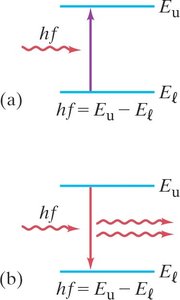
Lasers (Light Amplification by Stimulated Emission of Radiation) produce coherent light by stimulating atoms to emit photons in phase and in the same direction. This process relies on the quantum properties of energy levels and photon emission.
Stimulated Emission: An incoming photon causes an excited atom to emit a second photon with identical properties.
Coherence: The emitted photons are coherent, meaning they have the same wavelength, phase, and direction.
Nuclear Physics: Mass-Energy Equivalence and Binding Energy
Mass-Energy Equivalence
Einstein's famous equation relates mass and energy:
This principle is fundamental in nuclear physics, where small changes in mass correspond to large amounts of energy released or absorbed in nuclear reactions.
Nuclear Structure and Binding Energy
Nuclei are composed of protons and neutrons (nucleons). The binding energy is the energy required to separate a nucleus into its constituent nucleons. A stable nucleus has less mass than the sum of its parts; the difference is the binding energy, released in nuclear reactions such as fission and fusion.
Notation: denotes a nucleus with atomic number and mass number .
Binding Energy per Nucleon: Higher binding energy per nucleon means greater stability.
Example: In nuclear fission, about 200 MeV of energy is released per event, primarily as kinetic energy of the products and radiation.
Radioactivity
Unstable nuclei undergo radioactive decay, transforming into more stable nuclei and releasing energy in the process. This can occur naturally or be induced by neutron bombardment.
Additional info: This summary covers the quantum concepts of matter waves, photons, atomic structure, and nuclear physics, as outlined in the provided materials. All images included are directly relevant to the explanations and reinforce the academic content.
