 뒤로
뒤로Work, Kinetic Energy, and Applications (Ch 09 Study Notes)
스터디 가이드 - 스마트 노트
 자료에 맞춘 맞춤형 노트, 핵심 정의, 예시, 맥락을 확장해 제공합니다.
Work and Kinetic Energy
Introduction to Energy and Kinetic Energy
Energy is a fundamental physical quantity that objects possess, though its exact nature is abstract. What is well understood is how energy behaves: it can be transferred or transformed but cannot be created or destroyed (the Law of Conservation of Energy). The SI unit of energy is the joule (J). Energy exists in various forms, including kinetic, potential, thermal, light, sound, and electrical energy.
Kinetic Energy (KE or K): The energy due to an object's motion. It is a scalar quantity, always positive, and has no direction.
Formula:
Example: Calculate the kinetic energy of a 5 kg box moving at 3 m/s to the right and 2 m/s to the left. Since kinetic energy depends on speed (not direction), both cases use the same formula.
Application: The kinetic energy of large objects, such as meteors, can be immense due to their mass and speed. For example, a meteor with a mass of kg releasing J of energy can have its speed estimated using the kinetic energy formula.
Work
Work Done by a Constant Force
Work is the process of energy transfer to or from an object via the application of force along a displacement. The SI unit of work is the joule (J). Work is positive when the force acts in the direction of motion and negative when it acts against the motion.
Formula:
Where is the magnitude of the force, is the displacement, and is the angle between the force and displacement vectors.
Example: Pulling a 2 kg box with a 3 N force over 5 m, or stopping a 5 kg cart with a 100 N force over 2.5 m.
Work Done by Gravity
Gravity, as a force, can do work on objects. The work done by gravity depends only on the vertical displacement, not the path taken (path independence).
Formula: (positive if the object moves downward, negative if upward)
Example: Calculating the work done by gravity on a falling book or a rock thrown upward.
Dot Product and Work
Dot Product (Scalar Product)
The dot product is a way to multiply two vectors to obtain a scalar. It is essential in calculating work, as work is the dot product of force and displacement vectors.
Formula (magnitudes and angle):
Formula (components):
Properties: The dot product is maximum when vectors are parallel, zero when perpendicular, and negative when in opposite directions.
Work by Variable Forces
Work from Force vs. Displacement Graphs
When the force varies with position, the work done is the area under the force vs. displacement graph. Areas above the x-axis represent positive work, while areas below represent negative work.
For variable forces:
Example: Calculating work done by a force from m to m.
Springs and Hooke's Law
Spring Force and Hooke's Law
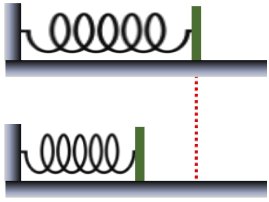
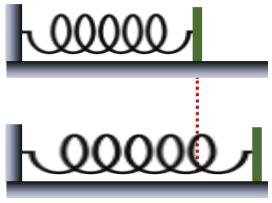
Springs exert a restoring force proportional to their displacement from equilibrium, described by Hooke's Law. The force is always directed opposite to the displacement.
Hooke's Law:
is the spring constant (N/m), is the displacement from equilibrium.
Restoring force: Always acts to return the spring to its original length.
Example: Calculating the force required to stretch or compress a spring, or finding the spring constant from force and displacement data.
Work Done by Springs
The work done by or on a spring is calculated using the area under the force vs. displacement curve, which is a triangle for a linear spring.
Formula:
The negative sign indicates that the work done by the spring is opposite to the direction of displacement.
Example: Calculating the work required to compress or stretch a spring between two positions.
Net Work and the Work-Energy Theorem
Net Work
The net work done on an object is the sum of the work done by all forces acting on it. It can be calculated by summing individual works or by using the net force over the displacement.
Formula:
The Work-Energy Theorem
The work-energy theorem states that the net work done on an object is equal to its change in kinetic energy.
Formula:
Application: Useful for solving problems where forces are not explicitly given but energy changes are known.
Power
Introduction to Power
Power is the rate at which work is done or energy is transferred. The SI unit of power is the watt (W), where .
Average Power:
Example: Calculating the energy used by a 100-watt light bulb in one hour, or the average power delivered by a car engine during acceleration.
Summary Table: Key Formulas
Concept | Formula | Description |
|---|---|---|
Kinetic Energy | Energy due to motion | |
Work (Constant Force) | Energy transferred by force | |
Work (Variable Force) | Area under F-x graph | |
Work by Gravity | Work done by gravity | |
Spring Force | Hooke's Law | |
Work by Spring | Work done by spring | |
Net Work | Sum of all works | |
Work-Energy Theorem | Net work equals change in kinetic energy | |
Power | Rate of energy transfer |
Additional info: These notes cover the core concepts of Chapter 9: Work and Kinetic Energy, including the calculation of work for constant and variable forces, the application of the dot product, the behavior of springs, and the relationship between work and energy. Problems and examples are provided to reinforce understanding and application of these principles.
