Ch. 02 - Describing Motion: Kinematics in One Dimension
Giancoli Douglas - Physics for Scientists and Engineers 5th edition
Giancoli Douglas5th editionPhysics for Scientists and EngineersISBN: 9780137488179당신이 사용하는 게 아니라요?교과서 변경
2장, 문제 68c

A baseball is seen to pass upward by a window with a vertical speed of 13 m/s. If the ball was thrown by a person 18 m below on the street, when was it thrown?

검증된 단계별 안내
1
Identify the known values: The vertical speed of the baseball as it passes the window is \( v = 13 \; \text{m/s} \), and the height difference between the thrower and the window is \( h = 18 \; \text{m} \). The acceleration due to gravity is \( g = 9.8 \; \text{m/s}^2 \). We need to determine the time \( t \) when the ball was thrown relative to the moment it passes the window.
Use the kinematic equation for vertical motion: \( v = v_0 - g t \), where \( v_0 \) is the initial velocity of the ball, \( v \) is the velocity at a given time, \( g \) is the acceleration due to gravity, and \( t \) is the time elapsed. Rearrange this equation to express \( t \) in terms of \( v \) and \( v_0 \): \( t = \frac{v_0 - v}{g} \).
Next, use the kinematic equation for displacement: \( h = v_0 t - \frac{1}{2} g t^2 \), where \( h \) is the vertical displacement. Substitute the expression for \( t \) from the previous step into this equation to solve for \( v_0 \), the initial velocity of the ball.
Once \( v_0 \) is determined, substitute it back into the equation \( t = \frac{v_0 - v}{g} \) to calculate the time \( t \) when the ball was thrown relative to the moment it passes the window.
Perform the algebraic manipulations and substitutions carefully to ensure consistency in units and accuracy in solving for \( t \). This will give you the time elapsed from the throw to the moment the ball passes the window.

비슷한 문제에 대한 검증된 영상 답변:

이 영상 해법은 위 문제에 도움이 된다고 튜터들이 추천한 것입니다.
도움이 되었나요?

주요 개념

질문에 올바르게 답하기 위해 반드시 이해해야 하는 핵심 개념들은 다음과 같습니다.

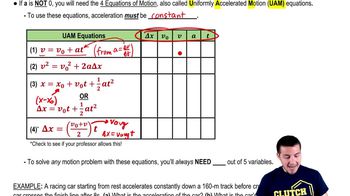
Kinematics

Kinematics is the branch of physics that deals with the motion of objects without considering the forces that cause the motion. It involves concepts such as displacement, velocity, and acceleration. In this scenario, understanding the kinematic equations is essential to determine the time it takes for the baseball to travel upward from the point of release to the window.
추천 영상:
가이드 코스
08:25
Kinematics Equations

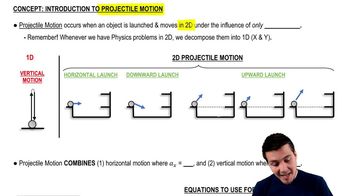
Projectile Motion

Projectile motion refers to the motion of an object that is thrown into the air and is subject to gravitational acceleration. The path of a projectile is typically parabolic, and its vertical and horizontal motions can be analyzed separately. In this case, the baseball's upward motion and the effect of gravity on its trajectory are crucial for calculating when it was thrown.
추천 영상:
가이드 코스
04:44
Introduction to Projectile Motion

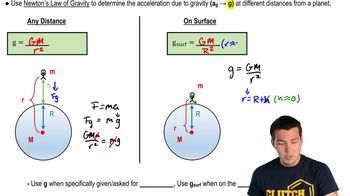
Acceleration due to Gravity

Acceleration due to gravity is the rate at which an object accelerates towards the Earth when in free fall, approximately 9.81 m/s². This constant affects the vertical motion of the baseball after it is thrown. Understanding how gravity influences the ball's upward speed and its eventual descent is vital for determining the time of the throw.
추천 영상:
가이드 코스
05:20
Acceleration Due to Gravity