Ch. 02 - Describing Motion: Kinematics in One Dimension
Giancoli Douglas - Physics for Scientists and Engineers 5th edition
Giancoli Douglas5th editionPhysics for Scientists and EngineersISBN: 9780137488179당신이 사용하는 게 아니라요?교과서 변경
2장, 문제 74b

Air resistance acting on a falling body can be taken into account by the approximate relation for the acceleration: a = dv/dt = g ― kv, where k is a constant. Determine an expression for the terminal velocity, which is the maximum value the velocity reaches.

검증된 단계별 안내
1
Start by understanding the given equation: \( a = \frac{dv}{dt} = g - kv \), where \( g \) is the acceleration due to gravity, \( k \) is a constant, and \( v \) is the velocity. The terminal velocity occurs when the acceleration \( a \) becomes zero, meaning the velocity no longer changes.
Set \( a = 0 \) in the equation \( a = g - kv \). This gives \( 0 = g - kv \). Rearrange this equation to solve for \( v \), which represents the terminal velocity.
Rearranging \( 0 = g - kv \), we get \( kv = g \). Divide both sides of the equation by \( k \) to isolate \( v \). This results in \( v = \frac{g}{k} \).
Interpret the result: The terminal velocity \( v_t \) is given by \( v_t = \frac{g}{k} \). This is the maximum velocity the object can reach when the force of air resistance balances the gravitational force.
Conclude that the terminal velocity depends on the constant \( k \), which represents the proportionality of air resistance, and \( g \), the acceleration due to gravity. A larger \( k \) (stronger air resistance) results in a smaller terminal velocity, while a smaller \( k \) results in a higher terminal velocity.

비슷한 문제에 대한 검증된 영상 답변:

이 영상 해법은 위 문제에 도움이 된다고 튜터들이 추천한 것입니다.

주요 개념

질문에 올바르게 답하기 위해 반드시 이해해야 하는 핵심 개념들은 다음과 같습니다.

Terminal Velocity

Terminal velocity is the constant speed that a freely falling object eventually reaches when the resistance of the medium through which it is falling prevents further acceleration. At this point, the force of gravity is balanced by the drag force, resulting in zero net acceleration. This concept is crucial for understanding how objects behave under the influence of gravity and air resistance.
추천 영상:
가이드 코스
7:27
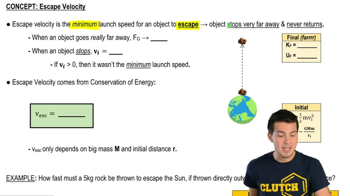
Escape Velocity

Air Resistance

Air resistance, or drag, is the force that opposes the motion of an object through air. It increases with the speed of the object and is influenced by factors such as the object's shape, size, and the density of the air. In the context of falling bodies, air resistance plays a significant role in determining the terminal velocity and affects how quickly an object accelerates.
추천 영상:
가이드 코스
05:06
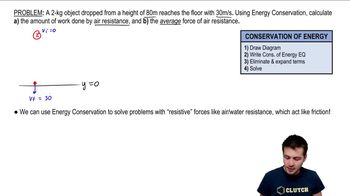
Energy Conservation with Air Resistance

Differential Equations

Differential equations are mathematical equations that relate a function to its derivatives, often used to describe dynamic systems. In this context, the equation a = dv/dt = g - kv represents a first-order linear differential equation that models the motion of a falling body under gravity and air resistance. Solving this equation helps determine the velocity of the object as a function of time, leading to the expression for terminal velocity.
추천 영상:
가이드 코스
08:25
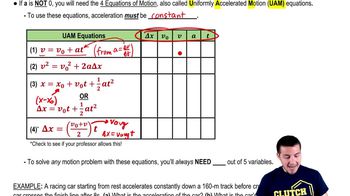
Kinematics Equations