
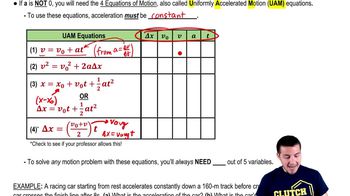
A robot used in a pharmacy picks up a medicine bottle at t = 0. It accelerates at 0.20 m/s² for 4.5 s, then travels without acceleration for 68 s and finally decelerates at ―0.40 m/s² for 2.5 s to reach the counter where the pharmacist will take the medicine from the robot. From how far away did the robot fetch the medicine?
Two children are playing on two trampolines. The first child bounces up one-and-a-half times higher than the second child. The initial speed upwards of the second child is 4.0 m/s. What is the initial speed of the first child?
검증된 단계별 안내
비슷한 문제에 대한 검증된 영상 답변:
주요 개념
Kinematics
Potential Energy and Height
Energy Conservation
A police car at rest is passed by a speeder traveling at a constant 140 km/h. The police officer takes off in hot pursuit and catches up to the speeder in 850 m, maintaining a constant acceleration. Qualitatively plot the position vs. time graph for both cars from the police car's start to the catch-up point.
The position of a ball rolling in a straight line is given by 𝓍 = 2.0 ― 3.6t + 1.7t², where 𝓍 is in meters and t in seconds. What do the numbers 2.0, 3.6, and 1.7 refer to?
A parachutist bails out of an airplane, and freely falls 75 m (ignore air friction). Then the parachute opens, and her acceleration is ― 1.5 m/s² (up). The parachutist reaches the ground with a speed of 1.5 m/s. From how high did she bail out of the plane?
Air resistance acting on a falling body can be taken into account by the approximate relation for the acceleration: a = dv/dt = g ― kv, where k is a constant. Determine an expression for the terminal velocity, which is the maximum value the velocity reaches.
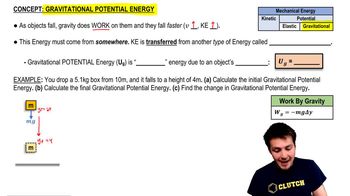
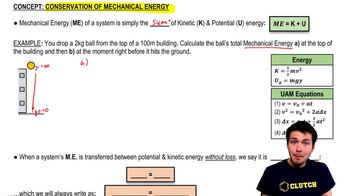
Suppose a 65-kg person jumps from a height of 3.0 m down to the ground. What is the speed of the person just before landing (Chapter 2)?
<IMAGE>
