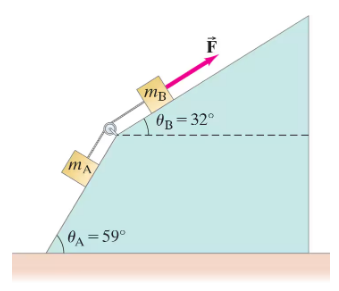
Consider the system shown in Fig. 4–68 with mA = 8.2kg and mB = 11.5kg. The angles θA = 59° and θB = 32°. In the absence of friction, what force would be required to pull the masses at a constant velocity up the fixed inclines?
Ch. 04 - Dynamics: Newton's Laws of Motion
Giancoli Douglas5th editionPhysics for Scientists and EngineersISBN: 9780137488179당신이 사용하는 게 아니라요?교과서 변경
4장, 문제 88c
Consider the system shown in Fig. 4–68 with mA = 8.2kg and mB = 11.5kg. The angles θA = 59° and θB = 32°. In the absence of , what is the tension in the string?

검증된 단계별 안내1
Identify the forces acting on each mass. For m_A, the forces are its weight (m_A * g), the tension in the string (T), and the component of the normal force along the incline. For m_B, the forces are its weight (m_B * g) and the tension in the string (T).
Break the forces into components along the incline for m_A and along the vertical for m_B. For m_A, the component of its weight along the incline is m_A * g * sin(θ_A). For m_B, the weight acts directly downward, so no trigonometric decomposition is needed.
Write the equations of motion for the system. Since the system is in equilibrium (no external force F→ and no acceleration), the net force along the direction of motion for both masses must be zero. This gives: T = m_A * g * sin(θ_A) for m_A and T = m_B * g - m_B * g * sin(θ_B) for m_B.
Set the two expressions for tension (T) equal to each other, as the string is the same for both masses. This gives: m_A * g * sin(θ_A) = m_B * g - m_B * g * sin(θ_B).
Solve for T (tension in the string) by isolating T in the equation. Simplify the equation to express T in terms of the given masses, angles, and gravitational acceleration (g).

비슷한 문제에 대한 검증된 영상 답변:
이 영상 해법은 위 문제에 도움이 된다고 튜터들이 추천한 것입니다.
영상 길이:
15m도움이 되었나요?
주요 개념
질문에 올바르게 답하기 위해 반드시 이해해야 하는 핵심 개념들은 다음과 같습니다.
Tension in a String
Tension is the force transmitted through a string, rope, or cable when it is pulled tight by forces acting from opposite ends. In a system involving pulleys or inclined planes, tension can vary depending on the masses involved and the angles of inclination. Understanding how to calculate tension is crucial for analyzing forces in static or dynamic systems.
추천 영상:
가이드 코스
Energy & Power of Waves on Strings
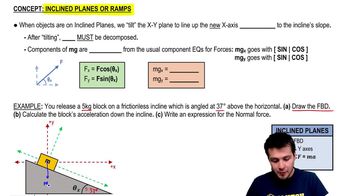
Forces on Inclined Planes
When objects are placed on inclined planes, the gravitational force acting on them can be resolved into two components: one parallel to the incline and one perpendicular to it. The angle of inclination affects these components, influencing the net force acting on the object. This concept is essential for determining the forces at play in the system described in the question.
추천 영상:
가이드 코스
Intro to Inclined Planes
Equilibrium Conditions
For a system to be in equilibrium, the sum of all forces acting on it must equal zero. This means that the forces in both the horizontal and vertical directions must balance out. In the context of the question, applying the conditions of equilibrium allows us to solve for unknowns, such as the tension in the string, by setting up equations based on the forces acting on the masses.
추천 영상:
가이드 코스
Torque & Equilibrium
관련 실천
교과서 질문
1278
views
교과서 질문
The double Atwood machine shown in Fig. 4–55 has frictionless, massless pulleys and cords. Determine the tensions FTA and FTC in the cords.
100
views
교과서 질문
Three mountain climbers who are roped together in a line are ascending an icefield inclined at 29° to the horizontal (Fig. 4–67). The last climber slips, pulling the second climber off his feet. The first climber is able to hold them both. If each climber has a mass of 75 kg, calculate the tension in each of the two sections of rope between the three climbers. Ignore friction between the ice and the fallen climbers.
<IMAGE>
1271
views