Ch. 04 - Dynamics: Newton's Laws of Motion
Giancoli Douglas - Physics for Scientists and Engineers 5th edition
Giancoli Douglas5th editionPhysics for Scientists and EngineersISBN: 9780137488179당신이 사용하는 게 아니라요?교과서 변경
4장, 문제 6

According to a simplified model of a mammalian heart, at each pulse approximately 20 g of blood is accelerated from 0.25 m/s to 0.35 m/s during a period of 0.10 s. What is the magnitude of the force exerted by the heart muscle?

검증된 단계별 안내
1
Identify the given values: mass of the blood (m) = 20 g = 0.020 kg (convert grams to kilograms), initial velocity (v₁) = 0.25 m/s, final velocity (v₂) = 0.35 m/s, and time interval (Δt) = 0.10 s.
Calculate the change in velocity (Δv) using the formula: Δv = v₂ - v₁. Substitute the given values to find the change in velocity.
Determine the acceleration (a) using the formula: a = Δv / Δt. Substitute the values of Δv and Δt to calculate the acceleration.
Use Newton's second law of motion, F = m * a, to calculate the force exerted by the heart. Substitute the values of mass (m) and acceleration (a) into the formula.
Simplify the expression to find the magnitude of the force exerted by the heart muscle.

비슷한 문제에 대한 검증된 영상 답변:

이 영상 해법은 위 문제에 도움이 된다고 튜터들이 추천한 것입니다.
도움이 되었나요?

주요 개념

질문에 올바르게 답하기 위해 반드시 이해해야 하는 핵심 개념들은 다음과 같습니다.

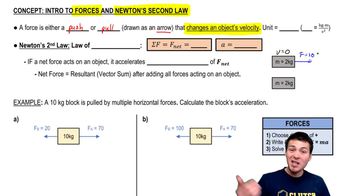
Newton's Second Law of Motion

Newton's Second Law states that the force acting on an object is equal to the mass of the object multiplied by its acceleration (F = ma). In this context, the heart's force can be calculated by determining the acceleration of the blood and multiplying it by the mass of the blood being accelerated.
추천 영상:
가이드 코스
06:54
Intro to Forces & Newton's Second Law

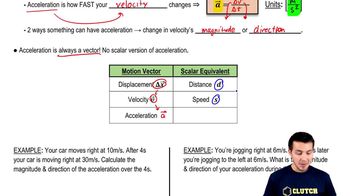
Acceleration

Acceleration is the rate of change of velocity of an object over time. It can be calculated by taking the difference between the final and initial velocities and dividing by the time taken for that change. In this case, the acceleration of the blood can be found by using the velocities of 0.25 m/s and 0.35 m/s over the time period of 0.10 s.
추천 영상:
가이드 코스
05:47
Intro to Acceleration

Mass

Mass is a measure of the amount of matter in an object, typically measured in kilograms or grams. In this problem, the mass of the blood being accelerated is given as 20 g. It is important to convert this mass into kilograms (0.02 kg) when applying it in calculations involving force, as the standard unit of mass in physics is the kilogram.
추천 영상:
가이드 코스
20:32
Mass Spectrometers