Ch. 04 - Dynamics: Newton's Laws of Motion
Giancoli Douglas - Physics for Scientists and Engineers 5th edition
Giancoli Douglas5th editionPhysics for Scientists and EngineersISBN: 9780137488179당신이 사용하는 게 아니라요?교과서 변경
4장, 문제 47

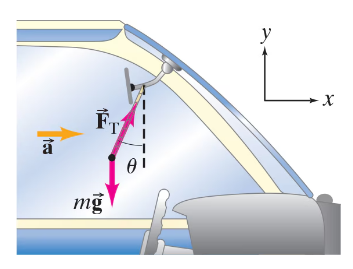
An object is hanging by a string from your rearview mirror. While you are accelerating at a constant rate from rest to 28 m/s in 5.0 s, what angle θ does the string make with the vertical? See Fig. 4–46.
Diagram showing a hanging object in a car, with forces acting on it as the car accelerates, illustrating angle θ with vertical.

검증된 단계별 안내
1
Identify the forces acting on the object: The object is subject to two forces—(1) the gravitational force acting vertically downward, \( F_g = m g \), where \( m \) is the mass of the object and \( g \) is the acceleration due to gravity, and (2) the tension in the string, which has components both vertically and horizontally.
Determine the horizontal acceleration of the car: The car is accelerating at a constant rate. Using the kinematic equation \( a = \frac{v_f - v_i}{t} \), where \( v_f = 28 \ \text{m/s} \), \( v_i = 0 \ \text{m/s} \), and \( t = 5.0 \ \text{s} \), calculate the horizontal acceleration \( a \).
Relate the horizontal force to the horizontal acceleration: The horizontal force on the object is due to the tension in the string, which provides the horizontal component \( F_{T,x} = m a \), where \( a \) is the horizontal acceleration calculated in the previous step.
Analyze the forces to find the angle \( \theta \): The tension in the string has two components—\( F_{T,x} \) (horizontal) and \( F_{T,y} \) (vertical). The vertical component balances the gravitational force, so \( F_{T,y} = m g \). The angle \( \theta \) that the string makes with the vertical can be found using \( \tan \theta = \frac{F_{T,x}}{F_{T,y}} = \frac{m a}{m g} = \frac{a}{g} \).
Solve for \( \theta \): Use the relationship \( \tan \theta = \frac{a}{g} \) to find \( \theta \). Take the arctangent of both sides: \( \theta = \arctan \left( \frac{a}{g} \right) \). Substitute the values of \( a \) and \( g \) to compute the angle.

비슷한 문제에 대한 검증된 영상 답변:

이 영상 해법은 위 문제에 도움이 된다고 튜터들이 추천한 것입니다.
도움이 되었나요?

주요 개념

질문에 올바르게 답하기 위해 반드시 이해해야 하는 핵심 개념들은 다음과 같습니다.

Newton's Second Law of Motion

Newton's Second Law states that the acceleration of an object is directly proportional to the net force acting on it and inversely proportional to its mass. This principle is crucial for understanding how forces affect the motion of the hanging object as the car accelerates, leading to a resultant force that causes the string to make an angle with the vertical.
추천 영상:
가이드 코스
06:54
Intro to Forces & Newton's Second Law

Tension in a String

Tension is the force transmitted through a string or rope when it is pulled tight by forces acting from opposite ends. In this scenario, the tension in the string must balance both the gravitational force acting on the object and the horizontal force due to the car's acceleration, which determines the angle θ that the string makes with the vertical.
추천 영상:
가이드 코스
04:39
Energy & Power of Waves on Strings

Components of Forces

When analyzing forces, it is often useful to break them down into their components, typically horizontal and vertical. In this case, the gravitational force acts vertically downward, while the tension force has both vertical and horizontal components due to the angle θ, allowing us to set up equations to solve for the angle based on the object's acceleration.
추천 영상:
가이드 코스
07:30
Vector Addition By Components