Ch. 04 - Dynamics: Newton's Laws of Motion
Giancoli Douglas - Physics for Scientists and Engineers 5th edition
Giancoli Douglas5th editionPhysics for Scientists and EngineersISBN: 9780137488179당신이 사용하는 게 아니라요?교과서 변경
4장, 문제 40b

At the instant a race began, a 65-kg sprinter exerted a force of 720 N on the starting block at a 22° angle with respect to the ground. If the force was exerted for 0.32 s, with what speed did the sprinter leave the starting block?

검증된 단계별 안내
1
Step 1: Break the force into its horizontal and vertical components. The horizontal component of the force is given by \( F_x = F \cdot \cos(\theta) \), and the vertical component is \( F_y = F \cdot \sin(\theta) \), where \( F = 720 \; \text{N} \) and \( \theta = 22^\circ \).
Step 2: Focus on the horizontal motion, as it determines the sprinter's speed. Use Newton's second law \( F_x = m \cdot a \) to find the horizontal acceleration \( a \). Rearrange the equation to solve for \( a \): \( a = \frac{F_x}{m} \), where \( m = 65 \; \text{kg} \).
Step 3: Use the kinematic equation \( v = u + a \cdot t \) to calculate the final velocity \( v \). Here, \( u = 0 \; \text{m/s} \) (initial velocity), \( a \) is the horizontal acceleration from Step 2, and \( t = 0.32 \; \text{s} \) is the time the force was applied.
Step 4: Substitute the values of \( a \) and \( t \) into the kinematic equation to find \( v \). This will give the sprinter's speed as they leave the starting block.
Step 5: Verify the solution by ensuring all units are consistent (e.g., force in Newtons, mass in kilograms, time in seconds) and that the calculations align with the physical principles of motion.

비슷한 문제에 대한 검증된 영상 답변:

이 영상 해법은 위 문제에 도움이 된다고 튜터들이 추천한 것입니다.
영상 길이:
6m

주요 개념

질문에 올바르게 답하기 위해 반드시 이해해야 하는 핵심 개념들은 다음과 같습니다.

Newton's Second Law of Motion

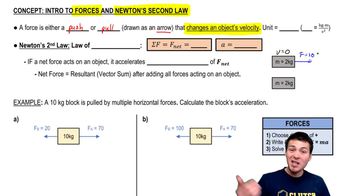
Newton's Second Law states that the acceleration of an object is directly proportional to the net force acting on it and inversely proportional to its mass. This relationship is expressed by the formula F = ma, where F is the net force, m is the mass, and a is the acceleration. In this scenario, understanding how the sprinter's force translates into acceleration is crucial for determining the speed at which they leave the starting block.
추천 영상:
가이드 코스
06:54
Intro to Forces & Newton's Second Law

Components of Force

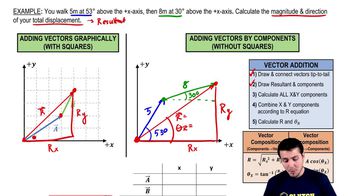
When a force is applied at an angle, it can be broken down into horizontal and vertical components using trigonometric functions. The horizontal component is found using cosine, while the vertical component uses sine. For the sprinter, only the horizontal component of the force contributes to the acceleration in the direction of motion, which is essential for calculating the resulting speed.
추천 영상:
가이드 코스
07:30
Vector Addition By Components

Kinematic Equations

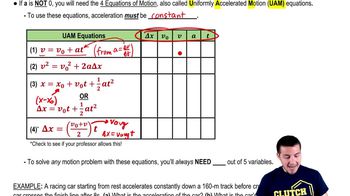
Kinematic equations describe the motion of objects under constant acceleration. They relate displacement, initial velocity, final velocity, acceleration, and time. In this case, the equation v = u + at can be used, where v is the final velocity, u is the initial velocity (zero for a sprinter starting from rest), a is the acceleration derived from the force, and t is the time the force is applied.
추천 영상:
가이드 코스
08:25
Kinematics Equations