
Ch. 05 - Using Newton's Laws: Friction, Circular Motion, Drag Forces
Giancoli Douglas - Physics for Scientists and Engineers 5th edition
Giancoli Douglas5th editionPhysics for Scientists and EngineersISBN: 9780137488179당신이 사용하는 게 아니라요?교과서 변경
5장, 문제 38

A jet plane traveling 1890 km/h (525 m/s) pulls out of a dive by moving in an arc of radius 4.80 km. What is the plane's acceleration in g's?

검증된 단계별 안내
1
Convert the radius of the arc from kilometers to meters. Since 1 km = 1000 m, multiply the radius (4.80 km) by 1000 to get the radius in meters.
Recall the formula for centripetal acceleration: a=v2/r, where v is the velocity and r is the radius of the circular path. Substitute the given velocity (525 m/s) and the radius (converted to meters) into the formula.
Calculate the centripetal acceleration in meters per second squared (m/s²) by performing the division of the squared velocity by the radius.
To express the acceleration in terms of g's, divide the calculated centripetal acceleration by the acceleration due to gravity, g=9.8 m/s2.
The result from the previous step gives the plane's acceleration in g's. Ensure the units are consistent and the final value is dimensionless.

비슷한 문제에 대한 검증된 영상 답변:

이 영상 해법은 위 문제에 도움이 된다고 튜터들이 추천한 것입니다.
영상 길이:
4m
도움이 되었나요?

주요 개념

질문에 올바르게 답하기 위해 반드시 이해해야 하는 핵심 개념들은 다음과 같습니다.

Centripetal Acceleration

Centripetal acceleration is the acceleration experienced by an object moving in a circular path, directed towards the center of the circle. It is calculated using the formula a_c = v²/r, where v is the tangential speed and r is the radius of the circular path. In this scenario, the jet plane's speed and the radius of its arc are essential for determining the centripetal acceleration.
추천 영상:
가이드 코스
06:48
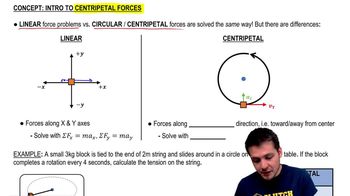
Intro to Centripetal Forces

Acceleration in g's

Acceleration in g's refers to the measurement of acceleration relative to the acceleration due to gravity (g), which is approximately 9.81 m/s². To express acceleration in g's, one divides the calculated acceleration by g. This allows for a more intuitive understanding of the forces acting on the plane and the sensation of acceleration experienced by the pilot.
추천 영상:
가이드 코스
05:47
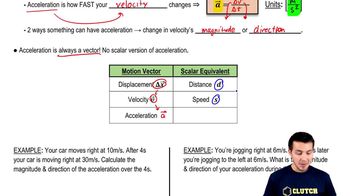
Intro to Acceleration

Units of Measurement

Understanding units of measurement is crucial in physics, as it ensures that calculations are consistent and accurate. In this problem, speed is given in kilometers per hour and meters per second, while radius is in kilometers. Converting all units to a consistent system, such as SI units (meters and seconds), is necessary for correctly applying formulas and obtaining the correct acceleration value.
추천 영상:
가이드 코스
07:46
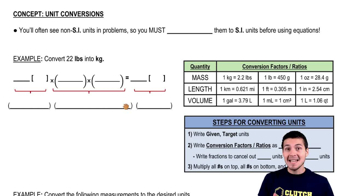
Unit Conversions
관련 실천
교과서 질문

(III) A 4.0-kg block is stacked on top of a 12.0-kg block, which is accelerating along a horizontal table at a = 5.2m/s2 (Fig. 5–43). Let μk = μs = μ. What is the force that must be applied to the 12.0-kg block in (a) and in (b), assuming that the table is frictionless?

1493
views
교과서 질문

On an ice rink two skaters of equal mass grab hands and spin in a mutual circle once every 2.5 s. If we assume their arms are each 0.80 m long and their individual masses are 55.0 kg, how hard are they pulling on one another?

1331
views
교과서 질문

Two blocks made of different materials connected together by a thin cord slide down a ramp inclined at an angle θ to the horizontal, Fig. 5–40 (block B is above block A). The masses of the blocks are mA and mB, and the coefficients of friction are μA and μB. If mA = mB=4.0kg, and μA = 0.20 and μB = 0.30, determine the acceleration of the blocks.

735
views
교과서 질문

Tarzan plans to cross a gorge by swinging in an arc from a hanging vine (Fig. 5–50). If his arms are capable of exerting a force of 1350 N on the vine, what is the maximum speed he can tolerate at the lowest point of his swing? His mass is 78 kg and the vine is 4.8 m long.

1412
views
교과서 질문

A pilot performs an evasive maneuver by diving vertically at a constant 310 m/s. If he can withstand an acceleration of 9.0 g’s without blacking out, at what altitude must he begin to pull his plane out of the dive (moving in a vertical circular path) to avoid crashing into the sea?

1420
views
교과서 질문

Two blocks made of different materials connected together by a thin cord slide down a ramp inclined at an angle θ to the horizontal, Fig. 5–40 (block B is above block A). The masses of the blocks are mA and mB, and the coefficients of friction are μA and μB. If mA = mB = 4.0kg, and μA = 0.20 and μB = 0.30, determine the tension in the cord, for an angle θ = 32°.

566
views