
Ch. 05 - Using Newton's Laws: Friction, Circular Motion, Drag Forces
Giancoli Douglas - Physics for Scientists and Engineers 5th edition
Giancoli Douglas5th editionPhysics for Scientists and EngineersISBN: 9780137488179당신이 사용하는 게 아니라요?교과서 변경
5장, 문제 60

Tarzan plans to cross a gorge by swinging in an arc from a hanging vine (Fig. 5–50). If his arms are capable of exerting a force of 1350 N on the vine, what is the maximum speed he can tolerate at the lowest point of his swing? His mass is 78 kg and the vine is 4.8 m long.

검증된 단계별 안내
1
Step 1: Identify the forces acting on Tarzan at the lowest point of his swing. At this point, the forces include the gravitational force (weight) acting downward and the tension in the vine acting upward. The net force provides the centripetal force required for circular motion.
Step 2: Write the equation for the net force at the lowest point of the swing. The tension in the vine (T) must counteract both the gravitational force and provide the centripetal force. The equation is: T = mg + (mv² / r), where m is Tarzan's mass, g is the acceleration due to gravity, v is the speed at the lowest point, and r is the length of the vine.
Step 3: Substitute the known values into the equation. Tarzan's mass (m) is 78 kg, the gravitational acceleration (g) is approximately 9.8 m/s², and the length of the vine (r) is 4.8 m. The maximum tension Tarzan's arms can exert is 1350 N. The equation becomes: 1350 = (78)(9.8) + (78v² / 4.8).
Step 4: Rearrange the equation to solve for v². Subtract the gravitational force term from both sides: 1350 - (78)(9.8) = (78v² / 4.8). Then multiply through by 4.8 and divide by 78 to isolate v².
Step 5: Take the square root of the result to find the maximum speed v. The final expression for v is: v = sqrt((1350 - (78)(9.8)) * (4.8 / 78)). This gives the maximum speed Tarzan can tolerate at the lowest point of his swing.

비슷한 문제에 대한 검증된 영상 답변:

이 영상 해법은 위 문제에 도움이 된다고 튜터들이 추천한 것입니다.
영상 길이:
7m
도움이 되었나요?

주요 개념

질문에 올바르게 답하기 위해 반드시 이해해야 하는 핵심 개념들은 다음과 같습니다.

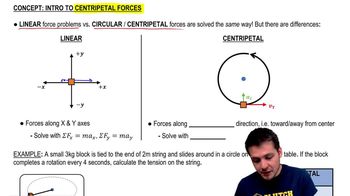
Centripetal Force

Centripetal force is the net force that acts on an object moving in a circular path, directed towards the center of the circle. In Tarzan's case, as he swings from the vine, the tension in the vine must provide the necessary centripetal force to keep him moving in an arc. This force is crucial for determining the maximum speed he can tolerate at the lowest point of his swing.
추천 영상:
가이드 코스
06:48
Intro to Centripetal Forces

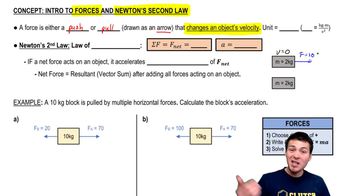
Newton's Second Law of Motion

Newton's Second Law states that the acceleration of an object is directly proportional to the net force acting on it and inversely proportional to its mass. This principle helps us calculate the forces acting on Tarzan at the lowest point of his swing, where the gravitational force and the tension in the vine interact to determine his maximum speed.
추천 영상:
가이드 코스
06:54
Intro to Forces & Newton's Second Law

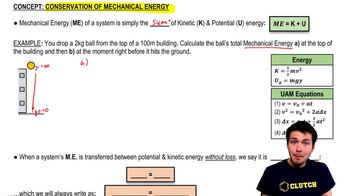
Energy Conservation

The principle of energy conservation states that energy cannot be created or destroyed, only transformed from one form to another. In Tarzan's swing, potential energy at the highest point converts to kinetic energy at the lowest point. Understanding this energy transformation is essential for calculating the maximum speed he can achieve during his swing.
추천 영상:
가이드 코스
06:24
Conservation Of Mechanical Energy
관련 실천
교과서 질문

(III) A 4.0-kg block is stacked on top of a 12.0-kg block, which is accelerating along a horizontal table at a = 5.2m/s2 (Fig. 5–43). Let μk = μs = μ. What is the force that must be applied to the 12.0-kg block in (a) and in (b), assuming that the table is frictionless?

1493
views
교과서 질문

On an ice rink two skaters of equal mass grab hands and spin in a mutual circle once every 2.5 s. If we assume their arms are each 0.80 m long and their individual masses are 55.0 kg, how hard are they pulling on one another?

1331
views
교과서 질문

A coffee cup on the horizontal dashboard of a car slides forward when the driver decelerates from 45 km/h to rest in 3.5 s or less, but not if she decelerates in a longer time. What is the coefficient of static friction between the cup and the dash? Assume the road and the dashboard are level (horizontal).

1631
views
교과서 질문

A jet plane traveling 1890 km/h (525 m/s) pulls out of a dive by moving in an arc of radius 4.80 km. What is the plane's acceleration in g's?

1570
views
교과서 질문

The position of a particle moving in the xy plane is given by r\(\overrightarrow{r}\) = (2.0m) cos [(3.0 rad/s)t ] i^\(\hat{i}\) +(2.0m) sin [(3.0 rad/s)t ] j^\(\hat{j}\), where r is in meters and t is in seconds. Calculate the velocity and acceleration vectors as functions of time.

1711
views
교과서 질문

A pilot performs an evasive maneuver by diving vertically at a constant 310 m/s. If he can withstand an acceleration of 9.0 g’s without blacking out, at what altitude must he begin to pull his plane out of the dive (moving in a vertical circular path) to avoid crashing into the sea?

1420
views